
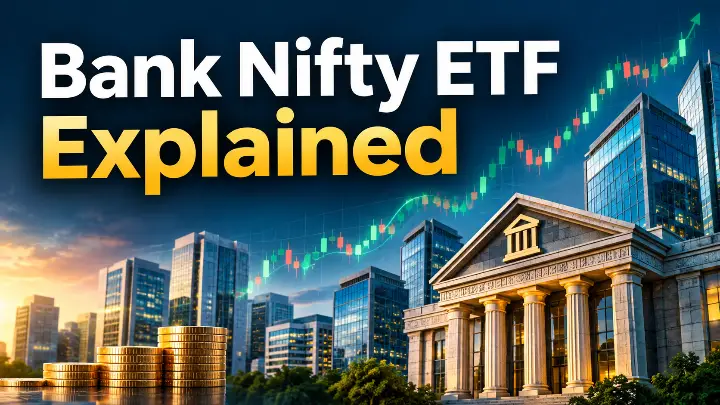
Banking is one of the most influential sectors in the Indian stock market. Banks play a central role in credit growth, deposits, consumption, infrastructure financing and economic expansion. For investors looking to participate in this sector without selecting individual banking stocks, a Bank Nifty ETF offers a relatively simple route.
A Bank Nifty ETF provides exposure to a basket of banking stocks through a single exchange-traded investment. Instead of buying shares of individual banks, investors can gain diversified exposure to leading banking companies in one transaction. However, the fund’s concentration in a single sector also creates risks that investors should understand before investing.
In simple words
A Bank Nifty ETF is an exchange-traded fund designed to track the Nifty Bank Index. It allows investors to invest in a basket of major banking stocks through one instrument. Its returns depend largely on the performance of the banking sector, rather than the entire stock market.
What Is a Bank Nifty ETF?
A Bank Nifty ETF is a passive investment fund that tracks the Nifty Bank Index. The index represents leading and liquid banking companies listed on the National Stock Exchange (NSE).
The index can include up to 14 banking companies. Its constituents are selected based on eligibility and liquidity criteria, with weights determined through a capped free-float market capitalisation methodology.
Unlike an actively managed banking mutual fund, a Bank Nifty ETF does not attempt to identify stocks that will outperform the market. Its primary objective is to replicate the performance of its benchmark index, subject to expenses and tracking error. Nifty Indices +1
How Does a Bank Nifty ETF Work?
When an investor purchases a Bank Nifty ETF, the investment provides exposure to the underlying banking stocks held by the fund.
Also Read: Liquid ETF Explained: How Liquid ETFs Work in India, Returns, Risks and Who Should Buy Them
The process works in the following way:
- The ETF invests in the banking stocks included in the Nifty Bank Index.
- Each stock receives a portfolio weight based on the index methodology.
- The fund adjusts its holdings when the index undergoes rebalancing.
- The ETF’s market price changes throughout the trading session based on demand, supply and the value of its underlying portfolio.
- Investors can purchase or sell ETF units through a stock exchange using a demat and trading account.
For example, if major private-sector banks perform strongly, they can contribute significantly to the ETF’s returns because of their relatively large index weights. However, a decline in banking stocks can also pull the ETF down.
Top Holdings of Bank Nifty ETFs
The portfolio generally has exposure to India’s largest private-sector banks, public-sector banks and selected small finance banks.
The following table illustrates the major constituents and their approximate weights using the October 2026 Nifty Bank ETF portfolio data.
Also Read: Liquid ETF Explained: How Liquid ETFs Work in India, Returns, Risks and Who Should Buy Them

| Banking stock | Approx. weight |
|---|---|
| HDFC Bank | 18.35% |
| ICICI Bank | 14.86% |
| Kotak Mahindra Bank | 11.08% |
| Axis Bank | 10.00% |
| State Bank of India | 9.98% |
| Federal Bank | 6.93% |
| IndusInd Bank | 4.77% |
| AU Small Finance Bank | 4.27% |
Illustrative holdings based on an October 2026 ETF portfolio. Weights change with market prices and index rebalancing. barodabnpparibasmf.in
The five largest holdings account for a substantial portion of the portfolio. This means the performance of a handful of large banking companies can have a meaningful influence on overall returns.
Popular Bank Nifty ETFs in India
Several mutual fund companies offer ETFs tracking the Nifty Bank Index. Some established options include:
| ETF | Fund house |
|---|---|
| Bank BeES | Nippon India |
| Nifty Bank ETF | SBI |
| Nifty Bank ETF | ICICI Prudential |
| Nifty Bank ETF | Kotak Mahindra |
| Nifty Banking ETF | HDFC |
| Nifty Bank ETF | UTI |
| Nifty Bank ETF | Mirae Asset |
| Nifty Bank ETF | Bajaj Finserv |
Investors should compare expense ratios, assets under management (AUM), trading volumes, bid-ask spreads and tracking differences before selecting a scheme. A lower expense ratio alone does not guarantee a better investment experience. Nifty Indices +2
Bank Nifty ETF vs Banking Mutual Fund
Both products provide exposure to banking stocks, but their investment structures differ.
| Feature | Bank Nifty ETF | Banking mutual fund |
|---|---|---|
| Management | Passive | Usually active |
| Trading | Stock exchange | Through fund house/platform |
| Price | Market price | End-of-day NAV |
| Demat account | Required | Not required for regular mutual fund investing |
| Portfolio | Tracks an index | Fund manager selects stocks |
| Costs | Generally lower | Often higher |
An ETF may appeal to investors who prefer index-based investing and exchange-traded flexibility. An actively managed banking mutual fund may suit investors who want a fund manager to make stock-selection decisions.
Risks of Investing in a Bank Nifty ETF
Despite offering exposure to multiple banks, a Bank Nifty ETF is not a diversified investment across the entire economy.
1. Sector concentration risk: The ETF invests primarily in banking stocks. A banking-sector downturn can affect almost the entire portfolio.
Also Read: Railway and Capital Goods ETF Explained: How It Works, Holdings, Risks and Who Should Buy It
2. Interest rate risk: Changes in interest rates can influence loan demand, borrowing costs, deposit expenses and banks’ net interest margins.
3. Credit risk: Rising bad loans, loan defaults and deterioration in asset quality can affect banking profitability and investor confidence.
4. Valuation risk: Even fundamentally strong banks can deliver disappointing returns if investors purchase their shares at excessive valuations.
5. Liquidity risk: Some ETFs have lower trading volumes. Wider bid-ask spreads can increase transaction costs when buying or selling units.
6. Tracking error: An ETF may not perfectly replicate its benchmark because of expenses, cash holdings, transaction costs and portfolio adjustments.
7. Regulatory risk: Changes in banking regulations, capital requirements and lending restrictions can influence the profitability of constituent banks.
Who Should Buy a Bank Nifty ETF?
A Bank Nifty ETF may suit investors who have a positive long-term outlook on India’s banking sector and want targeted exposure without purchasing individual banking shares.
It can be considered by:
Also Read: Bharat 22 ETF Explained: How It Works, Holdings, Risks and Who Should Buy It
- Investors who want exposure to leading Indian banks through one instrument.
- Long-term investors looking to complement an existing diversified equity portfolio.
- Investors who understand banking-sector cycles and can tolerate volatility.
- Experienced investors who want sector exposure as part of a broader asset allocation strategy.
However, it may not be suitable as the primary investment for someone building their first equity portfolio. A broad-market index fund or diversified equity ETF generally provides exposure across multiple sectors, reducing dependence on banking performance.
How to Choose the Right Bank Nifty ETF
Before investing, compare these important factors:
| Parameter | What to check |
|---|---|
| Expense ratio | Preferably competitive and sustainable |
| AUM | Larger funds may offer better market participation |
| Trading volume | Higher liquidity is generally preferable |
| Bid-ask spread | Narrower spreads reduce trading costs |
| Tracking difference | Lower long-term deviation is preferable |
| Fund history | Review consistency across market cycles |
Investors should also compare the ETF’s market price with its indicative NAV (iNAV). Buying at a substantial premium to the underlying portfolio value can reduce the investment’s effective return.
Taxation of Bank Nifty ETFs in India
Bank Nifty ETFs are treated as equity-oriented funds for taxation purposes, subject to applicable classification requirements.
Also Read: CPSE ETF Explained: How India’s PSU Enterprise ETF Works, Holdings, Risks and Who Should Buy It
For equity-oriented ETF units sold on or after July 23, 2024, the current capital gains tax framework is:
| Type of gain | Holding period | Tax rate |
|---|---|---|
| Short-term capital gains | Up to 12 months | 20% |
| Long-term capital gains | More than 12 months | 12.5% |
Long-term capital gains benefit from an annual exemption of ₹1.25 lakh across eligible equity investments. Applicable surcharge and cess may also apply. Tax rules should be checked before transactions, particularly if regulations change. SBI Mutual Fund
Key Takeaways
- A Bank Nifty ETF tracks the performance of the Nifty Bank Index.
- It provides exposure to leading Indian banking companies through one exchange-traded investment.
- HDFC Bank, ICICI Bank, Kotak Mahindra Bank, Axis Bank and SBI are among its major constituents.
- Returns depend heavily on banking-sector performance and economic conditions.
- Expense ratio, liquidity, bid-ask spread and tracking difference matter when selecting an ETF.
- It can complement a diversified equity portfolio but should not automatically replace broad-market investments.
- Investors should have a suitable investment horizon and the ability to tolerate sector-specific volatility.
Financial Disclaimer
This article is for educational and informational purposes only and should not be considered investment advice. Bank Nifty ETFs are subject to market risks, including sector concentration and volatility. Past performance does not guarantee future returns. Investors should evaluate their financial goals, risk tolerance and investment horizon before making investment decisions.




Keep learning with OneTrader
Explore structured lessons and practical guides to build your market knowledge.

Need a laugh after all that money talk?
Paisa LOL: India's funniest finance page, with memes, comics, jokes and long funny stories.
