
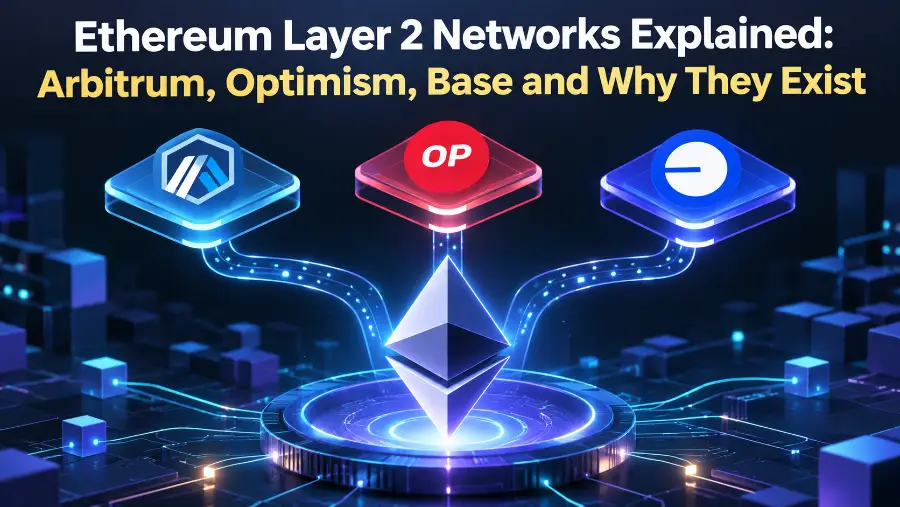
Ethereum is one of the most widely used blockchain networks for decentralised finance, smart contracts and digital applications. However, as its popularity increased, the network faced a practical challenge: processing large numbers of transactions quickly and affordably while maintaining security and decentralisation.
Ethereum Layer 2 (L2) networks emerged to address this problem. Networks such as Arbitrum, Optimism and Base process transactions outside Ethereum’s main execution layer while using Ethereum as their underlying security and settlement foundation. They make blockchain applications more accessible without requiring every transaction to be processed directly on Ethereum.
In simple words
Think of Ethereum as a busy main highway. Layer 2 networks are additional roads that handle much of the traffic before sending transaction data and results back to the main network. This reduces congestion and transaction costs while retaining a connection to Ethereum’s security.
Also Read: Ethereum Gas Fees and Staking Explained: How the Network Pays Validators
What Is Ethereum Layer 2?
Ethereum Layer 2 is a group of technologies built on top of Ethereum to improve transaction speed and scalability.
On Ethereum Layer 1, every transaction must be processed by the main network. When demand increases, users compete for limited block space, potentially pushing transaction fees higher.
Layer 2 networks move much of this transaction processing away from the main chain. They execute transactions independently, combine or organise transaction data, and submit relevant information to Ethereum.
This approach allows applications to handle more activity without placing the entire processing burden on Ethereum Layer 1.
Why Does Ethereum Need Layer 2 Networks?
Ethereum’s decentralised design prioritises security and network participation. However, processing every transaction directly on the main chain creates limitations when usage grows.
Layer 2 networks address three important challenges:
- High transaction fees: Users can often transfer tokens, trade and interact with applications at substantially lower costs.
- Network congestion: Transactions can be processed on separate networks instead of competing for all the available space on Ethereum.
- Scalability: Applications can support more users and transactions without depending entirely on Ethereum’s main execution capacity.
Ethereum remains responsible for important settlement and security functions, while Layer 2 networks handle much of the day-to-day transaction activity.
How Do Ethereum Layer 2 Networks Work?
Most major Ethereum Layer 2 networks use a technology called rollups.
Rollups execute transactions outside Ethereum’s main execution layer and periodically submit transaction data or commitments to the main network. This allows multiple transactions to share the cost of interacting with Ethereum.
There are two major rollup approaches.
Optimistic Rollups
Optimistic rollups assume transactions are valid unless someone challenges them with evidence of incorrect execution.
They use fraud-proof mechanisms to identify invalid state transitions. A dispute can trigger verification through Ethereum.
Arbitrum and Optimism are prominent examples of optimistic rollup ecosystems.
Zero-Knowledge Rollups
Zero-knowledge rollups use cryptographic validity proofs to demonstrate that transactions have been executed correctly.

Instead of relying primarily on a challenge period, they submit proofs that Ethereum can verify.
These systems can offer strong verification guarantees, although their architecture and implementation differ between projects.
| Feature | Optimistic rollups | Zero-knowledge rollups |
|---|---|---|
| Validation | Fraud-proof mechanism | Cryptographic validity proofs |
| Main assumption | Transactions are valid unless challenged | Validity is mathematically proven |
| Withdrawal experience | May involve challenge periods | Can be faster, depending on implementation |
| Examples | Arbitrum, Optimism | zkSync, Starknet |
Arbitrum: A Major Ethereum Scaling Network
Arbitrum
Technology: Optimistic rollup
Ecosystem: DeFi, trading, decentralised applications
Arbitrum is one of the established Layer 2 ecosystems built to scale Ethereum. Developed by Offchain Labs, it focuses on improving transaction efficiency while maintaining compatibility with Ethereum-based applications.
Its main network, Arbitrum One, supports decentralised exchanges, lending platforms, derivatives applications and other smart-contract services.
Developers can deploy applications using familiar Ethereum development tools, making it easier to bring existing projects into the ecosystem.
Arbitrum also has a separate technology stack, Arbitrum Orbit, which allows developers to build additional chains using Arbitrum technology.
Optimism: Building an Ethereum Scaling Ecosystem
Optimism
Technology: Optimistic rollup
Ecosystem: OP Stack and interconnected chains
Optimism is another major Ethereum scaling project. Its primary network, OP Mainnet, uses optimistic rollup technology to process transactions more efficiently.
Its broader strategy goes beyond operating a single Layer 2 network. Optimism developed the OP Stack, an open-source software framework that allows developers and organisations to launch their own Ethereum-compatible chains.
This approach has helped establish an ecosystem of networks using shared technology. Optimism’s long-term vision is to create an interconnected network of chains known as the Superchain.
Base: Coinbase’s Ethereum Layer 2 Network
Base
Technology: Optimistic rollup using OP Stack
Ecosystem: Consumer applications, DeFi and onchain activity
Base is an Ethereum Layer 2 network developed by Coinbase. It uses the OP Stack and is designed to make blockchain applications easier and more affordable to access.
Coinbase’s large existing user base gives Base an important distribution advantage. The network aims to bring more users, developers and businesses into the onchain economy.
Base supports Ethereum-compatible smart contracts and applications, including decentralised finance, gaming and social platforms.
Unlike Arbitrum and Optimism, Base does not have a separate native gas token. ETH is used to pay transaction fees on the network.
Arbitrum vs Optimism vs Base: Key Differences
Although all three networks aim to improve Ethereum scalability, their ecosystems and development strategies differ.
| Feature | Arbitrum | Optimism | Base |
|---|---|---|---|
| Technology | Optimistic rollup | Optimistic rollup | Optimistic rollup |
| Main ecosystem | Arbitrum One | OP Mainnet | Base |
| Technology framework | Arbitrum stack | OP Stack | OP Stack |
| Gas token | ETH | ETH | ETH |
| Key focus | DeFi and scaling | Shared chain infrastructure | Consumer adoption |
| Developer | Offchain Labs | Optimism contributors | Coinbase |
The three networks compete for developers, users and applications, but they also contribute to the broader Ethereum ecosystem.
What Is the Role of Ethereum in Layer 2 Networks?
Ethereum remains important because Layer 2 networks depend on it for critical infrastructure.
Depending on their architecture, these networks use Ethereum for transaction data availability, settlement and verification.
However, not every Layer 2 offers the same security guarantees. Some rely on different proof systems, upgrade mechanisms, sequencer arrangements and withdrawal designs.
Users should therefore understand that a Layer 2 network inherits important security properties from Ethereum, but it does not automatically inherit every property of the main network.
How Do Layer 2 Networks Make Money?
Layer 2 networks generally collect transaction fees from users. A portion of this revenue covers the cost of publishing transaction data to Ethereum, while the remaining amount may contribute to network revenue.
Their economics depend on transaction volume, data costs, operational expenses and fee structures.
The growth of Layer 2 activity can also increase demand for Ethereum block space because rollups need to publish data or proofs to the underlying network.
However, increased Layer 2 adoption does not automatically translate into higher value for every associated token.
Risks Investors and Users Should Understand
Layer 2 networks improve blockchain usability, but they introduce additional considerations.
- Centralisation: Some networks depend on relatively centralised sequencers that organise transactions.
- Bridge risks: Moving assets between Ethereum and Layer 2 networks can expose users to smart-contract and operational vulnerabilities.
- Upgrade risks: Administrator permissions and upgrade mechanisms can create additional security dependencies.
- Competition: Multiple networks are competing for developers, applications and transaction activity.
- Token valuation: Network adoption does not necessarily guarantee appreciation in the price of a related cryptocurrency token.
Users should evaluate security arrangements, decentralisation progress, bridge mechanisms and the actual utility of any token before making investment decisions.
Key Takeaways
- Ethereum Layer 2 networks improve scalability by processing transactions outside the main execution layer.
- Rollups reduce costs by batching transactions and using Ethereum for important settlement and verification functions.
- Arbitrum focuses on scaling and DeFi applications, while Optimism promotes shared infrastructure through the OP Stack.
- Base uses the OP Stack and benefits from Coinbase’s ecosystem and distribution capabilities.
- Layer 2 networks are important to Ethereum’s long-term scalability, but they have different security and decentralisation characteristics.
- More network activity does not automatically mean higher token prices or better investment returns.
Financial Disclaimer: This article is for educational and informational purposes only and should not be considered financial or investment advice. Cryptocurrencies and blockchain-related tokens are highly volatile and involve significant risks, including loss of capital. Readers should conduct independent research and consult a qualified financial adviser before making investment decisions.
Keep learning with OneTrader
Explore structured lessons and practical guides to build your market knowledge.

Need a laugh after all that money talk?
Paisa LOL: India's funniest finance page, with memes, comics, jokes and long funny stories.
