
Article ready Evergreen Business Deep Dive
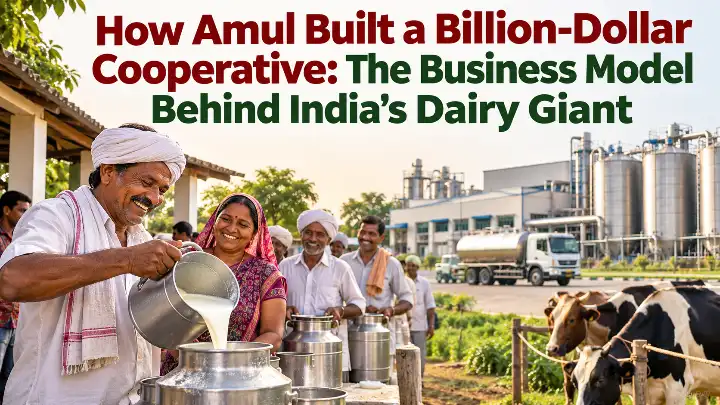
Amul is one of India’s most recognisable consumer brands, but its biggest achievement goes beyond selling milk, butter, cheese and ice cream. It built a massive dairy business around a structure in which millions of farmers are not merely suppliers but owners of the cooperative network. That model has helped Amul develop a scale that few traditional dairy businesses can match.
In FY2024-25, Gujarat Cooperative Milk Marketing Federation (GCMMF), which markets products under the Amul brand, reported a turnover of ₹65,911 crore. The wider Amul brand network, including sales made directly by its member unions, recorded approximately ₹90,000 crore in turnover. Behind these numbers is a business model that connects rural milk producers with consumers across India and international markets.
In Simple Words
Amul’s business works because millions of farmers collectively own the dairy cooperative instead of selling milk through independent middlemen. Village societies collect milk, district unions process it, and a federation markets products under one powerful brand. The result is a large consumer business that creates value for both farmers and customers.
Also Read: NSE History: How the National Stock Exchange Started and Why
How Amul Started: A Farmers’ Movement in 1946
Amul’s story began in 1946 in Anand, Gujarat, when dairy farmers faced an unfair marketplace dominated by private intermediaries. Farmers had limited bargaining power and struggled to receive fair prices for their milk.
The farmers decided to organise themselves into a cooperative rather than depend on private contractors. The Kaira District Cooperative Milk Producers’ Union was established, laying the foundation for what eventually became India’s dairy revolution.
Dr Verghese Kurien played a defining role in transforming this initiative into a professionally managed dairy movement. His approach combined farmer ownership with modern processing, distribution and business management.
The cooperative model eventually expanded across Gujarat and became an important foundation for India’s White Revolution.
Also Read: BSE History: How the Bombay Stock Exchange Started and Why
The Three-Tier Cooperative Business Model
The most important part of Amul’s business is its three-tier operating structure. Instead of purchasing milk through a conventional supplier network, the cooperative connects producers directly with processing and marketing organisations.
| Level | Responsibility |
|---|---|
| Village societies | Collect milk from individual farmers and conduct quality testing |
| District milk unions | Process milk, manufacture dairy products and provide farmer services |
| GCMMF | Marketing, branding, distribution and sales expansion |
At the village level, farmers deliver milk to their local cooperative societies. The milk is tested for quality and quantity before procurement. Payments are made to farmers based on the applicable procurement system.
District unions handle processing and manufacturing. They also provide services such as veterinary assistance, cattle feed and breeding support.
At the federation level, GCMMF manages the Amul brand, marketing strategy and distribution network.
Also Read: All Wars Happening in the World Right Now (2026): Major Conflicts Explained
This division of responsibilities allows the organisation to operate at scale without concentrating every business function in one entity.
How Amul Makes Money
Amul generates revenue by converting collected milk into products that serve different consumer needs.

Liquid milk provides regular household demand, while value-added products help the business reach different customer segments and improve its product mix.
Its major business categories include:
Also Read: CEO vs CFO vs COO: Who Runs What in a Business and How the Three Roles Work Together
- Liquid milk and flavoured milk
- Butter, ghee and cheese
- Ice cream and frozen desserts
- Milk powder and condensed milk
- Paneer, curd and other fresh dairy products
- Chocolates, beverages and packaged foods
The strategy is important because milk is a perishable commodity. Processing it into products with different storage requirements and consumption patterns helps the cooperative manage seasonal milk availability and reach wider markets.
Amul also benefits from selling through multiple channels, including retail stores, supermarkets, distributors, institutional customers and online platforms.
The Scale Behind Amul’s Business
Amul’s competitive advantage is closely connected to the size of its farmer network and milk collection infrastructure.
| Business metric | FY2024-25 |
|---|---|
| Farmer members | 36 lakh |
| Village cooperative societies | 18,600 |
| Member district unions | 18 |
| Daily milk procurement | Around 300-320 lakh litres |
| GCMMF turnover | ₹65,911 crore |
| Wider Amul brand turnover | Approximately ₹90,000 crore |
Milk procurement figures are approximate and can vary across reporting periods.
Also Read: Understanding Different Types of Costs: How Businesses Calculate, Manage and Control Their Expenses
The network gives Amul access to a large and geographically distributed milk supply. It also creates a connection between rural producers and a national consumer market.
For a new dairy company, building a comparable procurement network would require years of investment, farmer relationships, processing infrastructure and distribution development.
The Financial Growth Story
Amul’s financial expansion demonstrates how the cooperative has translated its supply-chain strength into a large consumer business.
GCMMF has consistently expanded its turnover through higher sales volumes, product development and wider market reach.
Also Read: Angel One’s Success Story: How Distribution Built One of India’s Largest Stockbrokers
| Financial year | GCMMF turnover |
|---|---|
| FY2022-23 | Not included |
| FY2023-24 | ₹59,259 crore |
| FY2024-25 | ₹65,911 crore |
GCMMF’s turnover increased approximately 11% in FY2024-25. The growth was primarily volume-driven, with increased sales across product categories rather than relying entirely on price increases.
An important distinction is that GCMMF’s turnover is not the same as the entire Amul brand’s sales. Member unions also sell products directly in their respective markets. Including these sales, the wider brand network generated approximately ₹90,000 crore during FY2024-25.
Why Amul’s Brand Is Difficult to Compete With
Amul’s strength is not limited to procurement and manufacturing. Its brand has become deeply connected with everyday Indian consumption.
The Amul Girl advertising campaign, introduced in 1966, helped establish a distinctive identity through topical humour and memorable communication.
Also Read: Groww’s Success Formula: How a Simple Investing App Overtook India’s Established Stockbrokers
More importantly, the brand has built trust across generations. Consumers associate Amul with familiar dairy products, widespread availability and consistent market presence.
Its distribution network also creates a significant advantage. Getting products into thousands of retail outlets and maintaining reliable cold-chain operations is a difficult task for new competitors.
The combination of farmer relationships, manufacturing infrastructure, brand recognition and distribution creates a competitive advantage that is difficult to replicate.
Amul’s Expansion Beyond India
Amul has gradually expanded its international presence, targeting markets with demand for Indian dairy products.
Its products are exported to around 50 countries. The cooperative has also explored international manufacturing and distribution opportunities, including its entry into the US fresh milk market.
International expansion gives Amul an opportunity to diversify revenue and build its brand beyond India’s domestic dairy market.
However, competing internationally requires meeting different food safety regulations, consumer preferences and supply-chain requirements.
Challenges Facing the Cooperative
Despite its scale, Amul faces several long-term business challenges.
Milk procurement depends on cattle productivity, animal health, feed availability and weather conditions. Rising cattle feed and transportation costs can put pressure on procurement economics.
Maintaining product quality across a large network is another operational challenge. Dairy products require efficient refrigeration, processing and distribution, particularly in India’s varied climate.
Competition is also increasing from private dairy companies and regional brands. Businesses are investing in premium products, packaged dairy, cheese, ice cream and direct-to-consumer distribution.
Amul must continue investing in processing capacity, technology, product innovation and farmer productivity to maintain its competitive position.
Key Takeaways
- Amul began as a farmers’ cooperative movement in Gujarat in 1946.
- Its three-tier model connects village societies, district unions and a state-level marketing federation.
- Farmer ownership is central to its procurement and operating structure.
- GCMMF recorded ₹65,911 crore in FY2024-25 turnover.
- The wider Amul brand network generated approximately ₹90,000 crore in the same financial year.
- Its competitive advantage comes from an integrated combination of farmer relationships, processing infrastructure, distribution and brand recognition.
- International expansion and value-added products offer further growth opportunities.
Amul’s biggest business achievement is demonstrating that a cooperative can compete with large private and multinational companies without separating the interests of producers from the commercial success of the business. Its model has turned millions of individual milk producers into part of one of India’s largest consumer businesses.
Financial Disclaimer
This article is intended for educational and informational purposes only. Business figures and operating metrics are based on publicly reported information and may change over time. This article does not constitute investment advice or a recommendation to buy or sell any security. Readers should conduct independent research before making financial or investment decisions.





Keep learning with OneTrader
Explore structured lessons and practical guides to build your market knowledge.

Need a laugh after all that money talk?
Paisa LOL: India's funniest finance page, with memes, comics, jokes and long funny stories.
