
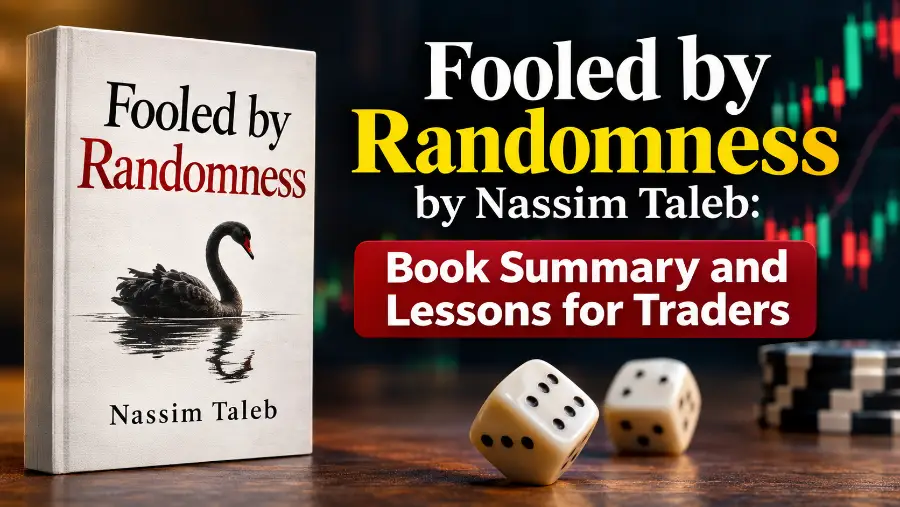
Book: Fooled by Randomness: The Hidden Role of Chance in Life and in the Markets Author: Nassim Nicholas Taleb Category: Trading Psychology, Investing, Risk Management
Financial markets often reward people who make the right decisions, but they also reward people who simply get lucky. The difficult part is knowing the difference. A trader may earn consistent profits for several months and begin believing that a successful strategy or exceptional skill is responsible for the results. Yet, some of those gains may have come from favourable market conditions or pure chance.
In Fooled by Randomness, Nassim Nicholas Taleb explores how randomness influences financial markets, investing and everyday decisions. The book challenges the assumption that success automatically reflects intelligence or ability. For traders, its central message is important: surviving in the market requires understanding probability, respecting uncertainty and never confusing a profitable outcome with a good decision.
In simple words
Also Read: Trading in the Zone by Mark Douglas: Complete Book Summary and Trading Psychology Lessons
Making money does not always mean you made the right decision. Sometimes luck produces profits, while even a well-researched trade can result in a loss. Successful traders focus on the quality of their decisions and risk management rather than judging themselves only by profits.
1. The Difference Between Skill and Luck
One of the book’s central arguments is that people frequently attribute success to their own abilities while ignoring the role of chance.
Consider two traders. The first follows a disciplined strategy, limits losses and earns a modest return. The second takes excessive risks and makes substantial profits during a favourable market phase.
The second trader may appear more talented, but the outcome does not necessarily prove superior skill. A favourable sequence of market movements may have helped produce those profits.
Also Read: The Psychology of Money by Morgan Housel: Book Summary
Taleb encourages readers to examine the process behind a result rather than judging performance through outcomes alone.
2. Survivorship Bias: Why We Notice Winners
Survivorship bias occurs when people focus on successful individuals or companies while ignoring those that failed.
In financial markets, investors frequently study successful traders, fund managers and investors. Their strategies are discussed, their decisions are analysed and their achievements become examples for others.

However, countless traders may have followed similar approaches and lost their capital. Their stories are less visible because they did not survive.
| What we see | What we often overlook |
|---|---|
| Successful traders | Traders who lost money |
| Profitable strategies | Failed versions of similar strategies |
| Successful investors | Investors who disappeared |
| Large market gains | Risks taken to achieve them |
Lesson for traders: Never assume that a strategy works simply because a successful trader uses it. Understand its risks, test it across different market conditions and examine unsuccessful outcomes.
3. Randomness Can Create False Confidence
A few profitable trades can create an exaggerated sense of confidence. Traders may increase their position sizes, ignore stop-losses and begin taking setups that do not meet their original criteria.
This is particularly dangerous after a winning streak.
A series of successful trades does not guarantee that the next trade will be profitable. Even a strategy with a statistical advantage can experience several consecutive losses.
Taleb’s message is that traders should remain cautious about drawing conclusions from limited observations.
4. Probability Matters More Than Predictions
Markets are uncertain. No trader can consistently predict every price movement, economic announcement or unexpected event.
Instead of trying to forecast every market move, traders should think in terms of probabilities.
For example, a trading setup may historically produce profitable outcomes in 55 out of 100 trades. That does not mean the next trade has to be profitable. It means the strategy has demonstrated an advantage across a sufficiently large sample, assuming the testing is reliable and market conditions remain comparable.
The focus should be on executing a strategy with positive expected value rather than attempting to be right every time.
5. The Importance of Risk Management
A major lesson from Taleb’s thinking is that protecting capital matters more than maximising short-term profits.
A trader can make money repeatedly and still face financial ruin if one unusually large loss wipes out previous gains.
Consider the following example:
| Trading approach | Potential outcome |
|---|---|
| Risk 1% per trade | Controlled individual losses |
| Risk 5% per trade | Faster capital deterioration |
| Risk 20% per trade | Severe damage from a few losses |
Risk management helps traders remain in the market long enough for their strategy’s statistical advantage to play out.
Position sizing, stop-loss discipline and avoiding excessive leverage are therefore essential parts of a sustainable trading approach.
6. Why Successful Traders Can Become Overconfident
Success can be more dangerous than failure when it creates false confidence.
A trader who earns money during a strong bull market may believe that personal skill is responsible for every profitable decision. When market conditions change, the same approach may stop working.
This is why traders should regularly question their assumptions and evaluate whether their strategy is genuinely effective or simply benefiting from favourable conditions.
Confidence should come from a tested process, not a temporary winning streak.
7. How Traders Can Apply the Book’s Lessons
The ideas in Fooled by Randomness can be translated into practical trading habits.
| Trading habit | Practical application |
|---|---|
| Maintain a trading journal | Record the reason behind every trade |
| Track a large sample | Avoid judging strategies after a handful of trades |
| Control position size | Keep individual losses manageable |
| Review losing trades | Identify process mistakes without emotional reactions |
| Avoid chasing profits | Do not increase risk after winning streaks |
| Test different conditions | Evaluate strategies in trending and sideways markets |
Traders should also separate decision quality from trade outcomes. A trade that follows the strategy and hits a stop-loss may still be a good decision. Conversely, a trade taken without proper analysis may generate a profit purely through luck.
This distinction is fundamental to developing long-term trading discipline.
Key Takeaways
- Luck plays a significant role in financial market performance.
- Profitable results do not automatically prove trading skill.
- Survivorship bias makes successful traders appear more common than they really are.
- A small number of winning trades cannot establish that a strategy works.
- Probability and expected value are more useful than trying to predict every market movement.
- Risk management protects traders from unexpected losses and financial ruin.
- A disciplined trading process matters more than short-term profits.
- Traders should evaluate decisions independently of their immediate outcomes.
Final Thoughts
Fooled by Randomness offers an important lesson for anyone participating in financial markets: uncertainty cannot be eliminated, but its impact can be managed. Traders who confuse luck with skill often become overconfident and expose their capital to unnecessary risks.
The book encourages a more realistic approach to trading. Build a repeatable strategy, measure performance over a meaningful sample, control risk and remain humble when markets reward your decisions. In the long run, protecting capital and surviving unfavourable market conditions are just as important as finding profitable opportunities.
Financial Disclaimer: This article is for educational and informational purposes only. It should not be considered investment advice or a recommendation to buy or sell any financial instrument. Trading and investing involve market risks, including the potential loss of capital. Readers should conduct their own research and consult a qualified financial adviser before making investment decisions.

Keep learning with OneTrader
Explore structured lessons and practical guides to build your market knowledge.

Need a laugh after all that money talk?
Paisa LOL: India's funniest finance page, with memes, comics, jokes and long funny stories.
