
Introduction
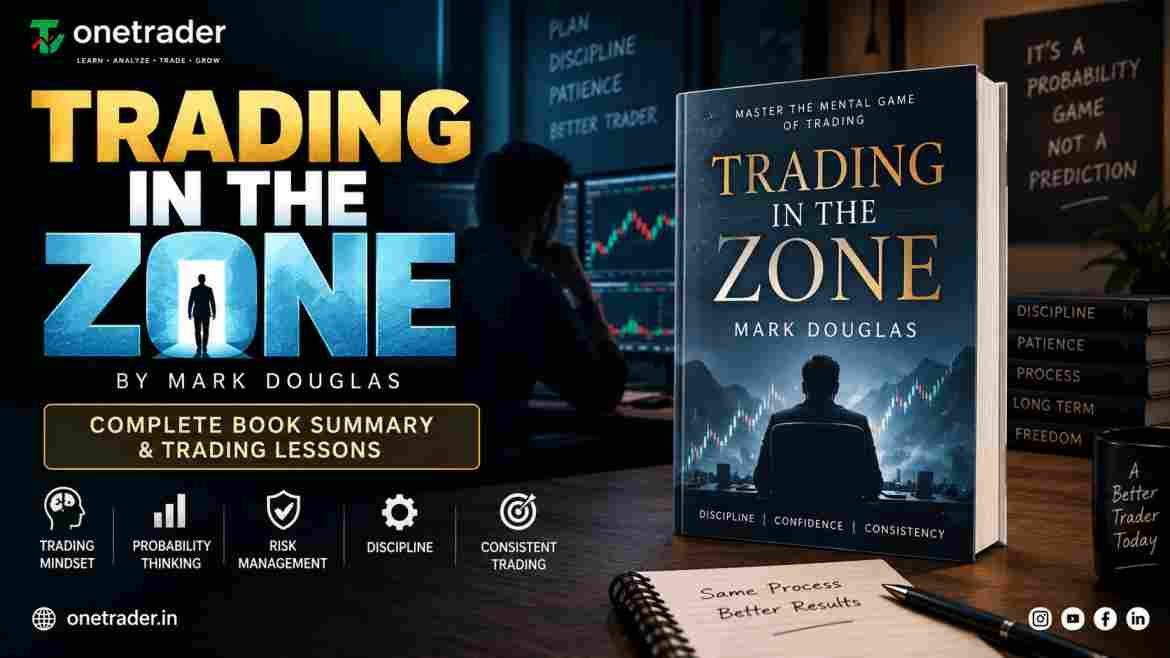
Many traders believe that success in the stock market depends mainly on finding the right strategy. They spend years learning indicators, chart patterns, price action and different entry techniques, yet still struggle to make consistent profits. Trading in the Zone by Mark Douglas explains why this happens. The book argues that having a good trading method is only one part of the equation. The bigger challenge is developing the mental discipline to execute that method consistently in an environment where the outcome of every individual trade is uncertain.
Mark Douglas focuses on the psychology behind trading decisions. Fear, greed, hesitation, overconfidence and the desire to be right can cause traders to behave differently from their own trading plans. A trader may know exactly where the stop-loss should be, but once the position starts losing money, fear can make them move it lower. Similarly, after a series of profitable trades, overconfidence can encourage them to take larger and riskier positions. Douglas’s central message is that successful trading requires accepting uncertainty and thinking in terms of probabilities rather than trying to predict every market movement.
Why a Good Strategy Alone Is Not Enough
A trading strategy can provide an edge, but it cannot guarantee the outcome of any particular trade. This is where many traders struggle. They may backtest a strategy and discover that it works over a large number of trades, but when they experience a few consecutive losses in real time, they begin to doubt the strategy and change their behaviour.
Imagine a trader has a setup that historically produces profitable results over hundreds of trades. The next setup appears, but immediately after entry the stock moves against the trader. If the trader believes that a good setup must produce a winning trade, they may hesitate to accept the loss or start changing the original plan. Douglas explains that this expectation is one of the reasons traders struggle psychologically. A good setup can lose, and a poor-looking trade can sometimes make money. The outcome of one trade does not determine whether the decision was good or bad.
Also Read: The Psychology of Money by Morgan Housel: Book Summary
The real objective is to execute a proven process consistently over a large sample of trades.
The Market Is a World of Probabilities
One of the most important ideas in Trading in the Zone is that the market does not provide certainty. No matter how strong the chart looks, there is always a possibility that the expected move will not happen. A breakout can fail, a support level can break and an apparently strong trend can reverse unexpectedly.
For many traders, accepting this reality is difficult because people naturally look for certainty. We want to believe that if our analysis is correct, the market should behave according to our expectations. But trading does not work that way. Analysis can increase the probability of a particular outcome without guaranteeing it.
Once a trader accepts this, the focus changes. Instead of asking, “Will this trade win?”, the trader begins asking, “Does this trade meet the conditions of my strategy, and am I comfortable with the risk?” That shift can significantly reduce emotional pressure.
Thinking Like a Casino
Douglas uses the idea of a casino to explain probabilistic thinking. A casino does not need to win every individual game. It knows that some customers will win and that some games will produce losses. Its advantage comes from the probabilities working in its favour over a sufficiently large number of events.
A trader can think in a similar way. If a strategy has a genuine edge, the trader should not become emotionally attached to the outcome of one trade. The trade is simply one event in a larger series.
For example, a strategy might produce several losing trades before generating a large winning trade. If the trader abandons the strategy after the first few losses, the long-term statistical advantage may never have a chance to appear. Thinking like a casino encourages the trader to focus on the quality of the process rather than demanding that every individual trade succeed.
Accepting Risk Before Entering a Trade
Douglas places significant importance on accepting the risk of a trade before entering it. A trader should know how much capital could be lost if the trade fails and be psychologically prepared to accept that possibility.
Suppose an Indian swing trader has ₹5 lakh of trading capital and decides that a particular trade should carry a maximum risk of ₹5,000. The entry and stop-loss can then be structured around that predetermined risk. If the stop-loss is eventually triggered, the trader does not need to make an emotional decision because the loss was already part of the plan.
The problem begins when traders enter positions without truly accepting the downside. Once the stock falls, they start hoping for recovery. They move the stop-loss, average down without a plan or convince themselves that the original analysis will eventually become correct. The planned trade then turns into an uncontrolled position.
Accepting risk beforehand allows the trader to remain objective after entering.
Why Traders Fear Losses
Losses create a psychological reaction that can interfere with decision-making. After experiencing several losing trades, a trader may become afraid of taking the next valid setup. Even if the setup completely matches their strategy, they may hesitate because they are thinking about their previous losses.
The opposite can happen after a winning streak. Confidence can turn into overconfidence, causing the trader to increase position sizes or take setups that do not meet the original rules.
Both reactions come from becoming emotionally attached to outcomes. Douglas argues that traders need to develop a mindset in which individual wins and losses do not determine their behaviour. The trader should be able to take the next valid opportunity without allowing the previous trade to influence the current decision.
Every Trade Is Independent
A common psychological mistake is believing that the market owes us a particular result because of what happened previously. After losing five trades, a trader may think the next trade is “due” to win. After winning five trades, they may believe their strategy has become unusually powerful.
Neither assumption is reliable.
The previous five trades do not determine the outcome of the sixth trade. What matters is whether the sixth trade meets the conditions of the strategy and whether the risk is acceptable.
This mindset is especially important after a losing streak. A trader should evaluate whether the strategy is still working over a meaningful sample, but should not take an oversized position simply because they want to recover previous losses. That is how disciplined trading can turn into revenge trading.
Consistency Comes From Following the Process
Douglas’s idea of consistency is deeper than simply making money every week. A trader can have a profitable month while making poor decisions, just as they can have a losing month while following their strategy perfectly.
True consistency means executing the same decision-making process regardless of the emotional outcome of the previous trade.
If a strategy requires a particular entry condition, risk level and exit rule, the trader should follow those rules whether the previous trade was a winner or a loser. Only then can the trader evaluate whether the strategy itself has an edge.
This also makes a trading journal extremely useful. Instead of recording only profit and loss, traders can record whether they followed their rules. Over time, this helps separate strategy performance from execution problems.
Don’t Turn a Trading Loss Into an Investment
One of the most common mistakes among traders is refusing to accept that a trade has failed. A position may have been opened for a short-term technical setup, but when that setup fails, the trader suddenly decides to hold the stock for the long term.
This is not necessarily investing. It is often an attempt to avoid accepting a loss.
Suppose a trader buys a stock because it breaks above resistance. The breakout fails and the price falls below the level that invalidates the setup. If the trader continues holding simply because they don’t want to book the loss, the original reason for entering has disappeared.
A disciplined trader understands that being wrong is normal. The objective is not to avoid every losing trade. It is to prevent a normal trading loss from becoming a large financial problem.
Developing Confidence in Your Method
Confidence is important in trading, but Douglas distinguishes between confidence in a process and confidence in a prediction. A trader does not need to believe that the next trade will definitely succeed. Instead, they need to believe that their strategy has an edge over a sufficiently large number of trades.
This distinction makes it easier to accept individual losses.
If a trader knows that their strategy has historically performed well across a large sample, one losing trade becomes less threatening. They can record it, learn from it and move forward rather than questioning their entire ability after every unsuccessful position.
Confidence therefore comes from preparation, testing and experience rather than from trying to predict the future with certainty.
Trading in the Zone for Indian Traders
The lessons of Trading in the Zone are particularly relevant to Indian traders because access to the market has become extremely easy. Traders can monitor stocks, derivatives and market news continuously through their phones. This convenience can also create the temptation to overtrade.
A trader may enter a position simply because the market is open and they feel they should be doing something. Social media can make this even worse by constantly presenting new stock ideas and dramatic market predictions.
Douglas’s philosophy suggests that traders should instead focus on their own process. If the setup is not present, there is no requirement to trade. If the setup appears, the trader should know the risk before entering. Once the position is open, the trader should follow the predetermined rules rather than allowing every price movement to influence their emotions.
The goal is not to eliminate uncertainty. It is to become comfortable operating within it.
The Biggest Lesson From Trading in the Zone
The deepest lesson from Mark Douglas is that successful trading does not require knowing what will happen next. It requires accepting that you cannot know with certainty and building a process that works despite that uncertainty.
A trader who believes every trade must win will constantly experience fear and frustration. A trader who understands probabilities can accept that losses are part of the business. They can take a valid setup, define the risk, accept the possible outcome and move to the next opportunity.
This creates a very different relationship with the market.
Instead of trying to control the market, the trader focuses on controlling their own behaviour.
Final Conclusion
Trading in the Zone is ultimately a book about the mindset required to execute a trading strategy consistently. Mark Douglas explains that many traders do not fail because they lack market knowledge. They fail because fear, greed, hope and the need to be right interfere with their decisions.
The market will always contain uncertainty. No strategy can guarantee that the next trade will be profitable. Once traders genuinely accept this reality, they can stop demanding certainty from the market and start focusing on probabilities, risk management and disciplined execution.
For an Indian trader, the practical lesson is straightforward. Develop a strategy that you understand, test it properly, decide how much you are willing to risk before entering and accept that some trades will lose. Don’t move your stop-loss simply because you don’t like the outcome, and don’t increase your risk simply because you have recently won.
You don’t need to predict the market perfectly. You need to become consistent enough to execute your edge over a large number of opportunities.
That is the real meaning of trading in the zone.
Frequently Asked Questions
What is the main lesson of Trading in the Zone?
The main lesson is that traders must learn to think in probabilities and accept uncertainty. No individual trade is guaranteed, so success depends on consistently executing a strategy with disciplined risk management.
Why do traders fail even when they have a good strategy?
A trader may understand a strategy but fail to execute it consistently because of fear, greed, hesitation, overconfidence or emotional reactions to previous trades.
What does thinking in probabilities mean?
It means understanding that a trading setup represents a potential statistical advantage rather than a guaranteed outcome. The focus shifts from predicting one trade to executing the strategy over a large number of trades.
How can traders control emotional decisions?
Having clearly defined entry, risk and exit rules before entering a trade can reduce the need to make emotional decisions after the position is open. Maintaining a trading journal can also help identify recurring behavioural mistakes.
Is Trading in the Zone suitable for beginners?
Yes. The book is particularly useful for beginners because it addresses the psychological challenges that often appear after a trader begins using real money.
Financial Disclaimer: This article is for educational and informational purposes only. It is a summary and analysis of ideas discussed in Trading in the Zone and should not be considered financial or trading advice. Trading involves significant risk, and losses can exceed expectations, particularly when leverage or derivatives are involved. Readers should conduct their own research and consider their financial situation and risk tolerance before making trading decisions.