
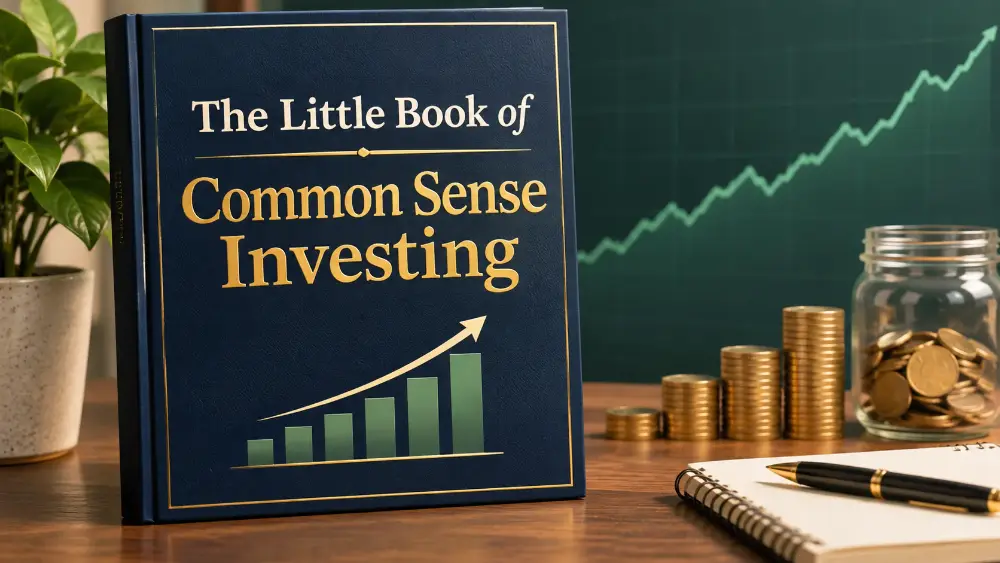
Investing successfully does not always require finding the next multibagger stock, predicting market movements or constantly adjusting a portfolio. Sometimes, the most effective strategy is surprisingly simple: own a broad collection of businesses, keep investment costs low and allow compounding to work over time. This is the central message of The Little Book of Common Sense Investing by John C. Bogle, founder of Vanguard and one of the strongest advocates of index investing.
First published in 2007, the book challenges the conventional investment industry’s focus on active stock selection and frequent trading. Bogle explains why most investors are better served by owning low-cost index funds rather than trying to consistently outperform the market. His approach puts discipline, patience and cost control ahead of market predictions.
In Simple Words
The book teaches investors to stop chasing market-beating returns and focus on capturing the returns the market already generates. Buy a diversified, low-cost index fund, invest regularly and hold it for the long term. The less money you lose to fees, taxes and unnecessary trading, the more wealth you can potentially build.
1. Why Most Investors Cannot Beat the Market
Bogle’s central argument is that the stock market generates returns through the collective performance of businesses. Investors, as a group, receive the market return before costs. Once management fees, brokerage expenses, taxes and trading costs are deducted, investors collectively earn less than the market.
Also Read: A Random Walk Down Wall Street by Burton G. Malkiel: Complete Book Summary and Investing Lessons
Active fund managers attempt to outperform their benchmarks by selecting stocks and timing market movements. However, consistently identifying winners is difficult, particularly over long periods.
Bogle argues that investors should stop treating market outperformance as the primary objective and focus instead on capturing the market’s overall return.
2. The Power of Index Investing
An index fund tracks a market index rather than attempting to select individual winning stocks. For example, a fund tracking the S&P 500 provides exposure to hundreds of leading US companies.
Instead of depending on one fund manager’s decisions, investors participate in the broader growth of the businesses represented in the index.
Also Read: Common Stocks and Uncommon Profits by Philip Fisher: Complete Book Summary and Investing Lessons
| Active investing | Index investing |
|---|---|
| Attempts to beat the market | Aims to match the market |
| Frequent buying and selling | Generally follows a passive strategy |
| Often higher costs | Usually lower costs |
| Requires manager selection | Tracks a predefined index |
| Performance can vary widely | Delivers benchmark-linked returns before costs and tracking differences |
The objective is not to identify the best-performing company every year. It is to own a diversified collection of businesses and remain invested.
3. Investment Costs Can Destroy Long-Term Returns
One of the book’s most important lessons is that costs matter enormously.
A seemingly small annual expense can significantly reduce the final investment value when compounded over several decades. Investors often concentrate on expected returns while overlooking the money deducted through fund management fees and other expenses.
Consider an illustrative investment of ₹10 lakh growing at 10% annually before expenses for 30 years.
Also Read: The Dhandho Investor by Mohnish Pabrai: Complete Book Summary and Investing Lessons
| Annual expense ratio | Approximate final value |
|---|---|
| 0% | ₹1.74 crore |
| 0.25% | ₹1.63 crore |
| 1% | ₹1.32 crore |
| 1.5% | ₹1.14 crore |
These figures assume a constant annual return, expenses deducted annually and no additional investments or taxes.

The difference demonstrates why choosing a low-cost fund can be an important investment decision.
4. Compounding Rewards Patience
Bogle repeatedly emphasizes the importance of allowing investments to grow over time.
Compounding occurs when investment returns generate additional returns. The longer money remains invested, the greater the potential effect of this process.
Also Read: The Warren Buffett Way by Robert G. Hagstrom: Complete Book Summary and Investing Lessons
However, investors frequently interrupt compounding by selling during market corrections, chasing fashionable stocks or switching funds based on recent performance.
Bogle’s philosophy encourages investors to remain invested through market fluctuations rather than attempting to predict every short-term movement.
5. Ignore Market Noise and Avoid Market Timing
Financial markets regularly experience excitement, fear, speculation and uncertainty. Investors may feel pressured to buy during rallies and sell when markets decline.
Bogle argues that market timing is extremely difficult because investors must correctly predict both when to exit and when to re-enter.
Also Read: One Up On Wall Street by Peter Lynch: Complete Book Summary and Investing Lessons
Missing a relatively small number of strong market days can materially affect long-term investment performance.
His preferred approach is straightforward: establish a sensible investment strategy, invest consistently and avoid unnecessary reactions to daily market movements.
6. Diversification Reduces Unnecessary Risk
A diversified index fund spreads investments across multiple companies and industries. This reduces dependence on the performance of any single business.
Bogle particularly supports broad-market index funds because they provide exposure to the overall economy rather than relying on a handful of selected stocks.
Also Read: The Intelligent Investor by Benjamin Graham: Book Summary
Diversification does not eliminate market risk. When the broader stock market falls, index funds also decline. Its purpose is to reduce company-specific concentration risk.
7. Asset Allocation Matters
Although Bogle strongly supports stock market index investing, he does not suggest that every investor should hold 100% equities.
The appropriate allocation between stocks and bonds depends on investment goals, age, financial responsibilities, risk tolerance and investment horizon.
| Investor profile | General allocation approach |
|---|---|
| Long investment horizon | Higher equity allocation may be suitable |
| Moderate risk tolerance | Balanced equity and debt exposure |
| Short investment horizon | Greater focus on capital stability |
| Retired investors | Allocation based on income needs and risk capacity |
Investors should select an allocation they can maintain even during difficult market conditions.
Also Read: Poor Charlie’s Almanack Part 2 – Charlie Munger’s Mental Models for Investing
8. Regular Investing and Staying the Course
The book encourages investors to focus on consistent participation rather than perfect market entry points.
Regular investments help build financial discipline and reduce the temptation to wait indefinitely for market corrections.
Bogle’s philosophy also discourages unnecessary portfolio changes. Investors should review their investments periodically, rebalance when necessary and avoid switching strategies simply because another fund has recently performed better.
Key Lessons for Indian Investors
The principles in Bogle’s book are relevant to Indian investors as well.
Also Read: Poor Charlie’s Almanack Book Summary (Part 1)
Investors can apply the same philosophy through low-cost index funds and ETFs tracking benchmarks such as the Nifty 50, Nifty Next 50 and Nifty 500.
Some practical lessons include:
- Prefer low-cost index funds when broad market exposure is the objective.
- Compare expense ratios and tracking differences before selecting an ETF or index fund.
- Invest regularly instead of trying to predict every market correction.
- Diversify across asset classes according to financial goals.
- Avoid frequent portfolio switching based on short-term performance.
- Stay invested through normal market volatility.
- Give compounding enough time to work.
Index investing does not guarantee profits or protect investors from market declines. However, it offers a disciplined and relatively straightforward approach to long-term wealth creation.
Key Takeaways
- Investing in the market is generally more practical than constantly trying to beat it.
- Low investment costs can make a substantial difference over long periods.
- Broad diversification reduces dependence on individual companies.
- Compounding rewards patience and consistency.
- Market timing is difficult and can damage long-term returns.
- Regular investing encourages financial discipline.
- Asset allocation should reflect individual financial goals and risk tolerance.
- Staying invested is often more valuable than constantly changing strategies.
Final Thoughts
The Little Book of Common Sense Investing makes a powerful case for simplicity in an industry that often profits from complexity. John Bogle’s message is that investors do not need complicated strategies, constant trading or expensive fund managers to participate in long-term market growth.
The book is particularly useful for beginners, long-term investors and anyone who wants to build wealth without spending every day tracking the stock market. Its greatest lesson is simple: keep costs low, diversify sensibly, invest consistently and give time the opportunity to do its work.
Financial Disclaimer: This article is intended for educational purposes only and should not be considered investment advice or a recommendation to buy or sell any financial instrument. Mutual fund and ETF investments are subject to market risks, including the possible loss of principal. Investors should evaluate their financial goals, risk tolerance and investment horizon before making investment decisions.
Keep learning with OneTrader
Explore structured lessons and practical guides to build your market knowledge.

Need a laugh after all that money talk?
Paisa LOL: India's funniest finance page, with memes, comics, jokes and long funny stories.
