Introduction
Investing in the stock market can appear complicated when investors look at financial statements, analyst reports, economic forecasts, institutional research and constantly changing market opinions. But Peter Lynch, one of the most successful fund managers of his generation, presents a surprisingly practical idea in One Up On Wall Street: individual investors can sometimes have an advantage over professional investors because they encounter businesses in everyday life long before Wall Street notices them.
Lynch’s approach is not about randomly buying companies that look popular. His philosophy is about observing businesses, understanding what makes them attractive, researching the company properly and then deciding whether the stock price offers a reasonable opportunity. The central message of the book is that investors should use their everyday knowledge as a starting point, but never as a substitute for proper research.
For Indian investors, this idea is particularly relevant. A consumer may notice a particular food brand becoming popular, a payment app gaining users, a discount retailer expanding rapidly or a company benefiting from a new technology trend. These observations can potentially lead to investment ideas, but the next step should always be fundamental research.
What Is One Up On Wall Street About?
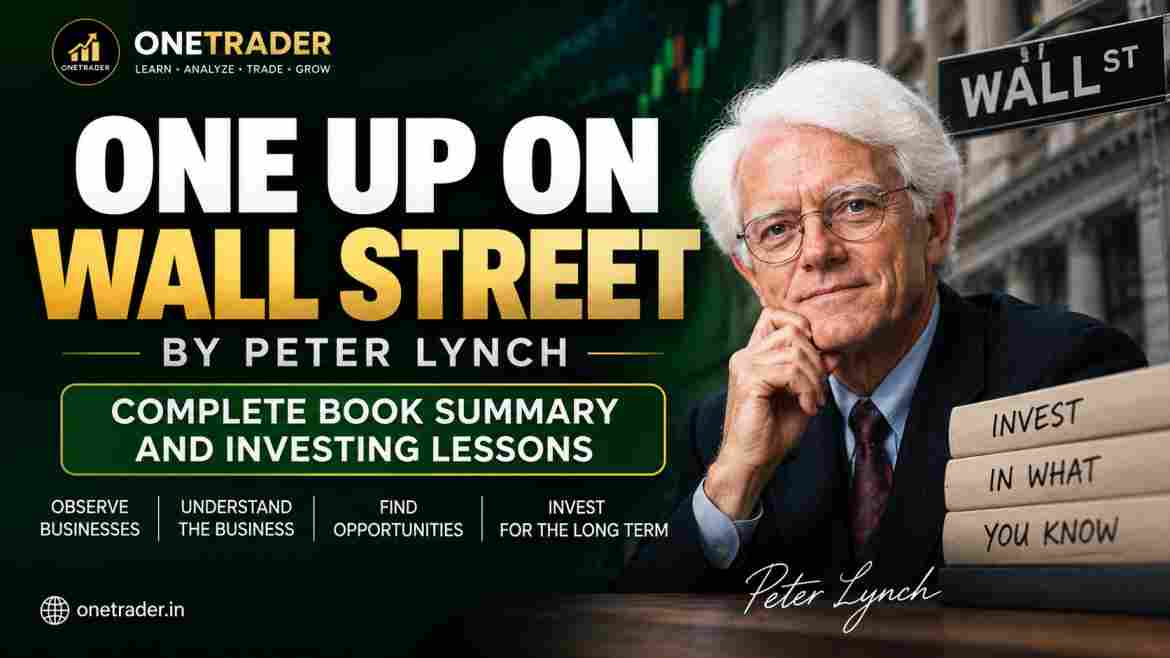
One Up On Wall Street explains Peter Lynch’s philosophy of finding investment opportunities before they become obvious to the broader market. Lynch argues that ordinary investors can develop valuable insights from their own experiences as consumers, employees and observers of businesses.
Also Read: The Intelligent Investor by Benjamin Graham: Book Summary
However, Lynch does not suggest that investors should simply buy whatever products they like. Seeing a company everywhere does not automatically make its stock a good investment. The real advantage comes when an investor notices something interesting and then investigates the business before making a decision.
This distinction is extremely important. Your personal experience can help you discover a company, but financial analysis helps you determine whether that company deserves your money.
Invest in What You Know
One of the most famous ideas associated with Peter Lynch is to invest in what you know. But this concept is often misunderstood.
Lynch’s point is not that knowing a product makes you qualified to buy its stock. Instead, familiarity can help you identify companies worth researching. If you frequently see a particular brand gaining popularity, that observation may be the beginning of an investment thesis.
Also Read: Poor Charlie’s Almanack Part 2 – Charlie Munger’s Mental Models for Investing
Imagine an Indian investor noticing that a particular quick-service restaurant chain is opening outlets rapidly and attracting customers. Rather than immediately buying the stock, the investor could investigate the company’s store expansion, revenue growth, profitability, debt, cash flow, valuation and competitive position.
The everyday observation creates the idea. The research creates the investment decision.
The Stock Is Not the Business
Lynch repeatedly emphasizes the importance of understanding the underlying company rather than becoming obsessed with its share price.
A stock represents ownership in a business. If the business grows its earnings, expands its competitive advantages and generates increasing cash flows over time, the underlying value of the company can potentially rise. But the stock price can behave very differently over shorter periods.
Also Read: Poor Charlie’s Almanack Book Summary (Part 1)
This is why investors should ask questions such as: What does this company actually do? How does it make money? What drives its growth? How strong is its balance sheet? Who are its competitors? What could go wrong? And most importantly, what expectations are already reflected in the current valuation?
A great company can still be a poor investment if investors pay an unreasonable price for it.
Understanding Different Types of Companies
One of Lynch’s most useful contributions is his classification of companies into different categories. Instead of treating every stock the same way, he suggests understanding the type of business you are buying because different categories have different expectations.
Slow growers are mature companies whose growth rates are generally modest. These businesses may provide stability or dividends, but investors should not expect explosive earnings growth.
Stalwarts are larger companies with relatively dependable businesses and moderate growth. They may not become spectacular multibaggers quickly, but their established operations can provide resilience and potentially reasonable returns when purchased at sensible valuations.
Fast growers are companies capable of growing earnings and revenue at high rates. These are particularly interesting to Lynch because a successful fast-growing company can potentially become a major long-term investment. However, high growth also comes with risk because expectations can become excessive and growth can eventually slow.
Cyclicals are businesses whose performance depends heavily on economic or industry cycles. Automobile companies, commodities, metals, chemicals and certain industrial businesses can experience major changes in earnings depending on the economic environment. Investors need to understand where the company is within its cycle rather than assuming that temporarily high profits will continue forever.
Turnarounds are companies facing serious problems but possessing the possibility of recovery. These situations can offer substantial returns if the turnaround succeeds, but the risks are also significant because the problems may be deeper than expected.
Asset plays are companies whose underlying assets may be worth considerably more than what the market price suggests. The challenge is determining whether those assets can actually be realized and whether management will unlock their value.
This classification teaches an important lesson: before evaluating a stock, understand what kind of company you are dealing with.
Look for the Story Behind the Company
Lynch places significant importance on having a clear investment story.
Before buying a stock, an investor should be able to explain in simple language why the company should perform well over the coming years. The story could involve store expansion, market-share gains, new products, improving margins, debt reduction, capacity expansion or a turnaround in profitability.
The story should also include the reasons it could fail.
For example, suppose an investor believes an Indian manufacturing company can grow because it is expanding production capacity and entering a rapidly growing export market. That is the positive story. But the investor should also examine whether the expansion will require excessive debt, whether demand is sustainable, whether competitors are increasing capacity and whether the expected margins are realistic.
A good investment thesis is not simply optimistic. It identifies both the opportunity and the risks.
The Importance of Earnings
For Lynch, earnings ultimately matter enormously.
Stock prices can move because of sentiment, speculation, news and market cycles, but over longer periods, business performance becomes increasingly important. If earnings grow consistently, the company can potentially create substantial value for shareholders.
This is particularly important for investors looking for multibagger opportunities. A company that grows earnings substantially over many years can experience significant appreciation in its stock price, provided the valuation does not become excessively expensive.
This is why investors should examine revenue growth, earnings growth, margins, return on capital, debt, cash generation and other relevant financial indicators instead of focusing only on the stock chart.
The Tenbagger Concept
One of the most famous ideas from Lynch’s investing philosophy is the tenbagger—an investment that increases tenfold from its original purchase price.
The concept is powerful because it changes how investors think about returns. Instead of constantly searching for small short-term gains, investors can potentially benefit from identifying businesses capable of compounding for many years.
But Lynch’s philosophy does not mean every investor should hunt aggressively for tenbaggers. The lesson is that significant wealth creation can come from holding exceptional businesses for long periods rather than constantly trading in and out of stocks.
The difficult part is identifying whether a company’s growth opportunity is genuine and whether the current valuation provides enough room for future returns.
Don’t Ignore Valuation
Growth alone is not enough.
A company may be growing rapidly, but if its stock price already assumes years of extraordinary growth, future returns may disappoint even when the business continues to perform well.
This is one of the most important lessons for modern investors. A wonderful company purchased at an unrealistic valuation can produce poor investment results. Conversely, a strong company purchased at a reasonable valuation can offer a more attractive risk-reward relationship.
Investors should therefore compare valuation with the company’s growth prospects, profitability, balance-sheet strength and industry position.
Do Your Own Research
Lynch’s philosophy strongly encourages individual investors to think independently.
Market opinions can change quickly. Analysts can disagree. News headlines can create excitement or fear. A stock can become fashionable simply because everyone is talking about it.
An investor who understands the business is less dependent on these external opinions.
This does not mean ignoring research from professionals. It means using outside information as an input rather than allowing someone else to make the investment decision.
For an Indian investor, this could mean reading annual reports, studying investor presentations, understanding management commentary, comparing competitors and tracking the company’s financial performance over several years.
The Two-Minute Drill
Lynch describes the importance of being able to explain why you own a stock in a simple and concise manner.
If you cannot explain the basic reason for owning a company, it may indicate that you have not understood the investment properly.
Imagine someone asks, “Why do you own this stock?”
A strong answer should not be “because someone recommended it” or “because it is going up.”
Instead, the investor should be able to explain the business, the growth opportunity, the reason the market may be underestimating it and the key risks that could invalidate the thesis.
If you cannot explain the company clearly, more research may be required.
What Indian Investors Can Learn From Peter Lynch
The Indian stock market provides countless opportunities to apply Lynch’s philosophy. Investors interact with businesses every day through banks, supermarkets, automobiles, digital payments, food delivery, consumer products, telecom services, healthcare and technology.
These everyday observations can become useful sources of investment ideas.
Suppose you notice that a particular consumer brand is becoming increasingly popular among people around you. Instead of immediately purchasing the stock, investigate whether the company’s revenue is actually growing, whether distribution is expanding, whether margins are improving and whether the valuation is reasonable.
Similarly, if you notice a company losing customers or struggling with competition, that observation can encourage you to investigate the business from the opposite direction.
The key is to move from observation → research → valuation → decision.
The Biggest Lesson From One Up On Wall Street
The biggest lesson from One Up On Wall Street is that successful investing does not require investors to predict every movement of the stock market.
Instead, investors can focus on businesses they understand, identify companies with attractive characteristics, research them carefully, evaluate their financial performance and valuation, and then allow time to work in their favor.
Lynch’s philosophy also reminds investors that finding a good company is only the beginning. The investor must understand why the company is attractive, what could make the investment fail and whether the current price provides a reasonable opportunity.
The objective is not to know what the market will do tomorrow. It is to understand what the business could become over the next several years.
Conclusion
One Up On Wall Street remains an important investing book because it makes fundamental investing approachable without suggesting that investing is easy.
Peter Lynch’s philosophy combines everyday observation with serious research. He encourages investors to look around them for potential opportunities, but he also makes it clear that familiarity alone is not enough. The investor must understand the business, classify the company correctly, study its financial performance, evaluate its growth prospects, consider valuation and remain patient.
For long-term investors, perhaps the most powerful message is that great investment opportunities can sometimes be found in ordinary businesses hiding in plain sight. The challenge is developing the discipline to recognize the opportunity, research it properly and hold the investment long enough for the business to prove itself.
Financial Disclaimer
The content on Onetrader is for educational and informational purposes only. It is not investment advice or a buy/sell recommendation. Onetrader is not SEBI registered. Investors should conduct their own research and consider their financial situation and risk tolerance before making any investment decision.