Introduction
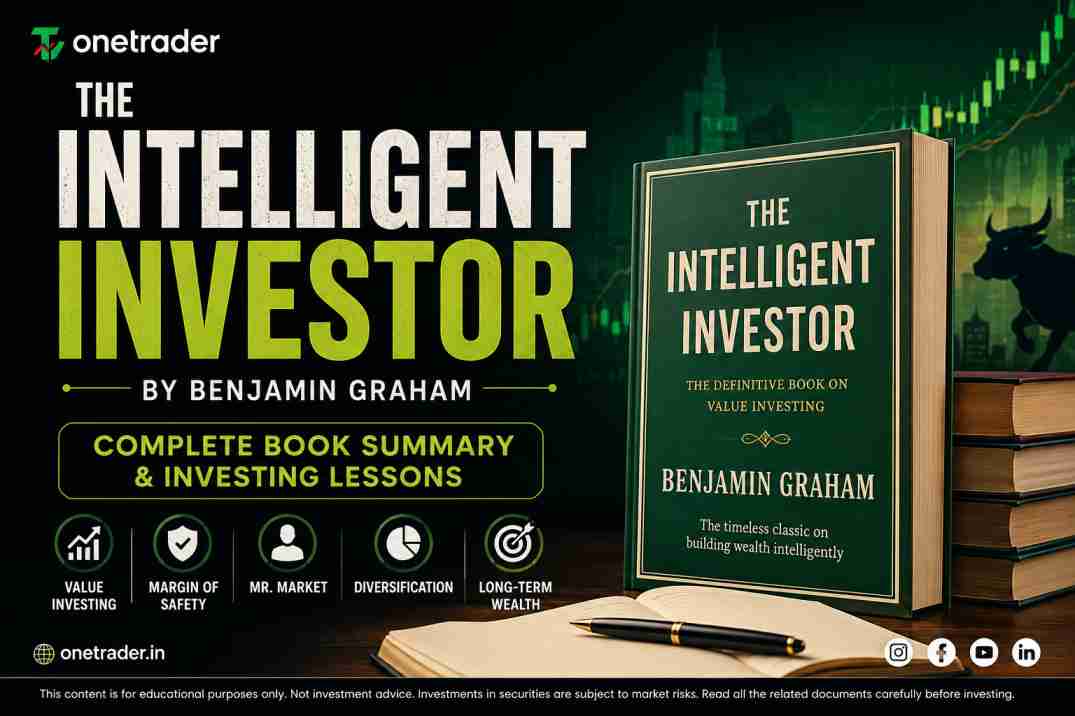
There are many books that teach investors how to find stocks, but very few explain how to think about the stock market itself. The Intelligent Investor by Benjamin Graham is one of those rare books. First published in 1949, it became one of the foundational works of value investing and strongly influenced investors such as Warren Buffett.
At its heart, the book does not promise a method for getting rich quickly. Graham’s approach is almost the opposite. He argues that successful investing requires patience, discipline, reasonable expectations and, above all, protection against permanent loss of capital.
This is what makes the book still relevant today. Markets have changed dramatically since Graham wrote the original edition, but human behaviour has not changed nearly as much. Investors still become excited when prices rise, frightened when markets fall and overly confident when a particular stock becomes popular.
Graham’s central message is simple: a stock is not merely a price moving on a screen. It represents ownership in a real business. The intelligent investor therefore focuses on value, risk and long-term fundamentals instead of allowing daily market movements to control every decision.
Also Read: The Dhandho Investor by Mohnish Pabrai: Complete Book Summary and Investing Lessons
What Does It Mean to Be an Intelligent Investor?
The word “intelligent” in Graham’s title does not mean having an exceptionally high IQ. It means being disciplined and rational.
An intelligent investor does not need to predict exactly what the market will do next month. Instead, the investor develops a process for buying investments at sensible prices, controlling risk and remaining patient.
This distinction is important because many people assume successful investing requires constant activity. They watch market news every morning, check stock prices throughout the day and continuously search for the next multibagger.
Graham suggests a different mindset.
Also Read: The Warren Buffett Way by Robert G. Hagstrom: Complete Book Summary and Investing Lessons
Investing should be based on analysis rather than excitement. Before buying a company, an investor should have a reasonable understanding of the business, its financial strength, earning power and the price being paid for it.
The goal is not to avoid every loss. That is impossible. The goal is to avoid permanent and unnecessary losses.
Investment vs. Speculation
One of Graham’s most important distinctions is between investing and speculation.
An investment operation, according to his philosophy, should involve careful analysis, reasonable safety of principal and an adequate return. Everything outside those conditions should be considered speculation.
Also Read: One Up On Wall Street by Peter Lynch: Complete Book Summary and Investing Lessons
This does not mean speculation is automatically evil. The important thing is to understand what you are doing.
For example, buying a company because you believe its earnings and business prospects justify the current valuation is an investment decision. Buying the same stock simply because it has risen 30 percent in two weeks and everyone on social media is talking about it is much closer to speculation.
The same stock can therefore be an investment at one price and speculation at another.
This is a powerful concept.
Also Read: Market Wizards by Jack Schwager: Book Summary & Trading Lessons
The quality of an investment depends not only on the company but also on the price you pay.
A wonderful company purchased at an absurd valuation can still produce disappointing returns.
Mr. Market: One of Graham’s Most Famous Ideas
Perhaps the most memorable concept in The Intelligent Investor is Graham’s fictional character called Mr. Market.
Imagine that you own a business with a partner named Mr. Market. Every day, your partner comes to you and offers to buy your share of the business or sell you his share.
Also Read: Poor Charlie’s Almanack Part 2 – Charlie Munger’s Mental Models for Investing
The strange thing is that his price changes constantly.
On some days, Mr. Market is extremely optimistic. He offers a very high price because he believes the business has a brilliant future.
On other days, he becomes deeply pessimistic and offers a dramatically lower price even though the underlying business has changed very little.
Graham’s point is that you don’t have to accept Mr. Market’s opinion.
Also Read: Poor Charlie’s Almanack Book Summary (Part 1)
You can simply ignore him when his price doesn’t make sense.
This idea is extremely relevant to modern investors.
When the stock market falls sharply, investors often assume that falling prices mean their businesses have suddenly become less valuable. But the price may simply reflect changing sentiment.
If a fundamentally strong company falls from ₹1,000 to ₹800 because of temporary market fear, the investor should not automatically conclude that the business has lost 20 percent of its value.
The important question is:
Has the underlying business actually deteriorated, or has the market simply changed its mood?
Price Is Not the Same as Value
This is the foundation of value investing.
The stock market gives you a price every second.
But the underlying business has an economic value that cannot be measured simply by looking at today’s share price.
Suppose a company consistently grows its earnings, generates strong cash flow, has manageable debt and possesses a durable competitive advantage.
If the market suddenly becomes pessimistic and pushes the stock price lower, the business itself may not have changed proportionately.
This creates the possibility of buying an asset below its estimated intrinsic value.
However, estimating intrinsic value is not an exact science.
Graham understood this uncertainty, which is why he emphasized the importance of a margin of safety.
The Margin of Safety
The margin of safety is arguably Graham’s most important practical principle.
Imagine you estimate that a company’s intrinsic value is around ₹1,000 per share. Buying it at exactly ₹1,000 gives you little protection if your estimate turns out to be wrong.
Perhaps the company’s future earnings are weaker than expected. Perhaps competition increases. Perhaps management makes poor decisions.
But if you can buy the same business for ₹700, you have some protection against analytical mistakes.
That difference between estimated value and purchase price is your margin of safety.
The idea is not to predict the future perfectly.
It is to recognize that your prediction can be wrong and structure your investment so that a reasonable mistake does not destroy your capital.
This principle remains highly relevant to Indian investors, especially when markets become euphoric and valuations rise rapidly.
Why Diversification Matters
Graham also believed investors should avoid putting too much capital into one idea.
Even after extensive research, an investor can be wrong.
A company that appears financially strong can encounter unexpected problems. A new competitor can emerge. Regulation can change. Technology can disrupt the industry. Management can make a poor acquisition.
Diversification reduces the damage caused when one investment disappoints.
However, diversification should not mean buying dozens of stocks without understanding any of them.
The purpose is to reduce unnecessary company-specific risk while still maintaining a portfolio that the investor can reasonably monitor.
For a long-term investor, a diversified portfolio of quality businesses or broad-market investments can provide a much stronger foundation than constantly searching for the single stock that will outperform everything else.
Defensive Investing
Graham divides investors broadly into defensive and enterprising investors.
The defensive investor prioritizes simplicity, diversification and protection of capital. This approach is particularly relevant to people who do not want to spend several hours every week researching individual companies.
A defensive investor may prefer diversified investments and high-quality businesses rather than trying to identify every undervalued stock in the market.
This is an important lesson because not every investor needs to behave like a professional fund manager.
Someone with a full-time job may have limited time for stock research. For that person, a simple and disciplined investment strategy may be more appropriate than maintaining a highly concentrated portfolio of individual companies.
The best strategy is not necessarily the one with the highest theoretical return.
It is the one you can follow consistently for many years.
The Emotional Investor and Market Cycles
One of Graham’s greatest concerns was the emotional behaviour of investors.
When markets rise for a long time, investors become increasingly optimistic. They begin believing that prices will continue rising indefinitely.
When markets fall sharply, the opposite happens. Fear takes control, and investors start believing that the financial system or economy is permanently broken.
Graham understood that markets move through cycles of optimism and pessimism.
The intelligent investor therefore tries to avoid making major decisions simply because everyone else is excited or frightened.
This is easier to understand with a simple example.
Imagine you buy a strong business after carefully studying it. A year later, the market falls 25 percent and your stock falls 30 percent.
If the company’s earnings, competitive position and balance sheet remain healthy, the lower price may actually create an opportunity rather than a reason to panic.
But if the company’s business has fundamentally deteriorated, the lower price may be justified.
The investor’s job is to distinguish between price volatility and fundamental deterioration.
The Importance of Fundamental Analysis
Graham’s philosophy places considerable importance on understanding the financial strength of a company.
An investor should not buy simply because the share price looks cheap.
A stock trading at ₹100 is not necessarily cheaper than a stock trading at ₹1,000.
The ₹100 company could be heavily indebted, have weak cash flows and declining earnings. The ₹1,000 company could be growing rapidly, generating excellent returns on capital and possessing a strong competitive advantage.
The relevant question is not:
“Is the share price low?”
It is:
“Is the company reasonably valued relative to its financial strength and future earning potential?”
This distinction helps investors avoid the classic value trap, where a stock appears cheap but continues falling because the underlying business is deteriorating.
A Practical Example for Indian Investors
Suppose two Indian companies operate in the same industry.
Company A trades at a relatively low valuation but has declining profits, high debt and weak cash generation.
Company B trades at a higher valuation but has consistent earnings growth, strong cash flows, low debt and a powerful competitive position.
A beginner might automatically choose Company A because its valuation appears cheaper.
Graham’s philosophy would encourage a much deeper analysis.
The cheaper company isn’t necessarily the better bargain.
If Company A’s intrinsic value is falling, its low valuation may be completely justified.
Company B may deserve a higher valuation because its underlying business is stronger.
This is why value investing is not simply buying cheap stocks.
It is buying assets at prices that provide a reasonable relationship between value, risk and expected return.
The Intelligent Investor and Long-Term Thinking
Graham strongly discourages investors from becoming obsessed with short-term market movements.
The stock market can be extremely unpredictable over days, weeks or even months.
But over longer periods, business performance becomes increasingly important.
This does not mean that every good company automatically produces excellent returns. Valuation still matters.
If you buy an excellent company at an extremely expensive price, you may experience years of disappointing returns even while the business continues growing.
That is why Graham’s philosophy combines business quality with valuation discipline.
You want a good investment, but you also want a sensible price.
What Modern Investors Can Learn From Benjamin Graham
Some specific numerical rules in the original book were designed for the market conditions of Graham’s era and should not simply be copied into today’s market.
The deeper principles, however, remain highly relevant.
Modern investors can still learn to distinguish investing from speculation, focus on business fundamentals, demand a margin of safety, diversify appropriately and avoid allowing market emotions to control their decisions.
Technology has made financial information faster and easier to access, but it has not eliminated fear and greed.
In fact, social media can amplify those emotions.
A stock can become popular overnight. Investors can see thousands of people discussing the same company and feel pressure to participate.
Graham’s Mr. Market concept provides a useful mental defence.
You don’t have to follow the crowd.
You can wait.
You can research.
You can say no.
And you can invest only when the opportunity makes sense for you.
The Biggest Lesson From The Intelligent Investor
The most powerful message of Graham’s book is that successful investing is less about predicting the future and more about managing uncertainty intelligently.
You will never know exactly what the economy will look like five years from now.
You will never know which company will experience an unexpected disruption.
You will never know when the next major market correction will arrive.
But you can control how much you pay, how much risk you accept, how diversified you are and how you respond to market volatility.
That is where intelligent investing begins.
Financial Disclaimer: This article is for educational and informational purposes only. It is a summary and analysis of ideas discussed in The Intelligent Investor and should not be considered financial or investment advice. Investing involves market risk, including the possibility of loss of capital. Readers should conduct their own research and consider their financial situation and risk tolerance before making investment decisions.