
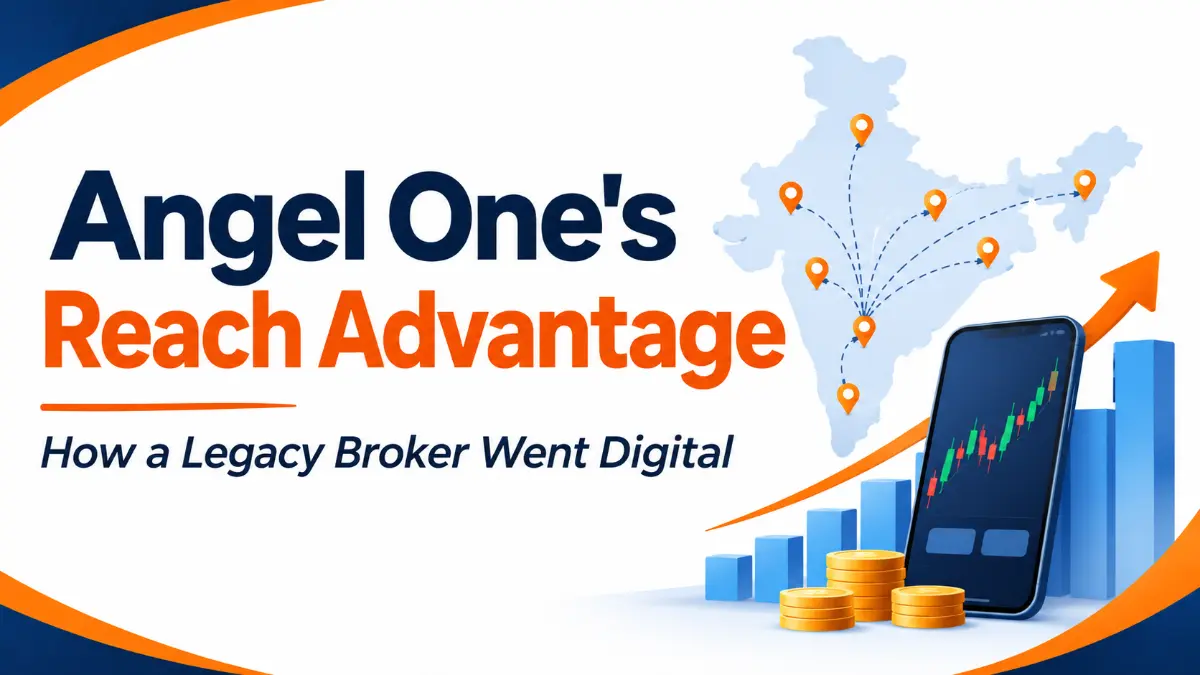
India’s stockbroking industry has undergone a remarkable transformation. What was once a business dominated by established brokerage houses, relationship managers and physical branches has become a fiercely competitive digital market. Mobile applications, low brokerage charges and simplified account opening have brought millions of new investors into the financial system.
Among the companies that successfully navigated this transition is Angel One. Originally known as Angel Broking, the company transformed itself from a traditional brokerage business into one of India’s largest stockbrokers by active client numbers.
Its growth story is particularly interesting because it did not depend entirely on building a better trading application or offering lower brokerage charges. Angel One combined something that many newer digital competitors lacked: an established distribution network reaching smaller Indian cities, supported by an increasingly sophisticated technology platform.
The result was a business capable of serving both customers who wanted to invest independently through a smartphone and those who preferred guidance from a familiar local financial intermediary.
Also Read: Groww’s Success Formula: How a Simple Investing App Overtook India’s Established Stockbrokers
Angel One’s success offers an important lesson about Indian financial services. Technology can make a product accessible, but distribution determines how far that product travels.
From Angel Broking to Angel One: The Advantage of an Established Business
Angel One’s story began long before discount broking became fashionable in India. Founded by Dinesh Thakkar, Angel Broking emerged as a conventional stockbroking business at a time when investing in shares often required personal relationships, telephone-based orders and assistance from brokerage representatives.
The traditional brokerage model was built around trust and service. Customers opened accounts through branches or intermediaries, received market information from dealers and relied on their brokers to execute transactions.
Angel Broking expanded through this system, building a network of branches, franchise partners and Authorised Persons across India. These relationships became particularly valuable in markets where customers were unfamiliar with online trading or uncomfortable making financial decisions without human assistance.
However, the arrival of discount brokers fundamentally changed the economics of the industry. Customers increasingly questioned why they should pay percentage-based brokerage charges when technology could execute the same transaction at a fraction of the cost.
Angel Broking faced a difficult choice. It could protect its traditional pricing structure and risk losing customers to newer platforms, or it could disrupt its own business model.
The company chose transformation.
It moved towards a digital-first, flat-fee brokerage structure, invested in mobile technology and gradually repositioned itself as a broader financial services platform. The change from Angel Broking to Angel One reflected this ambition.
The transformation was more than a branding exercise. It represented a shift from a relationship-led brokerage business towards a technology-enabled financial distribution company.
Importantly, Angel One did not abandon its distribution heritage during this transition. It attempted to combine the reach of an established brokerage network with the cost efficiency of a modern digital platform.
That combination became central to its competitive position.
The Real Growth Strategy: Taking Stock Market Access Beyond Metro Cities
Much of India’s early online investing activity was concentrated in large metropolitan markets. Investors in Mumbai, Bengaluru, Delhi, Hyderabad and other major cities generally had better access to financial services, market information and digital infrastructure.
But India’s potential investor population was much larger than its established urban trading community.
Smaller cities and towns contained salaried employees, business owners, professionals and young workers whose incomes were improving but whose participation in equity markets remained limited.
Angel One recognised the commercial opportunity in reaching these customers.
The company already had relationships with local financial intermediaries, many of whom understood the needs of investors in their communities. These partners could explain the basics of stock market participation, help customers understand account-opening procedures and provide a familiar point of contact.
This mattered because opening a demat account was not always a purely technological decision.
For an experienced investor, choosing a broker might involve comparing brokerage charges, charting tools and order execution. For a first-time investor in a smaller town, the initial question could be much simpler: which company can be trusted with personal savings?
A recognised local intermediary could help answer that question.
Angel One’s digital platform made the transaction possible, while its distribution relationships helped make the service approachable.
This strategy allowed the company to participate in India’s expanding investor base without depending exclusively on expensive metropolitan advertising campaigns.
The broader lesson is that financial inclusion creates a commercial opportunity when technology is supported by distribution that customers understand and trust.
The Authorised Person Network: Angel One’s Distribution Advantage
One of Angel One’s most distinctive business assets is its network of Authorised Persons, often associated with the older sub-broker distribution model.
An Authorised Person operates under a stockbroker’s regulatory framework and facilitates access to brokerage services. Such partners can help customers become familiar with the broker’s offerings, assist with permitted onboarding activities and maintain relationships within local markets.
They are not independent stockbrokers and must operate within the applicable exchange and regulatory requirements.
For Angel One, this network created a distribution channel that newer digital-first businesses could not immediately reproduce.
A financial intermediary operating in a smaller city may already have relationships with business families, salaried professionals and local investors. These relationships can generate referrals and introductions without requiring the broker to establish a company-owned branch in every location.
The economic appeal is straightforward. Instead of bearing the full fixed cost of a large physical network, a broker can use a partner-led model in which compensation is linked to commercial activity, subject to applicable agreements and rules.
This can make geographic expansion more flexible.
How the distribution models differ
| Distribution model | Main advantage | Main limitation |
|---|---|---|
| Company-owned branches | Direct control over service | Higher fixed operating costs |
| Authorised Person network | Local reach and relationships | Partner commissions and supervision |
| Digital advertising | Scalable customer acquisition | Competitive advertising costs |
| Organic referrals | Trust and lower acquisition expense | Less predictable growth |
| Hybrid distribution | Combines online scale with local access | Greater operational complexity |
Angel One’s strength comes from combining these approaches rather than depending on a single channel.
Its Authorised Person network is not an automatic competitive advantage in every situation. Partners must remain commercially productive, customers must receive appropriate service and the broker must supervise the network effectively.
Nevertheless, the relationships built through years of local market activity represent an asset that cannot be recreated simply by launching a trading application.
Why Distribution Can Lower Customer Acquisition Costs
Customer acquisition cost is one of the most important variables in the economics of a retail brokerage business.
A company that spends heavily to attract customers must earn enough revenue from those relationships to recover its acquisition expenses.
This becomes challenging when brokerage charges are low and many newly opened accounts generate limited trading activity.
Angel One’s hybrid distribution model provides several possible advantages.
Digital marketing can reach customers at scale, while local partners can introduce customers through established relationships. Brand recognition from its traditional brokerage business may also improve customer confidence during account opening.
Referrals can further reduce dependence on paid advertising.
However, partner-led acquisition is not free. Revenue-sharing arrangements, incentives, training, technology support and compliance supervision all create costs.
The correct measure of distribution efficiency is therefore not simply how little a company spends on advertisements. It is the total cost of acquiring and serving a customer relative to the revenue that customer generates over time.
A brokerage business becomes more attractive when customers remain active, use multiple services and require manageable levels of support.
Angel One’s distribution strategy is designed to create those conditions, although the economics depend on the quality and activity of the customers acquired.
The Technology Shift: Making a Traditional Broker Behave Like a Digital Platform
A large physical distribution network would have offered limited protection if Angel One had failed to modernise its technology.
As retail investors became accustomed to mobile banking, digital payments and instant financial transactions, their expectations of stockbrokers changed.
They wanted account opening without repeated paperwork, accessible portfolio information, responsive trading platforms and straightforward pricing.
Angel One invested in mobile applications, digital onboarding, trading infrastructure, analytics and automation to serve these expectations.
Its technology strategy was particularly important because the company needed to support different types of customers simultaneously.
A first-time investor might want a simple interface for purchasing shares or starting a mutual fund SIP. An experienced trader might require advanced charts, order types, market data and risk-management tools.
A digital brokerage platform must accommodate these different needs without making the experience unnecessarily complicated.
Technology also helps reduce the marginal cost of serving additional customers. Once the platform and supporting infrastructure are established, a broker can potentially add users without expanding its physical workforce at the same rate.
But stockbroking technology is not merely a matter of designing an attractive application.
Order execution, exchange connectivity, cybersecurity, margin systems, customer records and regulatory reporting all require substantial investment. As customer activity increases, reliability becomes just as important as user experience.
Angel One’s technology transformation allowed its established distribution business to compete in an industry increasingly defined by digital execution.
The Product Ladder: From Trading Accounts to Financial Relationships
Customer acquisition is only the beginning of a financial services business.
Once a customer opens an account, the broker has an opportunity to develop a longer relationship by offering additional financial products.
Angel One’s platform has expanded beyond conventional equity trading into a wider range of investment and financial services.
Its core offerings include equity investing, intraday trading, derivatives, mutual funds, systematic investment plans, exchange-traded funds and IPO participation.
The wider financial ecosystem also creates opportunities around lending, insurance and other financial products through eligible partnerships and distribution arrangements.
These services do not necessarily generate revenue in the same way, and their availability depends on product structure and regulatory permissions.
Angel One’s financial product ecosystem
| Product or service | Customer purpose | Business economics |
|---|---|---|
| Equity delivery | Long-term share ownership | Customer retention and related income |
| Intraday trading | Short-term market participation | Transaction brokerage |
| Futures and options | Derivatives trading | Transaction brokerage |
| Mutual funds and SIPs | Regular investing | Retention and permitted distribution income |
| ETFs | Diversified market exposure | Trading-related revenue where applicable |
| IPOs | Primary market investing | Engagement and related service opportunities |
| Margin funding | Financing eligible securities purchases | Interest income |
| Loans and insurance | Broader financial needs | Permitted partner or distribution income |
This product expansion has a strategic purpose.
An investor who uses a brokerage account only occasionally may generate limited revenue. But a customer who regularly invests, maintains a portfolio and uses additional services can develop a more valuable long-term relationship with the platform.
There is also a retention benefit. Customers who manage several financial activities through one application may find it less convenient to move their entire relationship elsewhere.
The challenge is to ensure that product expansion serves genuine customer needs rather than encouraging unnecessary trading or unsuitable financial products.
How Angel One Makes Money
Angel One’s revenue model reflects the economics of a modern retail brokerage with traditional distribution capabilities.
Transaction-related brokerage remains an important source of income, particularly from customers participating in intraday equity and derivatives markets.
Under a low-cost brokerage structure, revenue depends less on charging high percentage-based commissions and more on customer activity, transaction frequency and the applicable fee schedule.
This creates operating leverage. When transaction activity rises, brokerage income can increase without requiring a proportionate expansion in physical infrastructure.
But it also creates sensitivity to trading volumes.
A slowdown in retail market participation, particularly in derivatives, can affect brokerage income even when the total number of registered customers remains large.
Other sources of income can include interest from eligible margin funding arrangements, permitted transaction-related charges, distribution revenue and other financial services.
The precise contribution of each activity changes with market conditions, business mix and regulation.
Understanding brokerage unit economics
| Metric | Why it matters |
|---|---|
| Customer acquisition cost | Total expense required to acquire a customer |
| Active client ratio | Share of customers who remain commercially engaged |
| Revenue per active client | Monetisation of the active customer base |
| Customer lifetime value | Expected economic contribution over the relationship |
| Partner revenue sharing | Cost of distributing services through intermediaries |
| Technology cost per customer | Efficiency of the digital operating platform |
| Customer servicing cost | Expense of support, complaints and operations |
| Customer retention | Ability to sustain relationships beyond initial onboarding |
A broker with a large customer base is not necessarily the most profitable broker.
What matters is the combination of customer activity, revenue quality, operating expenses, regulatory costs and retention.
For Angel One, the central economic question is whether its broad distribution network can continue generating valuable customer relationships at a cost that supports sustainable profitability.
Angel One vs Zerodha and Groww: Three Different Competitive Strengths
India’s major digital brokers have approached customer acquisition and business development from different starting points.
Zerodhabuilt its reputation around transparent pricing, trading technology, educational resources and a disciplined business model.
Growwdeveloped its identity around accessible investing experiences and a simplified digital interface that appealed to a new generation of retail investors.
Angel One followed a different route.
It started with an established brokerage business, retained the advantages of its distribution network and modernised its pricing and technology to compete with digital-first platforms.
These differences matter because customer acquisition is not identical across India’s financial markets.
An experienced trader may choose a broker based on execution tools and reliability. A first-time investor may prioritise simplicity. Another customer may prefer a recognised financial intermediary who can explain the onboarding process.
Angel One’s strategy attempts to address a broad customer population through both digital and relationship-led channels.
Comparing the business models
| Broker | Distinctive strategic strength | Distribution approach |
|---|---|---|
| Angel One | Established reach and partner relationships | Hybrid digital and Authorised Person network |
| Zerodha | Technology, pricing discipline and education | Primarily direct digital |
| Groww | Accessible investing experience and brand appeal | Primarily digital |
| Upstox | Digital trading platform and competitive pricing | Primarily digital |
| Bank-backed brokers | Banking relationships and integrated financial services | Bank ecosystem, branches and digital |
None of these models guarantees permanent leadership.
Digital-first platforms may achieve lower servicing costs and strong organic acquisition. Bank-backed brokers can benefit from existing deposit relationships. Hybrid brokers may reach customers who prefer some human assistance.
The strongest business is ultimately the one that acquires suitable customers efficiently, retains their trust and earns sustainable revenue without taking excessive operational or regulatory risk.
The Competitive Moat: Reach, Relationships and Brand Heritage
Angel One’s competitive position rests on several interconnected advantages.
The first is geographic reach. A broker with established relationships across smaller cities can access customers beyond the most competitive metropolitan markets.
The second is its partner ecosystem. Local intermediaries may provide customer introductions, education and ongoing relationship support that are difficult to replicate through advertising alone.
The third is brand heritage. Angel One has operated through different phases of India’s capital market development, giving it a history that can matter to customers who value familiarity.
The fourth is technology. A broad distribution network becomes substantially more scalable when onboarding, transactions and customer servicing are digitised.
Finally, its range of financial products creates opportunities to deepen customer relationships.
These advantages reinforce one another. Distribution helps acquire customers, technology makes servicing scalable and a wider product offering creates reasons for customers to remain engaged.
However, this is not a conventional network effect in which every additional customer automatically makes the product more valuable for every other customer.
It is better understood as a distribution and operating-scale advantage.
A larger customer base can improve brand visibility, support technology investment and create opportunities for more efficient operations. But those benefits depend on execution, customer satisfaction and disciplined spending.
The moat must be maintained continuously.
Why the Smaller-City Opportunity Is Both Attractive and Difficult
India’s smaller cities represent a significant long-term opportunity for financial services companies.
Rising digital access, broader financial awareness and the availability of online investment platforms have reduced many historical barriers to stock market participation.
Yet customer needs outside major financial centres can differ considerably.
Some investors may have irregular incomes. Others may be unfamiliar with market volatility, derivatives or the risks associated with leveraged trading.
Language, financial literacy and access to reliable support can influence whether a customer develops a sustainable investing relationship.
For Angel One, these differences create both an opportunity and a responsibility.
A local distribution partner can help customers understand a platform, but the same relationship can become a source of risk if products are misrepresented or customers are encouraged to trade beyond their understanding.
Long-term success in smaller markets therefore requires more than acquiring demat accounts.
It requires responsible onboarding, appropriate communication, transparent pricing and reliable customer support.
A customer who remains invested for years may be more valuable to the overall franchise than one who opens an account during a promotional campaign and quickly becomes inactive.
This distinction is especially important in an industry where headline account growth can attract more attention than customer retention.
The Biggest Risk: Dependence on Active Traders and F&O Activity
One of the structural risks facing retail stockbrokers is their dependence on transaction activity.
Equity delivery investors may trade only occasionally, particularly when they follow long-term investment strategies.
Active traders, by contrast, can generate more frequent brokerage revenue.
This makes derivatives trading commercially important for many discount brokerage models.
But futures and options are also highly sensitive to regulation, transaction costs, market volatility and customer behaviour.
Changes in contract structures, margin requirements, trading eligibility, taxation or other regulatory conditions can materially affect retail participation.
If derivatives volumes decline, brokers with significant exposure to that activity may experience pressure on revenue.
Angel One faces this industry-wide challenge.
The company can reduce concentration risk by developing recurring investment relationships, permitted financing income and a broader product mix. Nevertheless, diversification takes time, and not every additional product will produce comparable revenue or profitability.
There is also an important conflict that brokers must manage responsibly.
Frequent trading can increase brokerage income, but excessive trading may harm customers. Sustainable financial services businesses need revenue models that do not depend on encouraging unsuitable market activity.
Other Risks That Could Challenge Angel One’s Growth
Customer attrition is another significant concern.
Opening a brokerage account has become relatively straightforward, and investors can maintain relationships with multiple platforms. This reduces switching barriers and makes retention an ongoing challenge.
A customer may initially join through a local partner but later migrate to another application offering a better experience, different pricing or more reliable service.
Pricing pressure can also affect profitability. When major brokers compete aggressively on transaction charges, there is limited room to differentiate through headline brokerage rates alone.
Customer service becomes especially important as the business expands. Order disputes, technical interruptions, account restrictions, settlement issues and delayed complaint resolution can damage trust.
The hybrid distribution model introduces additional complexity. Angel One must supervise its Authorised Person network, maintain appropriate controls and ensure that partner conduct meets applicable requirements.
Regulatory scrutiny is a continuing reality for the brokerage industry. Brokers are subject to requirements covering client funds and securities, advertising, cybersecurity, risk management, investor protection and intermediary conduct.
Compliance failures can lead to financial penalties, restrictions, remediation expenses and reputational damage.
Finally, technology itself creates operational risk. Trading platforms must remain dependable during periods of intense market activity, when customer demand and transaction volumes can rise sharply.
For a broker operating at scale, reliability is not simply a technical feature. It is a fundamental part of the customer relationship.
What Founders Can Learn From Angel One’s Business Transformation
Angel One’s journey offers a useful example of how an established business can adapt when technology changes its industry.
The company did not begin with the advantages of a digital-native startup. It had legacy operations, traditional customers and an established distribution structure.
But those assets became valuable when combined with a more competitive digital model.
The first lesson is that existing distribution can be a strategic asset rather than an obstacle to modernisation.
A business with strong customer relationships does not necessarily need to discard them when adopting new technology. It can use technology to make those relationships more productive.
The second lesson is that customer acquisition should be designed around the realities of the target market.
A purely digital strategy may work extremely well for customers comfortable making independent financial decisions. Other markets may benefit from a combination of digital access and human assistance.
The third lesson concerns pricing.
Angel One’s shift towards a discount brokerage structure demonstrates why companies sometimes need to challenge their own revenue models before competitors force the change.
Protecting a legacy pricing structure may preserve margins temporarily, but it can weaken the business if customers increasingly expect a different value proposition.
The fourth lesson is that scale and profitability are different achievements.
A company can acquire customers rapidly while generating weak economic returns if acquisition expenses, servicing costs or customer inactivity remain high.
Sustainable growth requires attention to customer lifetime value, operating efficiency and retention.
The final lesson is that successful transformation does not end with launching an application.
Technology, distribution, customer support, compliance and product development must improve together.
What Investors Can Learn From Angel One’s Business Model
For investors studying stockbroking companies as businesses, Angel One provides a useful framework for evaluating financial services platforms.
Client growth is important, but it should not be viewed in isolation.
A broker can report a growing account base while experiencing weaker trading activity or declining revenue per customer.
Likewise, strong brokerage revenue during periods of elevated market participation may not represent a permanent earnings level.
Investors examining a brokerage business should pay attention to the relationship between customer acquisition, active clients, transaction revenue, operating costs and regulatory exposure.
The quality of revenue also matters.
Income derived from frequent market transactions may behave differently from interest income or recurring financial distribution relationships.
Another consideration is the cost of maintaining a distribution network. Partner-led expansion can improve reach, but revenue-sharing obligations and compliance requirements influence the ultimate economics.
Angel One’s model demonstrates that distribution can create meaningful business value, provided that the customers acquired remain engaged and the network operates efficiently.
The broader principle applies well beyond stockbroking. A financial services company’s competitive position depends not only on how many customers it reaches, but also on the strength, profitability and durability of those relationships.
The Future of Angel One: Can Distribution Remain a Competitive Advantage?
The next phase of India’s brokerage industry is likely to be shaped by more demanding customers, tighter regulatory expectations, continued technology investment and competition across financial products.
Basic trading access has become increasingly standardised. Most major platforms offer digital onboarding, mobile trading, mutual funds and access to listed securities.
As a result, differentiation must increasingly come from customer experience, reliability, financial product integration, service quality and efficient distribution.
Angel One’s established network gives it an opportunity to compete beyond the conventional digital advertising model.
Its challenge is to ensure that this network remains relevant as customers become more comfortable managing investments independently.
Local partners may need to provide greater value through education, relationship support and assistance with permitted financial services rather than relying primarily on transaction facilitation.
At the same time, the company must continue investing in technology so that customers who prefer a fully digital experience have little reason to look elsewhere.
The strongest version of Angel One’s business model is therefore neither a return to traditional broking nor a complete abandonment of its distribution network.
It is a financial platform where digital efficiency and established customer relationships reinforce one another.
Conclusion: Angel One’s Success Was Built on Reach, Not Just Technology
Angel One’s rise among India’s largest stockbrokers illustrates a distinctive route to building scale in financial services.
The company began as a traditional brokerage, developed an extensive distribution network and later transformed its technology, pricing and product offering to compete in the digital era.
Its most important strategic decision was not simply to introduce a modern trading application. It was to connect that application with a distribution system capable of reaching customers across a much wider section of India.
That approach helped Angel One compete with digital-first brokers while retaining advantages developed through years of operating in traditional financial markets.
Its future success will depend on whether it can convert that reach into durable customer relationships, diversified revenue and consistent service quality while managing the risks of a heavily regulated industry.
The enduring business lesson is straightforward: technology makes financial services scalable, but distribution determines who can access them, and trust determines who stays.
Frequently Asked Questions
1. How did Angel One become one of India’s largest stockbrokers?
Angel One combined its established brokerage distribution network with digital onboarding, competitive pricing and modern trading technology. Its ability to reach customers in smaller cities helped expand its client base beyond traditional metropolitan markets.
2. What is the difference between Angel One and Zerodha?
Angel One combines digital brokerage services with an established Authorised Person distribution network. Zerodha has developed a primarily direct digital model built around trading technology, transparent pricing and investor education.
3. How does Angel One earn money?
Angel One earns revenue through brokerage charges, eligible margin funding interest, transaction-related income and other permitted financial services and distribution activities. Trading activity remains an important driver of its brokerage economics.
4. Why is Angel One’s Authorised Person network important?
The network helps the company reach customers through local financial intermediaries, particularly in markets where personal relationships and familiarity can influence financial decisions.
5. What are the biggest risks to Angel One’s business?
Major risks include dependence on trading activity, derivatives regulation, customer attrition, technology outages, compliance obligations, competition and pricing pressure.
6. Is Angel One’s business model sustainable over the long term?
Its sustainability depends on retaining active customers, maintaining efficient distribution, diversifying revenue, investing in technology and managing regulatory and operational risks.
OneTrader Disclaimer: This article is intended for educational and informational purposes only. It examines Angel One’s business model, competitive strategy and industry risks and does not constitute investment advice, a stock recommendation or an endorsement of any brokerage platform. Stock market investments and derivatives trading involve financial risk. Readers should conduct independent research and consult a qualified financial adviser before making investment decisions. OneTrader is not a SEBI-registered investment adviser or research analyst.

Keep learning with OneTrader
Explore structured lessons and practical guides to build your market knowledge.

Need a laugh after all that money talk?
Paisa LOL: India's funniest finance page, with memes, comics, jokes and long funny stories.