
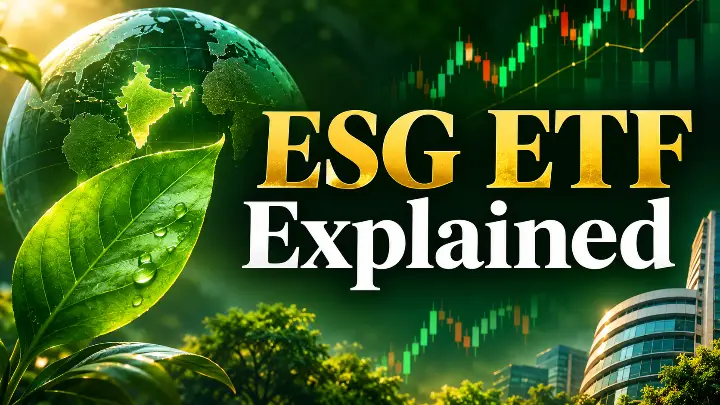
Investing is no longer just about identifying companies with strong earnings, competitive advantages and attractive valuations. A growing number of investors are also examining how businesses manage environmental responsibilities, treat employees, handle social issues and maintain corporate governance. These considerations have brought Environmental, Social and Governance (ESG) investing into the mainstream of global financial markets.
In India, ESG investing is gradually finding a place through mutual funds, index-based strategies and exchange-traded funds. ESG ETFs offer investors an opportunity to gain exposure to companies selected using sustainability-related criteria without having to analyse and purchase individual stocks themselves. However, understanding what these funds actually hold, how companies are selected and what risks they carry is essential before investing.
In simple words: An ESG ETF is an exchange-traded fund that invests in a basket of companies selected using environmental, social and corporate governance criteria. It allows investors to participate in equity markets while giving additional importance to how businesses operate, rather than considering financial performance alone.
What Is an ESG ETF?
ESG stands for Environmental, Social and Governance. These three factors help assess how responsibly a company manages its business and its impact on stakeholders.
Also Read: Liquid ETF Explained: How Liquid ETFs Work in India, Returns, Risks and Who Should Buy Them
Environmental factors examine carbon emissions, energy consumption, pollution control, water management and resource efficiency. Social factors consider employee welfare, workplace safety, customer protection, diversity and community relationships. Governance examines board independence, shareholder rights, transparency, executive compensation and business ethics.
An ESG ETF tracks an index constructed using one or more of these factors. Instead of selecting stocks purely by market capitalisation, the underlying index applies sustainability-related screening or scoring methods to determine which companies qualify and how much weight they receive.
Like other ETFs, ESG ETFs trade on stock exchanges. Investors can purchase and sell units through a demat and trading account during market hours.
How Do ESG ETFs Work in India?
ESG ETFs generally follow a passive investment strategy. The fund tracks a designated ESG index and attempts to replicate its composition and performance, subject to expenses and tracking differences.
Also Read: Liquid ETF Explained: How Liquid ETFs Work in India, Returns, Risks and Who Should Buy Them
The selection methodology depends on the underlying index. Some strategies exclude companies involved in specified controversial activities, while others favour businesses with relatively stronger ESG scores within their respective industries.
SEBI has established a separate ESG sub-category under thematic equity mutual funds, recognising six strategies:
- Exclusion
- ESG integration
- Best-in-class and positive screening
- Impact investing
- Sustainable objectives
- Transition-related investing
Under the regulatory framework, ESG schemes must allocate at least 80% of their assets to equity and equity-related instruments aligned with their selected strategy. They also have specific disclosure and sustainability-reporting requirements.
This framework helps investors understand what an ESG-labelled investment is designed to achieve rather than assuming every ESG fund follows identical rules.
Also Read: Railway and Capital Goods ETF Explained: How It Works, Holdings, Risks and Who Should Buy It

What Stocks Do ESG ETFs Hold?
ESG ETFs are not necessarily portfolios of renewable energy, electric vehicle or clean-technology companies. Their holdings can include established businesses from banking, information technology, automobiles, telecommunications, financial services and other industries.
For example, the Mirae Asset Nifty 100 ESG Sector Leaders ETF tracks the Nifty 100 ESG Sector Leaders Total Return Index.
Its portfolio has included companies such as:
| Company | Sector |
|---|---|
| ICICI Bank | Banking |
| HDFC Bank | Banking |
| Reliance Industries | Diversified energy and businesses |
| Bharti Airtel | Telecommunications |
| Infosys | Information technology |
| Axis Bank | Banking |
| Mahindra & Mahindra | Automobiles |
| Bajaj Finance | Financial services |
These companies qualify through the index’s selection methodology, not because all their business activities are directly related to environmental sustainability.
Investors should examine the latest monthly portfolio disclosure because constituent stocks and their weightings can change following index reviews and market movements.
Benefits of Investing in ESG ETFs
Diversification: An ESG ETF provides exposure to multiple companies through a single investment. This reduces dependence on the performance of an individual stock, although the fund remains exposed to equity-market risk.
Sustainability-focused investing: Investors can incorporate environmental, social and governance considerations into their portfolio without independently evaluating every company.
Exchange-traded flexibility: ETF units can be bought and sold through stock exchanges, offering intraday trading flexibility.
Also Read: Bharat 22 ETF Explained: How It Works, Holdings, Risks and Who Should Buy It
Transparent holdings: Regular portfolio disclosures allow investors to examine the companies and sectors represented in the fund.
Long-term business quality: Companies with stronger governance, responsible resource management and sound workplace practices may be better positioned to manage certain operational and regulatory risks over time. However, stronger ESG scores do not guarantee superior investment returns.
Risks Investors Should Understand
ESG ETFs carry several risks that investors should evaluate before committing money.
Market risk: These funds invest in equities and can decline significantly during market corrections. Sustainability screening does not protect investors from falling share prices.
Also Read: CPSE ETF Explained: How India’s PSU Enterprise ETF Works, Holdings, Risks and Who Should Buy It
ESG scoring differences: Different index providers may assess the same company differently. There is no single universal definition of a strong ESG business.
Concentration risk: Some ESG indices can become heavily weighted towards particular sectors or large companies. This may create exposure similar to conventional equity indices.
Greenwashing: A company or investment product may promote sustainability credentials without delivering meaningful environmental or social improvements. Investors should examine the actual screening methodology and holdings.
Liquidity and tracking risk: An ETF with limited trading activity may have wider bid-ask spreads. Its returns can also differ from its benchmark because of expenses, trading costs and tracking error.
Valuation risk: Popular companies with strong ESG credentials may already command expensive valuations. Sustainability does not automatically make a stock attractive at any price.
How to Choose an ESG ETF in India
Before investing, examine these important factors:
- Underlying index: Understand the index methodology, screening rules and company selection process.
- Portfolio composition: Check sector allocation, top holdings and concentration.
- Expense ratio: Compare annual fund expenses with competing investment options.
- Tracking error: Evaluate how closely the ETF follows its benchmark.
- Liquidity: Check trading volumes, bid-ask spreads and market-maker participation.
- Fund size: Consider assets under management alongside liquidity and operational efficiency.
Also examine the fund’s sustainability disclosures, ESG scores and voting policies. A lower expense ratio alone should not determine your selection.
Who Should Invest in ESG ETFs?
ESG ETFs may suit investors who want diversified equity exposure while incorporating sustainability considerations into their investment decisions. They can also interest long-term investors who believe responsible business practices will become increasingly important for corporate competitiveness.
Also Read: Nifty 50 Equal Weight ETF Explained: How It Works, Holdings, Risks and Who Should Buy It
However, these funds should generally be considered a thematic allocation rather than a complete replacement for a diversified core portfolio. Investors seeking broad Indian equity exposure may prefer to establish their core investments through diversified index funds or other suitable equity funds before adding specialised ESG exposure.
Those uncomfortable with equity-market volatility, or investors expecting guaranteed sustainable outcomes, should carefully reconsider whether these products match their objectives.
Key Takeaways
- ESG ETFs combine stock-market investing with environmental, social and governance screening.
- Their portfolios can include conventional businesses across banking, IT, automobiles and telecommunications.
- SEBI’s ESG framework recognises six distinct investment strategies.
- Diversification and sustainability-focused screening are potential benefits, but market, valuation, liquidity and greenwashing risks remain.
- Investors should compare index methodology, holdings, expenses, liquidity and tracking error before investing.
- ESG ETFs are best evaluated as part of a broader, diversified investment strategy.
Financial Disclaimer: This article is for educational and informational purposes only and should not be considered investment advice or a recommendation to buy or sell any ETF or security. Mutual fund and ETF investments are subject to market risks. Investors should read scheme documents carefully and assess their financial objectives, investment horizon and risk tolerance before investing.
Also Read: Alpha ETF Explained: How Alpha Factor ETFs Work, Holdings, Risks and Who Should Buy Them
Keep learning with OneTrader
Explore structured lessons and practical guides to build your market knowledge.

Need a laugh after all that money talk?
Paisa LOL: India's funniest finance page, with memes, comics, jokes and long funny stories.
