
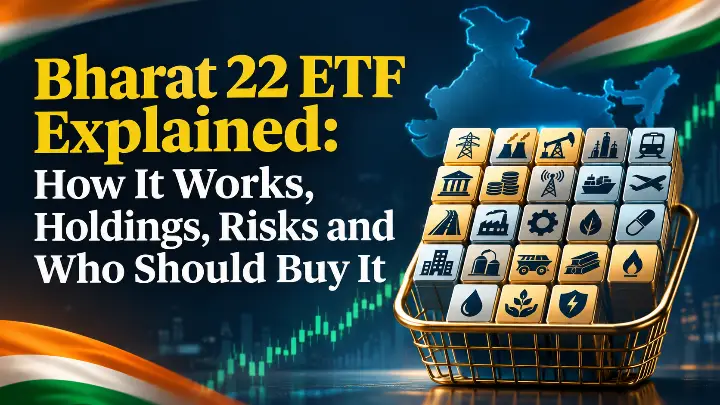
The Bharat 22 ETF offers investors a way to participate in a basket of 22 Indian companies spanning public sector enterprises, government-owned financial institutions and selected private sector businesses in which the government holds strategic stakes. Launched as part of India’s disinvestment programme, the fund provides exposure to businesses operating across important segments of the domestic economy.
However, Bharat 22 ETF is not simply a collection of government-owned companies. Its portfolio includes established private sector names such as Larsen & Toubro, ITC and Axis Bank alongside companies such as NTPC, Coal India and ONGC. Understanding its composition, sector exposure and investment risks is important before adding it to a long-term portfolio.
In simple words
Bharat 22 ETF is an exchange-traded fund that invests in 22 selected Indian companies. Instead of purchasing all these shares individually, investors can buy a single ETF unit through a stock exchange. Its performance broadly follows the underlying BSE Bharat 22 Index, after expenses and tracking differences.
What Is Bharat 22 ETF?
Bharat 22 ETF is an open-ended equity exchange-traded fund managed by ICICI Prudential Mutual Fund. It was launched in November 2017 as part of the Government of India’s strategic disinvestment initiative.
The fund tracks the BSE Bharat 22 Index, which represents 22 companies selected from central public sector enterprises, public sector banks and strategic government investments held through SUUTI (Specified Undertaking of the Unit Trust of India).
Unlike a conventional PSU fund, Bharat 22 also includes selected private sector companies. This gives investors exposure to a combination of government-linked businesses and established private enterprises.
How Does Bharat 22 ETF Work?
The ETF invests in the constituent stocks of its underlying index, broadly following their respective index weightings. As the share prices of these companies change, the ETF’s net asset value (NAV) also changes.
Also Read: Liquid ETF Explained: How Liquid ETFs Work in India, Returns, Risks and Who Should Buy Them
Investors can purchase and sell ETF units through the stock exchanges using a demat and trading account, just like ordinary shares.
The market price of an ETF unit may differ slightly from its NAV because of demand, supply and liquidity conditions. Investors should therefore check both the prevailing market price and indicative NAV before placing an order.
The fund aims to replicate its benchmark rather than actively select stocks based on a fund manager’s market predictions. Its returns will consequently depend largely on the performance of the 22 underlying companies.
Bharat 22 ETF Holdings: Which Stocks Are Included?
The portfolio covers businesses in power, energy, banking, construction, consumer goods, metals and other important industries.
Also Read: Liquid ETF Explained: How Liquid ETFs Work in India, Returns, Risks and Who Should Buy Them

Some of its prominent holdings include:
| Company | Business sector |
|---|---|
| Larsen & Toubro | Construction |
| ITC | Consumer goods |
| NTPC | Power |
| State Bank of India | Banking |
| Axis Bank | Banking |
| Power Grid | Power transmission |
| Coal India | Mining |
| ONGC | Oil and gas |
| Bharat Electronics | Defence electronics |
| National Aluminium | Metals |
The October 2026 portfolio placed Larsen & Toubro and ITC among its largest holdings, followed by NTPC, SBI and Axis Bank.
Importantly, investors should not assume that all 22 holdings carry equal weight. A relatively small number of companies account for a substantial portion of the portfolio, making their performance particularly influential.
Sector Allocation: Where Does the Money Go?
Bharat 22 ETF provides exposure to several economically important sectors. Its portfolio has meaningful allocations to financial services, energy, construction, power and consumer businesses.
This combination offers participation in India’s infrastructure expansion, electricity demand, banking activity, industrial development and consumption.
However, sector diversification does not automatically eliminate concentration risk. Energy and financial businesses, for example, can be affected by economic cycles, government policies, commodity prices and interest-rate movements.
What Are the Advantages of Bharat 22 ETF?
There are several reasons investors consider this ETF for equity portfolio diversification.
- Multiple companies in one investment: Investors gain exposure to 22 businesses without purchasing each stock separately.
- Low operating cost: The ETF has a relatively low expense ratio, making it an economical way to access its underlying index.
- Government-linked businesses: Several holdings operate in strategically important industries and benefit from their established market positions.
- Private sector exposure: Investments in companies such as L&T, ITC and Axis Bank provide exposure beyond traditional public sector enterprises.
- Exchange-traded flexibility: Investors can purchase or sell units during market hours.
The ETF also offers a straightforward way to participate in India’s infrastructure, energy and industrial development themes.
Also Read: Railway and Capital Goods ETF Explained: How It Works, Holdings, Risks and Who Should Buy It
Risks Investors Should Understand
Despite its advantages, Bharat 22 ETF is not a low-risk investment. It remains an equity product, and its value can decline when the underlying shares fall.
Concentration risk: Although the ETF holds 22 companies, its largest holdings carry significant portfolio weights. Poor performance by a few major constituents can affect overall returns.
Government policy risk: Several underlying businesses operate in regulated industries. Changes in government policy, pricing controls, disinvestment decisions and regulations can influence their profitability.
Sector risk: Exposure to energy, banking and infrastructure makes the ETF sensitive to economic cycles, commodity prices, interest rates and capital expenditure trends.
Market and liquidity risk: ETF units trade on exchanges, and low trading activity can result in wider bid-ask spreads or market prices that deviate from NAV.
Tracking risk: The fund may not perfectly match its benchmark because of expenses, cash holdings and portfolio adjustments.
Who Should Buy Bharat 22 ETF?
Bharat 22 ETF may suit investors who want diversified exposure to established Indian businesses, particularly companies operating in strategically important sectors.
It can be considered by:
Also Read: CPSE ETF Explained: How India’s PSU Enterprise ETF Works, Holdings, Risks and Who Should Buy It
- Long-term equity investors comfortable with market fluctuations.
- Investors seeking exposure to infrastructure, energy and government-linked businesses.
- Investors who prefer passive investing over individual stock selection.
- Investors looking to complement an existing diversified equity portfolio.
However, investors seeking broad exposure to the entire Indian stock market should not treat Bharat 22 ETF as a replacement for a Nifty 50 or broader-market index fund.
A gradual investment approach through periodic purchases can help reduce the risk of investing the entire amount at an unfavourable market level. Investors should also review the latest portfolio and sector allocation periodically.
Key Takeaways
Bharat 22 ETF provides exposure to 22 Indian companies through a single exchange-traded investment. Its combination of public sector enterprises and selected private sector businesses makes it different from conventional PSU-focused funds.
Its relatively low cost, established holdings and exposure to important economic sectors are attractive features. However, concentration, government policy, sector and market risks remain important considerations.
For long-term investors, Bharat 22 ETF can serve as a thematic component of an equity portfolio, but it should not replace a diversified core investment strategy.
Financial Disclaimer: Mutual fund and ETF investments are subject to market risks. Past performance does not guarantee future returns. Investors should read the scheme information document carefully and consider their financial goals, investment horizon and risk tolerance before investing.


Keep learning with OneTrader
Explore structured lessons and practical guides to build your market knowledge.

Need a laugh after all that money talk?
Paisa LOL: India's funniest finance page, with memes, comics, jokes and long funny stories.
