
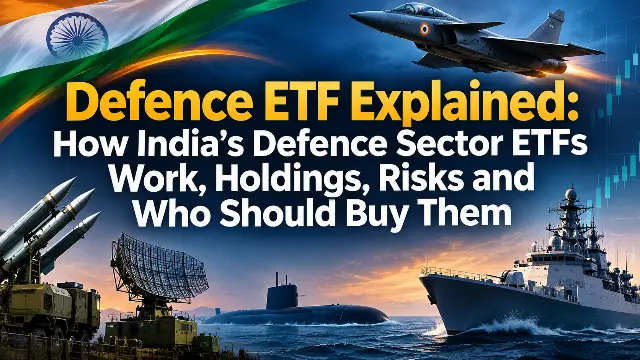
India’s defence sector has attracted growing investor attention as the government pushes domestic manufacturing, modernisation of the armed forces and reduced dependence on imported military equipment. Companies involved in aircraft, missiles, shipbuilding, electronics, radar systems and defence components are becoming an important part of this industrial expansion. For investors who want exposure to this theme, Defence Exchange Traded Funds (ETFs) offer a way to invest in a basket of defence-related companies through a single investment.
However, investing in a Defence ETF is not the same as buying a diversified market index fund. These funds concentrate their investments in a specific industry, making their returns dependent on defence spending, government policies, order execution and valuations. Understanding their structure, underlying holdings and risks is essential before committing money.
In simple words
A Defence ETF invests in a group of listed companies connected to India’s defence industry. Instead of selecting individual defence stocks, investors can buy units of one fund and gain exposure to several companies. The convenience comes with sector concentration risk, so it is better viewed as a specialised investment rather than a complete portfolio.
What Is a Defence ETF?
A Defence ETF is an exchange-traded investment fund designed to track an index representing companies involved in the defence sector. It collects money from investors and invests it in shares of companies included in its benchmark index, generally in proportions linked to their index weights.
In India, the Nifty India Defence Index is an important benchmark for this investment theme. It represents eligible listed companies involved in defence-related activities, including manufacturing, equipment, aerospace, shipbuilding and defence electronics.
Unlike actively managed mutual funds, index-based Defence ETFs generally follow a passive investment approach. Their objective is to replicate the performance of the underlying index, subject to expenses and tracking differences.
How Do India’s Defence ETFs Work?
Investors can purchase ETF units through a demat and trading account, just like listed shares. The units trade on the stock exchange during market hours, and their prices fluctuate according to the value of the underlying portfolio and market demand.
Also Read: Liquid ETF Explained: How Liquid ETFs Work in India, Returns, Risks and Who Should Buy Them

The fund invests in companies represented in its benchmark index. When the index composition or company weights change during periodic reviews, the ETF adjusts its portfolio accordingly.
Investors can earn returns through changes in ETF prices and distributions, if any. However, returns are not guaranteed, and the ETF can fall even when India’s defence industry continues to grow.
What Companies Do Defence ETFs Hold?
The underlying portfolio generally includes companies operating across different parts of the defence manufacturing ecosystem. Depending on the benchmark and its latest composition, investors may get exposure to businesses such as:
| Company | Defence-related business |
|---|---|
| Hindustan Aeronautics | Aircraft and helicopter manufacturing |
| Bharat Electronics | Defence electronics and radar systems |
| Bharat Dynamics | Missiles and defence systems |
| Mazagon Dock Shipbuilders | Warships and submarines |
| Cochin Shipyard | Shipbuilding and naval projects |
| Solar Industries India | Explosives and defence ammunition |
| Garden Reach Shipbuilders | Naval vessels and engineering |
These companies do not have identical business models. Some depend heavily on government defence contracts, while others operate in commercial markets alongside defence manufacturing. Their revenue growth, profitability and order execution can therefore differ significantly.
Also Read: Liquid ETF Explained: How Liquid ETFs Work in India, Returns, Risks and Who Should Buy Them
Why Are Investors Interested in Defence ETFs?
India’s defence manufacturing ambitions provide a long-term investment theme. The government has encouraged domestic procurement, indigenous equipment development and private-sector participation. Higher defence capital expenditure and export opportunities could support companies operating in this ecosystem.
Defence ETFs also offer diversification within the sector. Rather than depending on one company’s execution, investors gain exposure to multiple businesses involved in different defence activities.
Another attraction is the convenience of exchange trading. Investors do not need to research and monitor several individual defence companies to obtain sector exposure.
Key Risks of Investing in Defence ETFs
Despite the industry’s growth potential, Defence ETFs carry meaningful risks.
- Sector concentration: The fund invests in a narrow industry. A downturn in defence stocks can affect most of its holdings simultaneously.
- Valuation risk: Expectations of future orders and growth can push share prices above reasonable valuations. Strong business performance does not automatically translate into attractive investment returns.
- Government dependence: Defence procurement is influenced by government budgets, policies, approvals and project priorities.
- Execution risk: Delays in manufacturing, deliveries, clearances and payments can affect company performance.
- Liquidity and tracking risk: Low trading volumes can increase buying and selling costs. Fund expenses and portfolio differences can also cause returns to deviate from the benchmark.
A growing defence budget alone is not sufficient reason to buy an ETF at any price.
Defence ETF vs Individual Defence Stocks
An ETF provides exposure to several companies through one investment, reducing dependence on a single business. Individual stocks offer greater control over company selection but require deeper research into financial performance, valuations, order books and management execution.
Investors who understand individual companies may prefer direct stock selection. Those seeking broader exposure to the defence theme without selecting individual businesses may find ETFs more convenient.
Who Should Invest in Defence ETFs?
Defence ETFs may suit investors who have a long investment horizon, understand sector-specific volatility and want to add a specialised defence allocation to an already diversified portfolio.
Also Read: Railway and Capital Goods ETF Explained: How It Works, Holdings, Risks and Who Should Buy It
They are generally more appropriate as a satellite investment alongside diversified equity funds rather than as the foundation of a portfolio. Investors should assess the ETF’s expense ratio, assets under management, trading liquidity, tracking difference and portfolio concentration before investing.
Those with low risk tolerance, short-term financial goals or a need for predictable returns should be cautious. Investing through staggered purchases can help avoid committing the entire amount at one market level, although it cannot eliminate losses.
Key Takeaways
- Defence ETFs provide exposure to a basket of listed Indian defence companies.
- Their performance generally follows a defence-focused benchmark index.
- Holdings can include aerospace, shipbuilding, missile manufacturing and defence electronics companies.
- Government spending and domestic manufacturing initiatives can support long-term industry growth.
- Sector concentration, expensive valuations and project execution remain important risks.
- Defence ETFs are better considered a supplementary allocation than a replacement for diversified equity investments.
Financial Disclaimer
This article is for educational and informational purposes only and should not be considered investment advice. Defence ETFs are subject to market risks, including sector concentration and volatility. Investors should read the scheme information documents, evaluate their financial goals and risk tolerance, and consult a qualified financial adviser before investing.




Keep learning with OneTrader
Explore structured lessons and practical guides to build your market knowledge.

Need a laugh after all that money talk?
Paisa LOL: India's funniest finance page, with memes, comics, jokes and long funny stories.
