
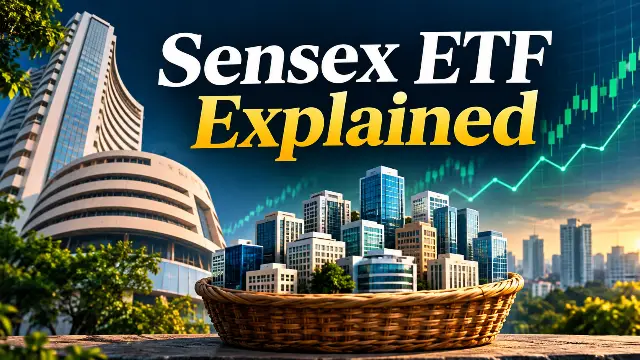
The BSE Sensex is one of India’s most widely followed stock market indices, representing 30 established companies listed on the Bombay Stock Exchange. Investors who want exposure to these companies without purchasing individual shares can consider a Sensex Exchange Traded Fund (ETF). It offers a simple way to participate in the performance of some of India’s largest businesses through a single investment.
A Sensex ETF aims to replicate the performance of the BSE Sensex by investing in the same companies in broadly similar proportions. It combines the diversification of an index fund with the flexibility of stock market trading, making it an option for investors seeking passive exposure to India’s large-cap equity market.
In simple words
A Sensex ETF is a basket of shares representing the 30 companies in the BSE Sensex. When the index rises or falls, the ETF generally moves in the same direction, after accounting for expenses and tracking differences. Investors can buy and sell ETF units through a stock exchange using a demat and trading account.
What Is a Sensex ETF?
A Sensex ETF is a passively managed mutual fund scheme designed to track the BSE Sensex. Instead of relying on a fund manager to select stocks and predict market movements, the fund follows the composition and weightings of its benchmark index.
The ETF invests primarily in the underlying Sensex companies. Since the index includes businesses from different sectors, investors receive exposure to several major segments of the Indian economy through one investment.
Unlike traditional index mutual funds, which are generally purchased or redeemed at the applicable end-of-day NAV, ETF units trade on stock exchanges throughout market hours. Their market prices fluctuate according to demand, supply and the value of their underlying holdings.
How Does a Sensex ETF Track the BSE Sensex?
The BSE Sensex is a free-float market-capitalisation-weighted index. This means companies receive weight based on the market value of shares available for public trading rather than their entire market capitalisation.
Also Read: Liquid ETF Explained: How Liquid ETFs Work in India, Returns, Risks and Who Should Buy Them
A Sensex ETF attempts to maintain a portfolio that mirrors these index weightings. If a particular company has a higher weight in the Sensex, it generally receives a larger allocation in the ETF.
For example, if a company represents a significant portion of the index, its share price movement will have a relatively greater influence on the ETF’s performance.
The index undergoes periodic reviews, and changes in its constituent companies or weightings are reflected in the ETF portfolio. This helps the fund remain aligned with its benchmark without requiring active stock selection.
However, an ETF may not deliver exactly the same return as the Sensex. Expenses, cash holdings, portfolio adjustments and trading costs can create small differences.
Also Read: Liquid ETF Explained: How Liquid ETFs Work in India, Returns, Risks and Who Should Buy Them
Sensex ETF Holdings: Which Companies Are Included?
A Sensex ETF invests in the companies forming part of the BSE Sensex. These businesses represent important sectors of the Indian economy, including banking, information technology, automobiles, energy, consumer goods and healthcare.

Some prominent companies commonly associated with the Sensex include:
| Company | Sector |
|---|---|
| HDFC Bank | Banking |
| ICICI Bank | Banking |
| Reliance Industries | Energy and Retail |
| Infosys | Information Technology |
| TCS | Information Technology |
| Bharti Airtel | Telecommunications |
| Larsen & Toubro | Engineering |
| ITC | Consumer Goods |
| Mahindra & Mahindra | Automobiles |
| Axis Bank | Banking |
The actual portfolio weights change with market prices and index rebalancing. Investors should check the latest monthly portfolio disclosure before investing.
One important point is that a Sensex ETF is not equally weighted. Larger index constituents influence its performance more than smaller constituents. Therefore, its returns are affected by the performance of its largest holdings.
Sensex ETF Costs: Expense Ratio and Other Charges
Cost is an important factor when comparing Sensex ETFs. Since these funds follow an index rather than actively selecting stocks, their expense ratios are generally lower than those of actively managed equity mutual funds.
However, the expense ratio is not the only cost investors should consider.
| Cost component | What it means |
|---|---|
| Expense ratio | Annual fund management and operating expenses |
| Brokerage | Charges paid when buying or selling units |
| Bid-ask spread | Difference between buying and selling prices |
| Demat charges | Applicable account-related charges |
| Tracking difference | Difference between ETF returns and benchmark returns |
A lower expense ratio can help improve long-term returns, but investors should also examine tracking difference and liquidity.
An ETF with a low expense ratio may still be less attractive if its trading volume is limited or its market price frequently deviates from its underlying NAV.
Also Read: Railway and Capital Goods ETF Explained: How It Works, Holdings, Risks and Who Should Buy It
Sensex ETF vs Sensex Index Mutual Fund
Both products aim to track the same benchmark, but their investment and trading mechanisms differ.
| Feature | Sensex ETF | Sensex Index Fund |
|---|---|---|
| Trading | Stock exchange | Mutual fund platform |
| Demat account | Required | Not required |
| Pricing | Market price | Applicable NAV |
| Investment method | Exchange orders | SIP or lump sum |
| Liquidity | Depends on exchange trading | Redemption through fund |
| Expense ratio | Generally low | Generally low |
For investors comfortable using a demat account, ETFs offer intraday trading flexibility. Index mutual funds may be more convenient for those who prefer automated monthly SIP investments without managing exchange orders.
Who Should Buy a Sensex ETF?
A Sensex ETF may suit investors who want long-term exposure to established Indian companies without actively researching and selecting individual stocks.
It can be considered by:
- Long-term investors: Those seeking large-cap equity exposure over an extended investment horizon.
- Passive investors: People who prefer index-based investing over active stock selection.
- Cost-conscious investors: Those looking for relatively low-cost equity market exposure.
- Experienced demat investors: Individuals comfortable buying and selling ETF units through stock exchanges.
- Portfolio diversifiers: Investors looking to add broad large-cap exposure alongside other investments.
However, a Sensex ETF is not suitable for everyone. Investors with short investment horizons, low risk tolerance or a need for predictable returns should carefully consider equity market volatility before investing.
Risks of Investing in a Sensex ETF
Although a Sensex ETF provides diversification across multiple companies, it does not eliminate market risk.
Market risk: If the broader Indian equity market declines, the ETF’s value can also fall.
Concentration risk: The index is weighted by free-float market capitalisation. A handful of large companies and sectors can therefore influence overall performance significantly.
Also Read: Bharat 22 ETF Explained: How It Works, Holdings, Risks and Who Should Buy It
Tracking error: Differences in portfolio holdings, expenses and cash balances can cause the ETF to underperform its benchmark.
Liquidity risk: ETFs with limited trading activity may have wider bid-ask spreads, increasing transaction costs.
No guaranteed returns: Index investing does not protect investors against market corrections or prolonged periods of weak performance.
How to Choose the Right Sensex ETF
Several mutual fund companies offer ETFs tracking the BSE Sensex. Although their investment objectives are similar, their costs, fund size and trading liquidity can differ.
Also Read: CPSE ETF Explained: How India’s PSU Enterprise ETF Works, Holdings, Risks and Who Should Buy It
Before investing, compare the following factors:
| Parameter | What to check |
|---|---|
| Expense ratio | Preferably lower |
| Tracking difference | Consistently close to the benchmark |
| Tracking error | Lower variation is preferable |
| AUM | Consider fund size and stability |
| Trading volume | Adequate daily liquidity |
| Bid-ask spread | Narrower spreads are preferable |
Investors should also compare the ETF’s market price with its indicative NAV (iNAV). Buying at a significant premium to the underlying portfolio value can increase the effective purchase cost.
A large fund with consistent tracking and healthy trading activity may be more practical than choosing an ETF solely because it advertises the lowest expense ratio.
Key Takeaways
- A Sensex ETF provides exposure to the 30 companies included in the BSE Sensex.
- It follows a passive investment strategy based on the index composition.
- ETF units can be bought and sold on stock exchanges during trading hours.
- Expense ratio, tracking difference and liquidity are important selection criteria.
- A Sensex ETF offers large-cap diversification but remains exposed to equity market risk.
- It can be considered for long-term portfolios by investors comfortable with market fluctuations.
Financial Disclaimer
This article is for educational and informational purposes only and should not be considered investment advice or a recommendation to buy or sell any ETF. Mutual fund investments are subject to market risks. Investors should read the scheme information documents, understand the associated risks and evaluate their financial objectives before investing. Past performance does not guarantee future returns.

Keep learning with OneTrader
Explore structured lessons and practical guides to build your market knowledge.

Need a laugh after all that money talk?
Paisa LOL: India's funniest finance page, with memes, comics, jokes and long funny stories.
