
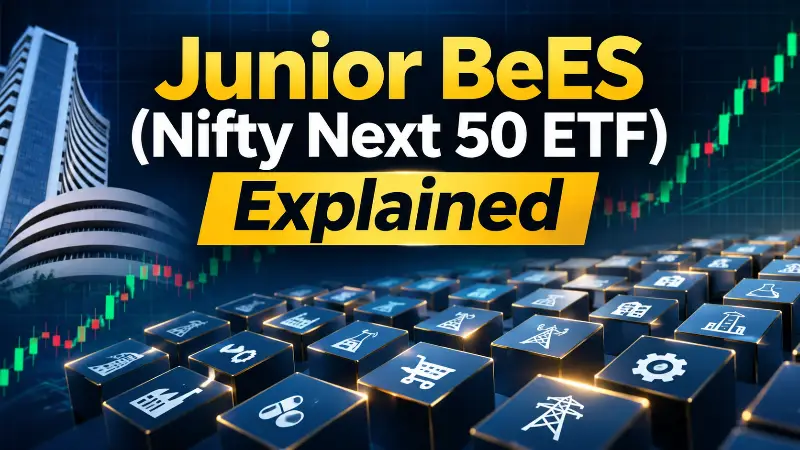
The Nifty 50 gets most of the attention, but the next 50 companies in India’s large-cap universe offer a different route to participate in corporate growth. These businesses are established enough to rank among the country’s largest listed companies, yet they sit just outside the benchmark most investors use as their starting point.
Junior BeES, managed by Nippon India Mutual Fund, gives investors access to this segment through a single exchange-traded fund. It can complement a Nifty 50 allocation, but its return pattern and risk profile are different. The question is whether this exposure belongs in an investor’s portfolio.
In simple words
Junior BeES tracks the Nifty Next 50 and holds a basket of 50 companies ranked below the Nifty 50 within the Nifty 100. It offers exposure to large businesses beyond the Nifty 50, but can be more volatile.
What Is Junior BeES and How Does It Work?
Nippon India ETF Nifty Next 50, commonly called Junior BeES, was launched in February 2003 and trades on the NSE under the symbol JUNIORBEES. Its benchmark is the Nifty Next 50 Total Returns Index (TRI). The index represents the 50 companies in the Nifty 100 after removing the Nifty 50 constituents. It is therefore a segment of the large-cap market, not a mid-cap index.
The ETF follows a passive strategy. It invests in the index constituents in broadly similar proportions, rather than asking a fund manager to select stocks expected to outperform. The portfolio is adjusted when the index changes. Investors buy and sell units on the exchange through a demat and trading account. The market price can differ slightly from NAV, so checking liquidity and the bid-ask spread before placing an order is sensible.
What Does Junior BeES Hold?
The portfolio spans businesses across pharmaceuticals, automobiles, power, industrials, financial services and consumer sectors. Holdings have included Divi’s Laboratories, TVS Motor Company, Hindustan Aeronautics, Tata Motors, Adani Power and Torrent Pharmaceuticals. Their business drivers range from healthcare demand and vehicle sales to defence orders and electricity consumption.
Holdings are not equally weighted. The index uses free-float market capitalisation, subject to capping rules, so larger companies generally carry greater weights. A few leading stocks can therefore influence returns meaningfully. Weights change with share prices and index reviews, making the latest monthly portfolio disclosure more useful than an old holdings list.
Also Read: Liquid ETF Explained: How Liquid ETFs Work in India, Returns, Risks and Who Should Buy Them
The mix can include fast-growing businesses as well as cyclical companies. Holding 50 stocks spreads company-specific risk, but does not remove market or sector risk.

Returns Profile: What Should Investors Expect?
Junior BeES aims to deliver returns close to the Nifty Next 50 TRI, after fund expenses and tracking differences. The TRI includes the effect of dividends, making it a more appropriate comparison than a price-only index. It can lag or lead the benchmark because of expenses, cash holdings, trading costs and portfolio adjustments.
The Nifty Next 50 has not consistently beaten the Nifty 50. During phases when investors favour established, defensive businesses, the Nifty 50 may hold up better. When economic activity, capital expenditure or appetite for growth stocks strengthens, the next 50 can do well. A long holding period gives investors more time to ride through market cycles, but does not guarantee a positive outcome. The ETF should add a distinct exposure and suit the investor’s ability to withstand corrections.
Junior BeES vs Nifty BeES
Nifty BeES tracks the Nifty 50, while Junior BeES tracks the Nifty Next 50. The first gives exposure to the 50 largest eligible companies; the second covers the next 50 within the Nifty 100. Both are passive equity ETFs, but are not interchangeable.
Also Read: Liquid ETF Explained: How Liquid ETFs Work in India, Returns, Risks and Who Should Buy Them
Nifty 50 companies are generally more established and widely held. Nifty Next 50 constituents can have higher growth expectations, but their valuations and share prices may also react more sharply to changes in interest rates, earnings outlook and market sentiment. Holding both broadens exposure, but investors should check overlap with existing mutual funds.
| Feature | Nifty BeES | Junior BeES |
|---|---|---|
| Benchmark | Nifty 50 TRI | Nifty Next 50 TRI |
| Exposure | Top 50 companies | Next 50 companies |
| Relative volatility | Generally lower | Generally higher |
| Portfolio role | Core large-cap exposure | Complementary allocation |
Costs, Tracking and Trading
The fund’s base expense ratio was 0.15% as of September 30, 2026. Its reported tracking error was 0.07% for the same disclosure period, while assets under management were approximately ₹8,654 crore. Tracking error measures how closely returns have followed the benchmark; it does not guarantee an exact match. Check the latest figures before investing.
| Fund detail | Figure |
|---|---|
| Launch date | February 21, 2003 |
| Expense ratio | 0.15% |
| Tracking error | 0.07% |
| AUM | ₹8,654 crore |
| Exit load | Nil |
The expense ratio is reflected in NAV. Investors may also pay brokerage, statutory charges and the bid-ask spread. Check the order book before trading. Exchange purchases are available from one unit; direct creation with the fund is meant for large transactions.
Risks Investors Should Understand
The main risk is volatility. The Nifty Next 50 can fall sharply when valuations compress or investors move away from growth and cyclical shares. A diversified basket does not prevent losses during a broad market sell-off. It is not a parking place for money needed soon.
Sector and valuation risks also matter. The index can have meaningful exposure to industries such as energy, financials, pharmaceuticals and automobiles, and a downturn in a heavily weighted sector can affect the whole ETF. Expensive valuations can also leave stocks vulnerable if earnings disappoint.
Tracking differences and wide trading spreads can also affect investor outcomes. The ETF offers no capital protection or assured return, and substantial temporary losses are possible.
Who Should Consider Junior BeES?
Junior BeES may suit investors who already have a diversified core portfolio and want measured exposure to the next group of large Indian companies. It may suit passive investors with a long horizon, ideally five years or more, and the ability to tolerate drawdowns. The right allocation depends on existing equity exposure, financial goals and risk tolerance.
It is usually better treated as a complementary holding than as the only equity investment. A Nifty 50 fund can provide core exposure, with Junior BeES as a satellite allocation. Check existing fund holdings to avoid unnecessary overlap.
Also Read: Railway and Capital Goods ETF Explained: How It Works, Holdings, Risks and Who Should Buy It
It may not suit conservative investors, short-term goals or anyone who would be forced to sell after a sharp fall. The Nifty Next 50 is not automatically a better version of the Nifty 50; relative performance changes across cycles.
Key Takeaways
Junior BeES offers a simple, exchange-traded route to the 50 companies below the Nifty 50 in the Nifty 100. It provides exposure to a range of established businesses and can complement a core large-cap portfolio. Its passive structure, expense ratio and tracking record are important considerations, but so are market liquidity and the price paid when buying units.
The ETF carries very high equity risk and can be more volatile than Nifty BeES. It is best considered by long-term investors who understand its role, check portfolio overlap and can tolerate market declines. The case for investing should rest on diversification and asset allocation, not on an expectation of guaranteed outperformance.
Financial Disclaimer: This article is for educational and informational purposes only and is not investment advice. ETFs are subject to market risks and investors may lose capital. Past performance does not guarantee future returns. Review the latest scheme documents and consult a qualified financial adviser before making investment decisions.
Article word count: approximately 1,228 words, including title, headings, table and In Simple Words box. SEO setup excluded.



Keep learning with OneTrader
Explore structured lessons and practical guides to build your market knowledge.

Need a laugh after all that money talk?
Paisa LOL: India's funniest finance page, with memes, comics, jokes and long funny stories.
