
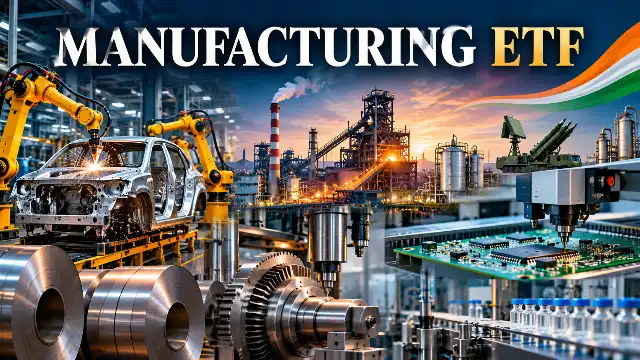
India’s manufacturing sector is attracting investor attention as companies expand production capacity, global manufacturers diversify supply chains, and government policies encourage domestic industrial development. From automobiles and electronics to defence equipment, capital goods and engineering, manufacturing is becoming an important part of India’s long-term economic growth story.
Manufacturing Exchange Traded Funds (ETFs) offer investors a way to participate in this theme without selecting individual manufacturing stocks. However, these funds are not identical to broad-market index ETFs. Their performance depends on the companies included in their underlying indices, sector concentration, valuations and the pace at which India’s manufacturing ambitions translate into business growth.
In simple words
A manufacturing ETF is a stock market investment fund that tracks an index of companies linked to India’s manufacturing industry. Instead of buying individual shares, investors get exposure to a basket of manufacturing-related businesses through one exchange-traded product. Its returns depend on the performance of those companies and the index it follows.
What Is a Manufacturing ETF?
A manufacturing ETF is a passive investment product designed to replicate the performance of a manufacturing-focused stock market index. The index typically includes companies involved in producing automobiles, industrial machinery, metals, chemicals, electrical equipment, defence products, engineering goods and other manufactured products.
Unlike a diversified Nifty 50 ETF, which spreads investments across several sectors, a manufacturing ETF concentrates its portfolio around one economic theme. This provides targeted exposure to industrial growth but also increases sector-specific risk.
Manufacturing ETFs are listed on stock exchanges, allowing investors to buy and sell units during market hours through a demat and trading account.
How India’s Manufacturing ETFs Work
These ETFs follow an underlying index that determines which companies enter the portfolio and their respective weightings. The fund manager generally replicates the index by purchasing its constituent stocks in similar proportions.
Also Read: Liquid ETF Explained: How Liquid ETFs Work in India, Returns, Risks and Who Should Buy Them
When the index is rebalanced, the ETF adjusts its holdings accordingly. Investors do not need to select individual companies or actively manage the portfolio.
The ETF’s market price can fluctuate throughout the trading session. Its Net Asset Value (NAV) represents the underlying value of its investments, while the exchange-traded price may trade at a small premium or discount to that value.
Two important factors deserve attention:
- Tracking error: Measures how closely the ETF follows its underlying index.
- Expense ratio: Represents the annual cost charged by the fund, which reduces investor returns.
What Do Manufacturing ETFs Hold?
Manufacturing ETFs generally provide exposure to multiple industries rather than investing exclusively in factories or industrial producers.
Also Read: Liquid ETF Explained: How Liquid ETFs Work in India, Returns, Risks and Who Should Buy Them

Typical portfolio segments include:
| Industry | Business exposure |
|---|---|
| Automobiles | Cars, commercial vehicles and components |
| Capital goods | Industrial machinery and equipment |
| Engineering | Electrical and industrial engineering |
| Defence | Aircraft, electronics and defence equipment |
| Chemicals | Specialty and industrial chemicals |
| Metals | Steel, aluminium and related products |
| Electronics | Electronic components and manufacturing |
| Pharmaceuticals | Drug and healthcare product manufacturing |
The actual holdings vary according to the underlying index. Some indices may have significant exposure to large automobile manufacturers, while others may allocate more weight to engineering, industrial equipment or defence companies.
Investors should examine the latest portfolio rather than assuming every manufacturing ETF offers the same exposure.
Why Are Investors Interested in India’s Manufacturing Theme?
India’s manufacturing opportunity is supported by several structural developments. Government initiatives such as Make in India and production-linked incentive schemes aim to encourage domestic production, attract investment and strengthen industrial capabilities.
Other growth drivers include:
- Global companies diversifying supply chains beyond traditional manufacturing hubs.
- Rising domestic demand for automobiles, electronics and industrial products.
- Infrastructure development creating demand for machinery, steel and engineering products.
- Defence indigenisation encouraging domestic equipment production.
- Increasing investment in electronics, renewable energy equipment and industrial capacity.
However, these developments represent long-term opportunities, not guaranteed profits for manufacturing companies or ETF investors.
Major Risks of Investing in Manufacturing ETFs
Manufacturing ETFs offer concentrated exposure to an economic theme. Investors should understand the risks before committing money.
1. Sector concentration: A manufacturing ETF is not a substitute for a diversified equity portfolio. A slowdown in industrial activity can affect several portfolio companies simultaneously.
Also Read: Railway and Capital Goods ETF Explained: How It Works, Holdings, Risks and Who Should Buy It
2. Valuation risk: Manufacturing stocks can become expensive when investors anticipate strong future growth. Even businesses with good prospects can deliver disappointing investment returns if their shares are purchased at excessive valuations.
3. Economic slowdown: Manufacturing depends on consumer demand, infrastructure spending, exports and business investment. Weak economic conditions can reduce production, orders and profitability.
4. Commodity price fluctuations: Steel, aluminium, energy and other raw materials influence manufacturing costs. Sudden price increases can squeeze margins, particularly when companies cannot pass higher costs to customers.
5. Government policy risk: Incentives, import duties, trade policies and regulatory changes can influence manufacturing businesses. Changes in policy support may affect investment plans and profitability.
6. Tracking and liquidity risk: An ETF may not perfectly replicate its benchmark because of expenses and tracking differences. Low trading volumes can also increase the difference between buying and selling prices.
How to Choose the Right Manufacturing ETF
Investors should compare ETFs on more than historical returns. Two funds tracking the same index may offer broadly similar exposure but differ in costs, trading liquidity and tracking quality.
Consider these factors before investing:
| Parameter | What to examine |
|---|---|
| Underlying index | Companies and industries included |
| Expense ratio | Annual fund management cost |
| Tracking error | Consistency in following the index |
| AUM | Overall fund size |
| Trading volume | Ease of buying and selling |
| Portfolio concentration | Exposure to top companies |
| Bid-ask spread | Difference between buying and selling prices |
Also examine whether the ETF tracks a broad manufacturing index or a narrower industrial theme. The underlying index methodology determines which businesses qualify and how much weight each company receives.
Also Read: Bharat 22 ETF Explained: How It Works, Holdings, Risks and Who Should Buy It
Investors should compare the latest factsheets and portfolio disclosures rather than choosing a fund simply because it recently delivered higher returns.
Who Should Invest in Manufacturing ETFs?
Manufacturing ETFs may suit investors who:
- Have a long investment horizon, preferably five years or more.
- Believe India’s manufacturing sector has sustainable long-term growth potential.
- Already hold a diversified core equity portfolio.
- Can tolerate periods of significant volatility.
- Want thematic exposure without selecting individual manufacturing stocks.
They may be unsuitable for investors seeking predictable returns, capital protection or short-term gains. Investors who already have substantial exposure to industrial, automobile, defence and capital goods funds should also consider overlapping holdings before adding another thematic investment.
How Much Should You Allocate?
Manufacturing ETFs are generally better treated as satellite investments rather than the foundation of an equity portfolio.
Also Read: CPSE ETF Explained: How India’s PSU Enterprise ETF Works, Holdings, Risks and Who Should Buy It
An investor with a diversified portfolio might consider allocating around 5% to 10% of their equity investments to manufacturing and other thematic opportunities combined, depending on risk tolerance and existing exposure. This is an illustrative allocation, not a universal recommendation.
Investors can consider staggered purchases instead of committing the entire amount at once. However, spreading purchases over time does not eliminate the risk of losses.
Key Takeaways
- Manufacturing ETFs provide exposure to a basket of Indian manufacturing-related companies.
- Their holdings can span automobiles, engineering, metals, chemicals, defence and pharmaceuticals.
- India’s industrial expansion creates long-term opportunities, but growth is not guaranteed.
- Valuations, sector concentration, commodity prices and economic cycles can influence returns.
- Expense ratios, tracking error, liquidity and underlying index composition deserve careful comparison.
- Manufacturing ETFs are better suited to long-term investors who already have diversified core investments.
Financial Disclaimer
This article is for educational purposes only and should not be considered investment advice. Mutual fund and ETF investments are subject to market risks. Investors should read scheme-related documents carefully, understand their risk tolerance and consult a qualified financial adviser before making investment decisions.


Keep learning with OneTrader
Explore structured lessons and practical guides to build your market knowledge.

Need a laugh after all that money talk?
Paisa LOL: India's funniest finance page, with memes, comics, jokes and long funny stories.
