
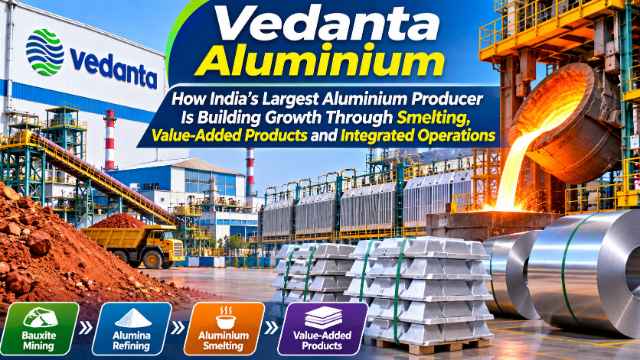
Explore Vedanta Aluminium's integrated business model, bauxite sourcing, alumina refining, aluminium smelting, value-added products, power requirements, competition and long-term growth opportunities.
- Vedanta Aluminium converts bauxite into alumina and then aluminium metal through large-scale industrial operations.
- Vedanta Aluminium Metal is the aluminium business that was demerged from Vedanta Limited and now operates as a separately listed company.
- The company primarily earns revenue by converting raw materials into aluminium metal and selling products to industrial customers.
Vedanta Aluminium is India’s largest aluminium producer and a major participant in the global aluminium industry. The business operates across the aluminium value chain, combining access to raw materials, alumina refining, aluminium smelting, power generation and downstream manufacturing. This integrated structure helps the company manage important production inputs while supplying metal to customers across infrastructure, transportation, construction, electrical and industrial markets.
Aluminium is an important industrial metal because it is lightweight, durable, recyclable and widely used in modern manufacturing. Vedanta Aluminium’s growth strategy focuses on expanding production capabilities, increasing value-added aluminium products, improving operational efficiency and strengthening its position in domestic and international markets. Its ability to manage energy costs, raw material availability and global commodity cycles will remain central to its long-term competitiveness.
In simple words
Vedanta Aluminium converts bauxite into alumina and then aluminium metal through large-scale industrial operations. It earns money by selling aluminium in different forms, including primary metal and specialised value-added products. Its integrated operations and manufacturing scale are important advantages in an industry where raw materials, electricity and production efficiency determine profitability.
What Vedanta Aluminium Does
Vedanta Aluminium Metal is the aluminium business that was demerged from Vedanta Limited and now operates as a separately listed company. It operates large-scale refining and smelting facilities in India and supplies aluminium products to domestic and international customers.
Its operations cover several stages of aluminium manufacturing, beginning with raw material sourcing and processing and extending to finished metal products.
The business produces aluminium for applications such as electrical transmission, automotive manufacturing, packaging, construction, consumer goods and industrial equipment.
Its manufacturing portfolio includes primary aluminium, aluminium ingots, billets, wire rods, rolled products and specialised alloys.
How Vedanta Aluminium Makes Money
The company primarily earns revenue by converting raw materials into aluminium metal and selling products to industrial customers.
Its business benefits from the difference between the selling price of aluminium and the cost of producing it. This makes production efficiency, electricity costs, raw material availability and international aluminium prices important determinants of profitability.
| Revenue area | Main products |
|---|---|
| Primary aluminium | Aluminium ingots and metal |
| Aluminium billets | Extrusion-grade products |
| Wire rods | Electrical and industrial applications |
| Rolled products | Sheets and coils |
| Value-added products | Specialised alloys and manufactured products |
Primary aluminium provides the foundation of the business, while value-added products allow the company to serve specialised customer requirements.
The product mix matters because different aluminium grades and manufactured forms serve different industries and can have different realisation and margin characteristics.
Integrated Operations: From Bauxite to Aluminium
One of Vedanta Aluminium’s most important competitive advantages is its integrated operating structure.
Aluminium manufacturing involves several stages. Bauxite is first mined and processed into alumina. Alumina is then converted into aluminium metal through an energy-intensive electrolytic process called smelting.
The company participates across important stages of this production chain.
The aluminium production chain has four main stages.
| Stage | Role in production |
|---|---|
| Bauxite sourcing and mining | Primary aluminium ore |
| Alumina refining | Conversion of bauxite into alumina |
| Aluminium smelting | Energy-intensive conversion into metal |
| Downstream manufacturing | Billets, wire rods, ingots and specialised products |
Bauxite and alumina: Access to bauxite and alumina processing capabilities is important for securing raw material supply and managing production costs.
Also Read: BSE Ltd: How Asia’s Oldest Stock Exchange Earns from Trading, Data, Listings and Derivatives
Coal and power generation: Aluminium smelting requires substantial and continuous electricity. Coal-based power generation and captive power capabilities help support the company’s energy requirements.
Smelting: The smelting process converts alumina into liquid aluminium using electricity and specialised production technology. Large-scale operations help spread fixed costs across higher production volumes.
Downstream manufacturing: The company converts primary aluminium into products designed for specific industrial applications. This creates opportunities to move beyond commodity metal sales.
Integration across these stages can reduce supply chain dependence and improve operational coordination. However, it does not eliminate exposure to commodity prices, mining costs, energy expenses or regulatory requirements.

Products and Their Industrial Applications
Aluminium demand comes from industries that require lightweight, corrosion-resistant and recyclable materials.
Vedanta Aluminium supplies products for several important applications.
| Product | Major applications |
|---|---|
| Aluminium ingots | Industrial manufacturing and casting |
| Billets | Construction and automotive extrusions |
| Wire rods | Electrical conductors and cables |
| Rolled products | Packaging, transport and construction |
| Specialised alloys | Automotive and industrial components |
The growing use of aluminium in transportation, electrical infrastructure and modern construction provides opportunities for specialised product manufacturers.
Value-added products are strategically important because customers often require specific technical properties, product consistency and reliable delivery rather than undifferentiated commodity metal.
Growth Strategy: Scale, Value Addition and Efficiency
Vedanta Aluminium’s growth strategy rests on expanding manufacturing capabilities while improving the quality of its product portfolio.
Increasing production capacity
Large-scale smelting operations can improve cost competitiveness when supported by reliable raw materials, electricity and efficient production systems.
Capacity expansion allows the company to participate in growing domestic and international aluminium demand.
Expanding value-added products
The company is focusing on products that serve specific customer requirements across electrical, transportation, construction and manufacturing industries.
Also Read: Federal Bank: How the Lender Is Building Growth Through Retail Banking and Digital Finance
A broader downstream portfolio can strengthen customer relationships and reduce dependence on standard primary aluminium sales.
Strengthening integration
Control over important production inputs is a significant advantage in aluminium manufacturing. Investments in mining, refining, power and logistics can improve supply reliability and operating efficiency.
Improving energy efficiency
Electricity is one of the largest cost components in aluminium smelting. Better energy efficiency, improved production technology and optimisation of captive power operations can strengthen manufacturing economics.
Growing domestic demand
India’s infrastructure development, electricity network expansion, automobile manufacturing and construction activity provide long-term demand opportunities for aluminium products.
Also Read: IDFC FIRST Bank: How the Lender Is Building Growth Through Retail Banking and Digital Finance
International market participation
Aluminium is globally traded, allowing producers with competitive manufacturing capabilities to participate in export markets. International sales also expose the company to global pricing and trade conditions.
Why Aluminium Demand Could Grow in India
Aluminium is used across industries where reducing weight, improving energy efficiency and increasing material durability are important.
Several sectors provide long-term demand opportunities.
| Industry | Aluminium applications |
|---|---|
| Power and electrical | Conductors and cables |
| Automobiles | Lightweight vehicle components |
| Railways | Coaches and structural components |
| Construction | Doors, windows and structural systems |
| Packaging | Cans, foils and containers |
| Renewable energy | Solar frames and electrical systems |
| Aerospace | Lightweight engineered components |
The transition towards electric mobility is another potential demand driver. Electric vehicles require lightweight materials to improve efficiency and vehicle range.
Also Read: IndusInd Bank: How the Lender Is Rebuilding Growth Through Retail Banking and Vehicle Finance
Renewable energy projects also use aluminium in electrical infrastructure, solar installations and supporting structures.
India’s expanding manufacturing base could create additional opportunities for domestic aluminium producers.
Competition: Hindalco, NALCO and Global Producers
Vedanta Aluminium operates in a competitive industry where production scale, access to raw materials, electricity costs, technology and downstream capabilities determine market position.
Its major Indian competitors include Hindalco Industries and National Aluminium Company (NALCO).
| Competitor | Main competitive strengths |
|---|---|
| Vedanta Aluminium | Integrated operations and large-scale smelting |
| Hindalco Industries | Integrated aluminium and downstream products |
| NALCO | Bauxite mining, alumina and aluminium production |
| Global producers | International scale and specialised products |
Hindalco has a significant presence across aluminium production and downstream manufacturing, while NALCO benefits from its integrated mining, refining and smelting operations.
Global producers add another layer of competition, particularly in specialised alloys, industrial products and export markets.
Vedanta Aluminium’s competitive position depends on maintaining production efficiency while increasing its share of higher-value products.
Key Business Risks
Aluminium manufacturing is capital-intensive and exposed to several operational and market risks.
Also Read: Vedanta: How Commodity Prices, Higher Volumes and Debt Reduction Drive Its Business
Electricity costs: Smelting requires substantial and continuous power. Higher energy costs can reduce operating margins.
Raw material availability: Disruptions in bauxite, alumina and other input supplies can affect production.
Global aluminium prices: International commodity price movements directly influence selling realisations and profitability.
Coal dependence: Captive power operations create exposure to coal availability, fuel costs and environmental regulations.
Environmental regulations: Mining, refining and smelting involve environmental responsibilities, emissions management and regulatory compliance.
Capital expenditure: Large expansion projects require significant investment and efficient execution.
Global competition: International producers can influence pricing, particularly during periods of excess supply.
Demand cycles: Weakness in construction, automotive and industrial activity can affect aluminium consumption.
The company’s integrated structure helps manage certain supply chain risks, but profitability remains sensitive to the relationship between aluminium prices and production costs.
What Investors Should Watch
Production efficiency: Investors should monitor whether manufacturing facilities operate efficiently and maintain consistent production levels. Better capacity utilisation can improve unit economics.
Aluminium realisations: International aluminium prices and product premiums influence revenue and profitability. The company’s ability to maintain attractive selling realisations is important.
Power costs: Electricity is a major component of smelting economics. Energy efficiency and reliable captive power operations can influence competitiveness.
Also Read: Siemens Energy India: How Power Transmission, Generation and Project Backlogs Drive Its Business
Value-added product contribution: A growing share of specialised products can improve customer relationships and reduce dependence on commodity metal sales.
Raw material integration: Access to bauxite, alumina and coal can support supply security and cost management.
Capital expenditure returns: Expansion investments should translate into higher production, better efficiency and attractive returns on capital.
Environmental performance: Emissions management, responsible mining and energy transition initiatives will influence the company’s long-term operating environment.
Also Read: Shree Cement: How Premium Products, Sales Growth and Cost Management Drive Its Business
Domestic demand: Growth in automobiles, power infrastructure, construction and manufacturing can support the company’s Indian market opportunity.
Key Takeaways
Vedanta Aluminium is India’s largest aluminium producer and operates across important stages of the aluminium value chain.
Its integrated business connects bauxite sourcing, alumina refining, smelting, captive power and downstream manufacturing.
Primary aluminium remains the foundation of its business, while value-added products provide opportunities for stronger customer relationships.
Electricity costs, raw material availability and production efficiency are central to profitability.
Infrastructure, automobiles, electrical networks, packaging and renewable energy support long-term aluminium demand.
Hindalco, NALCO and global producers are important competitors.
Expansion, downstream manufacturing and operational integration are central to its growth strategy.
Also Read: REC: How Power and Infrastructure Financing Drive Its Business
Commodity price volatility, environmental requirements and capital expenditure remain important risks.
Vedanta Aluminium’s competitive advantage comes from its manufacturing scale and integration across the aluminium production chain. India’s growing infrastructure, manufacturing and transportation requirements provide a favourable long-term demand environment. However, the business remains exposed to global aluminium prices, energy costs and capital-intensive operations. Its ability to increase value-added production while maintaining cost efficiency will be important in determining the quality of its future growth.
Financial Disclaimer: This article is intended for educational and informational purposes only. It does not constitute investment advice or a recommendation to buy, sell or hold Vedanta Aluminium Metal shares. Investors should independently evaluate the company’s financial performance, valuation, commodity exposure, operating risks and investment objectives before making any investment decision.
Also Read: Punjab National Bank: How Deposits, Lending and Improving Asset Quality Drive Its Business






Keep learning with OneTrader
Explore structured lessons and practical guides to build your market knowledge.
