
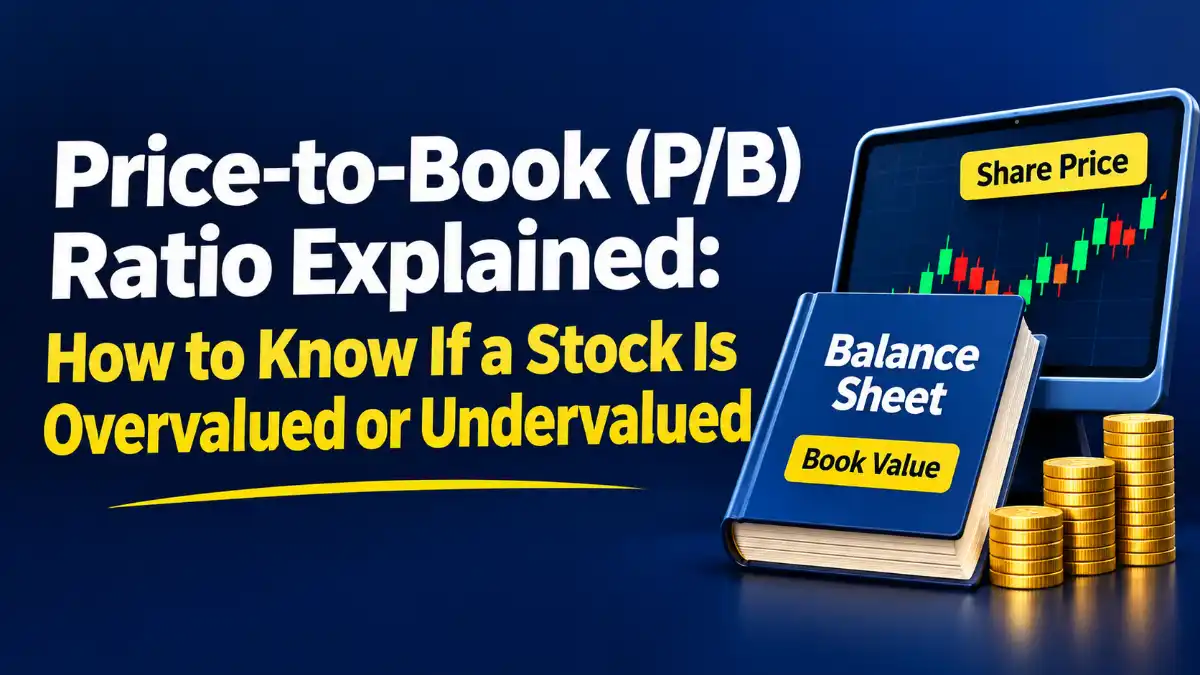
The Price-to-Book ratio helps investors compare a company’s market valuation with its accounting net assets. It is particularly useful when analysing banks, financial institutions and asset-heavy businesses.
What Is the Price-to-Book (P/B) Ratio?
The Price-to-Book ratio compares a company’s current share price with its book value per share. Book value represents the accounting net worth attributable to shareholders after deducting liabilities from assets. It helps investors understand how much the market is willing to pay for every rupee of a company’s reported net assets.
P/B Ratio = Current Share Price ÷ Book Value Per Share
For example, if a company has a book value per share of ₹100 and its stock trades at ₹200, its P/B ratio is 2. Investors are paying twice the company’s accounting book value for each share.
Also Read: Operating Margin vs Net Margin: What Each One Tells You About a Company
| Particulars | Example |
|---|---|
| Current share price | ₹200 |
| Book value per share | ₹100 |
| P/B ratio | 2 |
| Market valuation | 2 times book value |
A P/B ratio of 2 does not automatically mean the stock is expensive. Investors may be willing to pay a premium because the company generates strong profits, uses its assets efficiently or has attractive growth prospects.
Understanding Book Value Per Share
Book value per share is calculated by dividing shareholders’ equity by the number of outstanding ordinary shares.
Book Value Per Share = Shareholders’ Equity ÷ Outstanding Shares
Consider a hypothetical Indian manufacturing company with total assets of ₹2,000 crore and total liabilities of ₹1,200 crore. Its shareholders’ equity is ₹800 crore. If it has 8 crore outstanding shares, its book value per share is ₹100.
Also Read: How to Analyze Earnings Per Share (EPS) Before Buying a Stock
| Particulars | Amount |
|---|---|
| Total assets | ₹2,000 crore |
| Total liabilities | ₹1,200 crore |
| Shareholders’ equity | ₹800 crore |
| Outstanding shares | 8 crore |
| Book value per share | ₹100 |
This calculation provides an accounting-based measure of the net assets attributable to shareholders. However, book value is not necessarily the actual selling value of a company’s assets. Property, machinery and other assets may have different market values from their recorded accounting values. Internally developed brands and technology may also be missing from the balance sheet.
Therefore, book value is a useful starting point, but it should not be treated as the complete economic value of a business.
What Do High and Low P/B Ratios Mean?
A P/B ratio below 1 indicates that a stock is trading below its reported book value. This may attract value investors, but there could be reasons behind the discount. The company might be experiencing declining profitability, excessive debt, poor asset quality or weakening demand.
For example, an Indian manufacturing company may trade below book value because its factories are operating below capacity and its products are losing market share. Although its balance sheet shows substantial assets, those assets may not generate sufficient future earnings. Such a stock could become a value trap rather than an investment opportunity.
Also Read: How to Analyze Revenue Growth Before Investing in Stocks

A P/B ratio above 1 means investors are paying a premium over the company’s book value. This premium may be justified when the business generates strong returns on equity, maintains a competitive advantage or has attractive future growth opportunities.
Consider a hypothetical financial services company with a book value per share of ₹150 and a market price of ₹600. Its P/B ratio is 4. Investors are paying four times its accounting book value, potentially because they expect strong profitability and future growth.
However, a premium valuation also creates expectations. If profitability weakens or asset quality deteriorates, investors may reduce the valuation multiple, putting pressure on the share price.
Why ROE and Industry Comparison Matter
One of the most important ratios to examine alongside P/B is Return on Equity (ROE). It measures how efficiently a company generates profits using shareholders’ equity. A business consistently generating strong ROE may justify a higher P/B ratio than a company struggling to earn adequate returns from its capital.
Also Read: Free Cash Flow Explained: Why It Matters in Fundamental Stock Analysis
Imagine two companies with similar book values. The first consistently generates strong profits, while the second struggles with profitability. Investors may be willing to pay a higher multiple for the first company because its capital is being used more productively.
Industry comparison is equally important. Comparing two Indian private-sector banks or similar manufacturing businesses can reveal differences in profitability, asset quality and market valuation. However, the company with the lowest P/B is not automatically the better investment. A higher multiple may reflect stronger ROE, better management or lower financial risk.
Historical valuation also provides useful context. If a company traditionally trades at a P/B of 2 but currently trades at 1.2, investors should investigate whether its fundamentals have weakened or whether the market has become excessively pessimistic. Historical valuations are reference points, not guaranteed fair values.
Where Is the P/B Ratio Most Useful?
The P/B ratio is particularly useful when analysing banks and financial institutions because shareholders’ equity and asset quality are important parts of their business models. Investors can examine whether the market valuation is supported by profitability, loan quality and the company’s ability to generate sustainable returns.
Also Read: How to Analyze a Company’s Debt Before Buying Its Stock
It can also provide useful information when evaluating manufacturing, infrastructure and other asset-heavy businesses. However, it is generally less informative for technology companies, software businesses and asset-light companies whose value depends heavily on intellectual property, brands and internally developed technology.
There are other limitations worth understanding. When a company has negative shareholders’ equity, the conventional P/B ratio becomes difficult to interpret. The ratio also does not directly measure earnings growth, cash generation or management quality.
For a more complete assessment, investors should examine P/B alongside ROE, ROCE, debt, earnings growth and cash flow. These measures help determine whether the company’s assets are generating attractive economic returns.
How Should Investors Use the P/B Ratio?
A practical approach begins with examining the company’s balance sheet and calculating its book value per share. Investors can then compare its current P/B ratio with relevant industry competitors and its own historical valuation.
Also Read: How to Analyse Earnings Quality: Profit, Cash Flow and Debt
Next, investigate why the stock trades at that particular multiple. Examine ROE, profitability, debt and asset quality to determine whether the market premium or discount is supported by business performance. For banks, asset quality and capital strength deserve particular attention, while manufacturing businesses require closer examination of asset utilisation and operating profitability.
The objective is not simply to find stocks trading below book value. It is to identify businesses whose valuations are reasonable compared with the quality of their assets, profitability and future earning potential.
Final Thoughts
The Price-to-Book ratio offers another perspective on stock valuation beyond earnings-based measures such as P/E. It is especially useful for analysing financial institutions and asset-heavy businesses.
However, a low P/B does not automatically indicate an undervalued stock, and a high P/B does not necessarily mean a company is overpriced. Investors must understand the profitability and quality of the assets behind the valuation.
Also Read: ROE vs ROCE: Which Is More Important for Stock Analysis?
A good investment is not simply a stock trading below book value. It is a business whose valuation is justified by its financial strength and future earning potential.
Disclaimer: This article is for educational and informational purposes only. It does not constitute investment advice or a recommendation to buy or sell any securities. Stock-market investments involve risks, and investors should conduct independent research before making investment decisions. Onetrader is not a SEBI-registered investment adviser or research analyst.






Keep learning with OneTrader
Explore structured lessons and practical guides to build your market knowledge.

Need a laugh after all that money talk?
Paisa LOL: India's funniest finance page, with memes, comics, jokes and long funny stories.
