
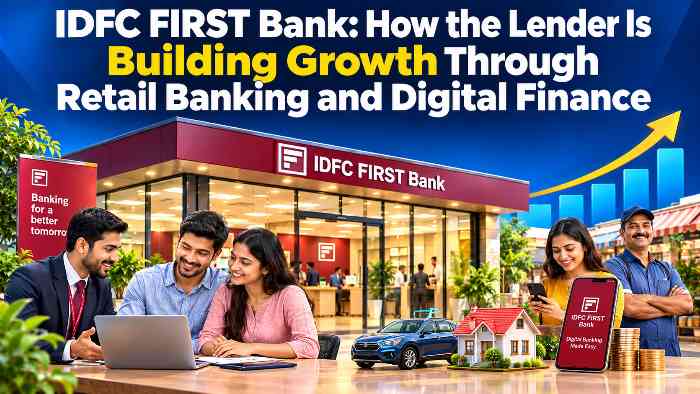
IDFC FIRST Bank is expanding through retail lending, MSME finance, digital banking and a growing deposit franchise while improving profitability and asset quality.
- IDFC FIRST Bank is a private-sector bank offering savings accounts, fixed deposits, personal loans, home loans, vehicle finance, credit cards, MSME finance and corporate banking services.
- IDFC FIRST Bank earns money primarily through lending and banking services.
- IDFC Limited was established in 1997 as an infrastructure financing institution.
India’s banking industry is becoming increasingly competitive as private lenders expand retail lending, strengthen deposits and invest in digital services. IDFC FIRST Bank is positioning itself as a diversified retail-focused bank.
What IDFC FIRST Bank Does
IDFC FIRST Bank is a private-sector bank offering savings accounts, fixed deposits, personal loans, home loans, vehicle finance, credit cards, MSME finance and corporate banking services.
The bank serves individuals and businesses through physical branches, digital platforms and relationship managers. Its services also include working-capital finance, trade finance, cash management and treasury operations.
Also Read: IndusInd Bank: How the Lender Is Rebuilding Growth Through Retail Banking and Vehicle Finance
As of September 2026, the bank served more than 40 million customers and operated approximately 1,200 branches across India.
Its business strategy focuses on retail, rural and MSME customers rather than depending heavily on large corporate loans. This diversified approach provides exposure to households, entrepreneurs, small businesses and corporate organisations.
Customers and How IDFC FIRST Bank Makes Money
IDFC FIRST Bank earns money primarily through lending and banking services. It collects deposits and uses those funds to provide loans. The difference between interest received from borrowers and interest paid to depositors contributes to net interest income.
Its customers include salaried professionals, self-employed individuals, small business owners, entrepreneurs, farmers and corporate organisations.
Retail banking generates income through personal loans, home loans, credit cards and other consumer finance products. MSME and corporate banking provide business loans, working-capital facilities and transaction services.
The bank also earns non-interest income through processing fees, credit card charges, insurance distribution, wealth management, foreign exchange and payment services.
Retail, Consumer and MSME Lending
Retail lending is central to the bank’s growth strategy. Its portfolio includes personal loans, home loans, two-wheeler finance, consumer durable loans, credit cards and loans against property. The bank targets customers across income groups, including first-time borrowers.
Also Read: Vedanta: How Commodity Prices, Higher Volumes and Debt Reduction Drive Its Business
Its MSME and rural banking operations provide business loans, working-capital facilities and livelihood financing to smaller businesses and entrepreneurs. These segments offer opportunities to expand the customer base, although smaller borrowers can be more vulnerable to economic disruptions.
The bank also benefits from cross-selling. A customer opening a savings account may subsequently use a credit card, personal loan or home loan, generating additional interest and fee income.
Merger History and Business Transformation
IDFC Limited was established in 1997 as an infrastructure financing institution. IDFC Bank commenced banking operations in November 2015 after receiving approval for a banking licence. In December 2018, IDFC Bank merged with Capital First, a consumer and MSME-focused financing company, creating IDFC FIRST Bank under V. Vaidyanathan’s leadership.
In the second major restructuring, IDFC Limited merged into IDFC FIRST Bank effective October 1, 2024, removing the intermediate holding company. Under the approved share exchange ratio, IDFC Limited shareholders received 155 bank shares for every 100 shares held.
Growth Drivers
- Retail lending: Personal loans, home loans and credit cards provide opportunities to increase interest income and cross-sell products to existing customers.
- Deposit franchise: Its 48.4% average CASA ratio and 82% retail deposit contribution provide a strong foundation for funding future lending.
- MSME and rural banking: Small businesses and rural customers offer opportunities to diversify the loan book and reach underserved borrowers.
- Digital banking: Investments in mobile banking, technology and analytics can improve customer acquisition, transaction volumes and operating efficiency.
Competition and Risks
IDFC FIRST Bank competes with established private-sector lenders such as HDFC Bank, ICICI Bank, Axis Bank and Kotak Mahindra Bank.
These competitors have established deposit franchises and substantial lending capabilities. Competition for savings deposits and quality borrowers can put pressure on margins.
Also Read: LTM: How IT Services, Digital Transformation and AI Are Driving Its Business
Deposit costs are an important risk. Maintaining a high CASA ratio becomes difficult when banks compete aggressively for customer savings.
Credit risk also deserves attention. Personal loans, MSME lending and rural finance can experience higher defaults during economic slowdowns. Rapid expansion without disciplined underwriting could increase provisions and reduce profitability.
The bank must also improve returns on assets and equity as its balance sheet expands. Strong loan growth alone does not guarantee attractive shareholder returns.
What Investors Should Watch
Investors should monitor five important indicators.
Also Read: Jindal Steel: How Steel Manufacturing, Value-Added Products and Expansion Drive Its Business
First, loan growth should remain diversified across retail, MSME and corporate lending rather than becoming concentrated in riskier segments.
Second, deposit growth and CASA will indicate whether the bank can maintain its funding advantage without significantly increasing deposit costs.
Third, net interest income, net interest margin and return on assets will show whether revenue growth is translating into sustainable profitability.
Fourth, gross NPA, net NPA, fresh slippages and credit costs will help investors assess the quality of the expanding loan book.
Also Read: IRFC: How Railway Financing, Leasing and Diversification Drive Its Business
Finally, operating efficiency and capital adequacy deserve attention as the bank continues expanding its customer base and distribution network.
Financial Disclaimer: This article is intended for educational and informational purposes only and should not be considered investment advice or a recommendation to buy or sell any security. Investors should conduct their own research and consult a qualified financial adviser before making investment decisions.




Keep learning with OneTrader
Explore structured lessons and practical guides to build your market knowledge.

Need a laugh after all that money talk?
Paisa LOL: India's funniest finance page, with memes, comics, jokes and long funny stories.
