
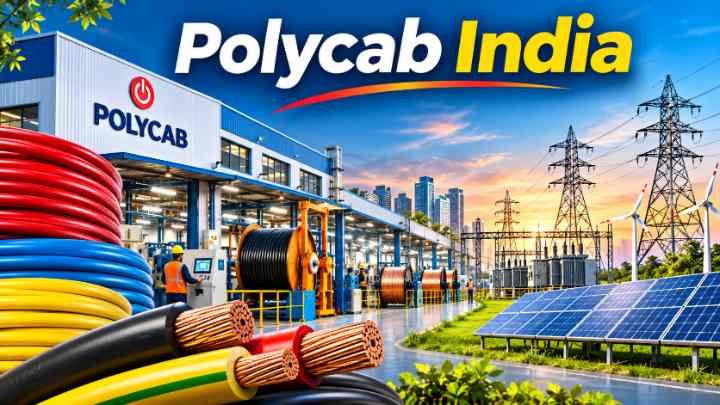
Explore Polycab India's business model, wires and cables leadership, FMEG expansion, EPC operations, infrastructure demand, Project Spring and long-term growth opportunities.
- Polycab makes the cables and electrical products needed to connect homes, factories, buildings and infrastructure to electricity.
- Polycab manufactures and sells wires, cables and a broad range of electrical products.
- Wires and cables account for the largest share of Polycab’s business.
Polycab India has established itself as India’s largest wires and cables manufacturer, supplying electrical products to households, businesses, industries and infrastructure projects. Its products are used across power distribution, construction, manufacturing, renewable energy and other sectors where reliable electrical connectivity is essential. The company has also expanded beyond its core cable business into fast-moving electrical goods and turnkey infrastructure projects.
The company’s growth opportunity is closely linked to India’s investment in electricity networks, housing, industrial capacity, renewable energy and infrastructure. While wires and cables remain its principal business, Polycab is working to strengthen its consumer-facing FMEG portfolio and expand its engineering, procurement and construction capabilities. This combination gives the company exposure to both industrial investment and household electrical demand.
In simple words
Polycab makes the cables and electrical products needed to connect homes, factories, buildings and infrastructure to electricity. It earns most of its revenue from wires and cables while expanding into fans, lighting, switches, solar products and electrical infrastructure projects. Its long-term growth depends on maintaining its cable leadership and making its consumer business more profitable.
What Polycab India Does
Polycab manufactures and sells wires, cables and a broad range of electrical products. Its portfolio serves retail customers, electrical contractors, industrial buyers, infrastructure developers and institutional clients.
The company operates across three principal business segments: Wires and Cables, Fast Moving Electrical Goods (FMEG), and Engineering, Procurement and Construction (EPC).
Its manufacturing capabilities, established distribution network, product range and brand recognition support its position in the organised electrical products market.
Polycab also benefits from backward integration, which means that it has developed capabilities across important stages of its manufacturing and supply chain. This can improve operational control, product consistency and cost efficiency.
How Polycab Makes Money
Wires and cables account for the largest share of Polycab’s business. The company manufactures products for residential wiring, industrial applications, power transmission, infrastructure and specialised electrical requirements.
Its revenue comes from different customer categories.
| Customer category | Main requirements |
|---|---|
| Retail customers | House wiring and electrical cables |
| Contractors | Building and commercial wiring |
| Industries | Industrial and specialised cables |
| Power companies | Transmission and distribution cables |
| Infrastructure developers | Underground and high-voltage cables |
| Institutional buyers | Large electrical supply contracts |
Polycab sells through distributors, dealers, retailers and direct institutional relationships. Its broad distribution network helps maintain product availability across different markets.
The company also earns revenue from electrical consumer products and turnkey infrastructure projects, reducing its dependence on a single customer category.
Business Segments: Cables, FMEG and EPC
Polycab’s three business segments have different growth drivers and profitability characteristics.
| Business segment | Products and services | Main demand drivers |
|---|---|---|
| Wires and Cables | Power, building and industrial cables | Infrastructure and construction |
| FMEG | Fans, lighting, switches, solar and appliances | Household consumption |
| EPC | Electrical infrastructure projects | Power networks and grid development |
Wires and Cables
This is Polycab’s core business and its primary competitive strength. It manufactures a wide range of cables for residential, commercial, industrial and institutional customers.
The business benefits from India’s electricity consumption growth, construction activity, power transmission investment and industrial expansion.
Its extensive product portfolio also allows it to serve specialised applications rather than competing only in standard household wiring.
Fast Moving Electrical Goods
FMEG expands Polycab’s presence in the consumer electrical market. Its products include fans, LED lighting, luminaires, switches, switchgear, solar products, pumps, conduits and domestic appliances.
Also Read: BSE Ltd: How Asia’s Oldest Stock Exchange Earns from Trading, Data, Listings and Derivatives
This segment gives the company access to household replacement demand and consumer spending.

Polycab is focusing on distribution expansion, product innovation, premiumisation and brand building. These efforts are important because consumer electrical products face competition from established brands with strong retail presence.
Engineering, Procurement and Construction
The EPC business provides turnkey electrical infrastructure solutions. Its activities include design, engineering, material supply, project execution and commissioning.
A key focus is the deployment of Polycab-manufactured cables in underground cabling and power infrastructure projects.
This business allows the company to participate in larger infrastructure opportunities rather than supplying products alone.
Growth Strategy: Infrastructure, Distribution and Premiumisation
Polycab’s growth strategy is built around expanding its leadership in cables while developing additional sources of revenue.
Infrastructure and power demand
India’s investment in electricity transmission, distribution, renewable energy and industrial infrastructure creates demand for specialised cables.
Power networks require cables for generation, transmission and distribution. Urban development also increases the need for electrical wiring in residential and commercial buildings.
Polycab is positioned to participate in these opportunities through its broad product range and manufacturing capabilities.
Project Spring
Project Spring is the company’s five-year strategic roadmap extending to FY2030. It focuses on strengthening market leadership, expanding international business, improving manufacturing productivity, increasing consumer reach and developing organisational capabilities.
The strategy also encourages a shift from selling individual products towards providing integrated electrical solutions to institutional customers.
FMEG expansion
Polycab is investing in brand positioning, dealer relationships, retail reach and product development to strengthen its consumer business.
Also Read: Federal Bank: How the Lender Is Building Growth Through Retail Banking and Digital Finance
Premium fans, energy-efficient lighting and modern electrical products provide opportunities to improve product mix and profitability.
International business
The company is also working to expand its presence in international markets. Specialised cables and electrical products can create opportunities beyond domestic infrastructure spending.
A stronger export business would diversify its customer base and provide additional growth avenues.
Infrastructure Demand: A Long-Term Growth Driver
Polycab’s business is closely connected to India’s infrastructure development. Several areas can support long-term demand for its products.
Also Read: IDFC FIRST Bank: How the Lender Is Building Growth Through Retail Banking and Digital Finance
| Sector | Opportunity for Polycab |
|---|---|
| Power transmission | High-voltage cables |
| Renewable energy | Solar and wind power cables |
| Real estate | Building wires and electrical products |
| Electric mobility | EV charging infrastructure cables |
| Data centres | Power and specialised cables |
| Industrial manufacturing | Industrial electrical cables |
| Urban infrastructure | Underground cabling and distribution |
The expansion of renewable energy projects, electricity networks and industrial facilities creates demand for reliable electrical connections.
Data centres and electric vehicle charging infrastructure also require specialised power cables. These markets offer opportunities for manufacturers with suitable technical capabilities and product approvals.
Competition in the Electrical Products Industry
Polycab competes with established Indian and international electrical equipment manufacturers. The competition varies across cables, consumer electrical products and infrastructure projects.
| Competitor | Main business strengths |
|---|---|
| KEI Industries | Wires and cables |
| RR Kabel | Wires and electrical products |
| Havells India | Electrical goods and consumer brands |
| Finolex Cables | Electrical and communication cables |
| V-Guard Industries | Consumer electrical products |
Polycab’s competitive advantages include its manufacturing scale, product range, distribution network, brand recognition and backward integration.
Also Read: IndusInd Bank: How the Lender Is Rebuilding Growth Through Retail Banking and Vehicle Finance
However, the company must continue investing in quality, technology, capacity and distribution to protect its position against organised competitors.
Key Business Risks
Despite its strong position in the cables market, Polycab faces several business risks.
Raw material volatility: Copper, aluminium and other input prices can affect manufacturing costs and margins.
Infrastructure spending: Delays in government and private infrastructure projects can affect demand for industrial cables.
Competition: Price competition can reduce profitability, particularly in standardised cable products.
FMEG profitability: Building consumer brands requires sustained spending on advertising, distribution and product development.
EPC execution: Project delays, cost overruns and working capital requirements can affect returns.
Capacity utilisation: New manufacturing investments must generate sufficient demand to justify the capital employed.
Also Read: Vedanta: How Commodity Prices, Higher Volumes and Debt Reduction Drive Its Business
International expansion: Entering new markets involves competition, regulatory requirements and distribution challenges.
The balance between growth investments and profitability will remain important as Polycab expands its operations.
What Investors Should Watch
Wires and cables market share: Polycab’s ability to maintain its leadership position is a central part of its investment story. Investors should monitor whether it continues to gain customers and expand its presence in specialised cable categories.
Manufacturing efficiency: Backward integration, automation and capacity utilisation can influence operating costs and margins.
FMEG profitability: The consumer business needs to establish sustainable profitability through stronger distribution, premium products and better cost management.
EPC order quality: Investors should assess project execution, order conversion, working capital requirements and profitability rather than focusing only on the size of the order book.
Export contribution: International business can diversify revenue and reduce dependence on domestic demand.
Infrastructure investment: Spending on power distribution, renewable energy, real estate, manufacturing and data centres can influence the company’s long-term growth.
Capital allocation: Capacity expansion and strategic investments should generate adequate returns without weakening financial discipline.
Key Takeaways
Polycab is India’s largest wires and cables manufacturer.
Wires and cables remain its primary business and competitive strength.
FMEG provides exposure to household electrical products and consumer spending.
Also Read: Siemens Energy India: How Power Transmission, Generation and Project Backlogs Drive Its Business
EPC allows the company to participate in large electrical infrastructure projects.
India’s power, renewable energy, construction and industrial investment cycles support long-term demand.
Project Spring focuses on market leadership, international expansion, manufacturing efficiency and consumer growth.
Distribution reach, backward integration and manufacturing capabilities provide competitive advantages.
Also Read: Shree Cement: How Premium Products, Sales Growth and Cost Management Drive Its Business
FMEG profitability, raw material prices and EPC execution remain important areas to monitor.
Polycab’s long-term business opportunity is built around India’s growing need for electricity, stronger power networks and expanding infrastructure. Its leadership in wires and cables provides a strong foundation, while FMEG and EPC offer opportunities to broaden its business. The company’s ability to maintain cable market share, improve consumer product profitability and execute infrastructure projects efficiently will shape its next phase of growth.
Financial Disclaimer: This article is intended for educational and informational purposes only. It does not constitute investment advice or a recommendation to buy, sell or hold Polycab India shares. Investors should independently evaluate the company’s financial performance, competitive position, valuation, business risks and investment objectives before making any investment decision.







Keep learning with OneTrader
Explore structured lessons and practical guides to build your market knowledge.
