
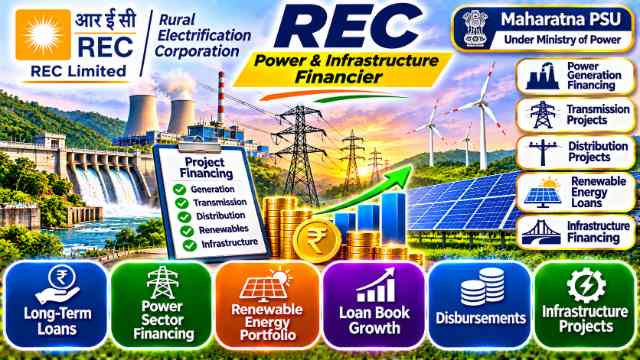
Explore REC Limited's power and infrastructure lending business, Q2 FY27 results, loan book growth, renewable energy portfolio and key risks.
- REC Limited is a Maharatna government-owned non-banking financial company (NBFC) under the Ministry of Power.
- REC’s customers include central government entities, state utilities and private companies involved in power and infrastructure projects.
- Financing requirements across the power sector provide the foundation for REC’s growth.
What REC Does
REC Limited is a Maharatna government-owned non-banking financial company (NBFC) under the Ministry of Power. It specialises in providing long-term loans for power and infrastructure projects across India.
Its financing covers electricity generation, transmission, distribution and renewable energy projects. REC lends to central and state entities as well as private-sector borrowers, supporting projects across different parts of the power sector.
The company follows a lending-based business model. It raises funds through borrowings and provides loans to project developers and utilities, earning income from the difference between its borrowing cost and lending rate.
Customers and How REC Makes Money
REC’s customers include central government entities, state utilities and private companies involved in power and infrastructure projects. Its lending supports generation facilities, transmission networks, distribution systems and renewable energy developments.
Also Read: Vedanta: How Commodity Prices, Higher Volumes and Debt Reduction Drive Its Business
The company earns interest on the loans it provides. The difference between the interest received from borrowers and the cost of raising funds contributes to its net interest income and profitability.

Because REC provides long-term financing, its financial performance is influenced by the size of its loan portfolio, fresh disbursements, borrower repayments and funding costs. The mix of projects it finances also determines its exposure across the power and infrastructure sectors.
Growth Drivers
Financing requirements across the power sector provide the foundation for REC’s growth. Projects involving electricity generation, transmission and distribution require long-term funding, creating lending opportunities among central, state and private borrowers.
Renewable energy is another important growth area. The company’s renewable energy portfolio increased 27% year on year, reflecting its expanding exposure to this segment.
Competition and Risks
Margin pressure is another risk. The company earns through the spread between its borrowing costs and lending rates, so changes in funding costs and interest rates can affect profitability.
Its exposure to state utilities and the wider power sector also deserves attention. The financial performance of borrowers and developments in the power sector can influence loan repayments and the quality of the lending portfolio.
Also Read: Siemens Energy India: How Power Transmission, Generation and Project Backlogs Drive Its Business
What Investors Should Watch
Investors should monitor whether REC can convert continued loan book growth and disbursements into stronger income and profitability. The movement in net profit margin and the difference between borrowing costs and lending rates will be particularly important.
The renewable energy portfolio is another area to follow, given its increasing contribution to the company’s lending activity. Investors should also track the pace of fresh disbursements and overall loan book expansion.
Asset quality, especially the movement in net NPA, remains relevant alongside changes in funding costs. The key is to assess whether REC can sustain lending growth without further pressure on margins and earnings.
Conclusion
REC is a specialised financier serving power and infrastructure projects through long-term loans to central, state and private borrowers. Its business spans conventional power financing and renewable energy, with interest income providing the foundation of its earnings.
Also Read: Shree Cement: How Premium Products, Sales Growth and Cost Management Drive Its Business
Financial Disclaimer: This article is for educational and informational purposes only. It is not investment advice or a recommendation to buy or sell REC shares. Investors should conduct independent research before making financial decisions.



Keep learning with OneTrader
Explore structured lessons and practical guides to build your market knowledge.

Need a laugh after all that money talk?
Paisa LOL: India's funniest finance page, with memes, comics, jokes and long funny stories.
