
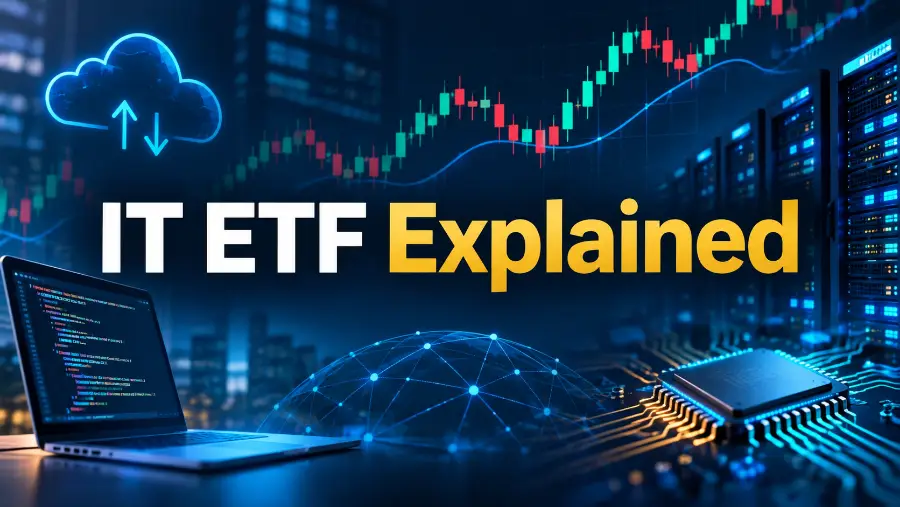
India’s information technology sector has long been an important part of the country’s stock market, supported by global demand for software development, IT services, cloud computing, cybersecurity and digital transformation. However, investing in individual IT companies requires investors to evaluate different business models, growth prospects and competitive positions. An IT Exchange Traded Fund (ETF) offers another way to participate in the sector without selecting individual stocks.
Nifty IT ETFs provide exposure to a basket of India’s leading listed technology companies through a single exchange-traded investment. Their performance is linked to the Nifty IT index, making them a convenient option for investors who want sector-specific exposure. Understanding their holdings, concentration, costs and risks is important before adding them to a portfolio.
In simple words
An IT ETF is a mutual fund scheme that invests in technology companies and trades on the stock exchange like an ordinary share. A Nifty IT ETF tracks the Nifty IT index, allowing investors to own exposure to multiple Indian IT companies through one investment.
What Is an IT ETF?
An IT ETF is a passive investment product designed to replicate the performance of an information technology stock index. In India, several ETFs track the Nifty IT Total Returns Index (TRI), which represents major listed IT companies on the National Stock Exchange.
Unlike actively managed technology funds, these ETFs do not attempt to identify stocks that will outperform the market. Instead, they follow the index composition and adjust their portfolios when the underlying index changes.
Investors can purchase ETF units through a demat and trading account during stock market hours. The price fluctuates throughout the trading session depending on the value of the underlying portfolio and market demand.
How Do Nifty IT ETFs Work?
The Nifty IT index follows a free-float market capitalisation-based methodology with periodic capping. Companies receive weight based on their eligible market capitalisation, subject to the index’s weight restrictions.
Also Read: Liquid ETF Explained: How Liquid ETFs Work in India, Returns, Risks and Who Should Buy Them
When investors purchase an IT ETF, the fund uses the collected money to invest in the companies represented in its benchmark index. The portfolio is periodically adjusted to reflect changes in index constituents and their respective weights.
For example, if Infosys and TCS account for significant portions of the index, they will generally represent substantial portions of the ETF portfolio.

The objective is to deliver returns broadly in line with the benchmark, after accounting for expenses and tracking differences.
Top Holdings of Nifty IT ETFs
The Nifty IT index consists of 10 companies representing different segments of India’s technology industry. These include traditional IT services providers, digital engineering businesses and specialised technology companies.
Also Read: Liquid ETF Explained: How Liquid ETFs Work in India, Returns, Risks and Who Should Buy Them
The major constituents include:
| Company | Approx. index weight |
|---|---|
| Infosys | 31.70% |
| TCS | 19.78% |
| HCL Technologies | 11.65% |
| Tech Mahindra | 10.46% |
| Coforge | 6.55% |
| Persistent Systems | 6.05% |
| Wipro | 4.94% |
| LTM | 3.61% |
| Mphasis | 3.07% |
| Oracle Financial Services Software | 2.19% |
Illustrative index weights based on October 2026 index data. Weights change periodically.
The portfolio is heavily influenced by large companies such as Infosys and TCS. Consequently, their performance can have a substantial impact on the ETF’s overall returns.
Advantages of Investing in IT ETFs
IT ETFs offer several benefits for investors seeking exposure to India’s technology industry.
- Diversification: One investment provides exposure to multiple listed IT companies instead of relying on a single stock.
- Convenience: Investors can buy and sell units through their trading accounts during market hours.
- Transparency: The underlying index and portfolio composition are publicly available.
- Lower management complexity: Passive investing removes the need for continuous individual stock selection.
- Sector participation: Investors can participate in the broader IT industry’s growth without managing multiple company investments.
However, diversification within one sector does not provide the same protection as holding stocks across different industries.
Risks of Investing in Nifty IT ETFs
The biggest risk is sector concentration. Unlike a Nifty 50 ETF, which spreads exposure across several industries, a Nifty IT ETF remains dependent on the technology sector.
Global economic conditions also influence Indian IT companies. Weak technology spending in the United States and Europe, delayed client projects and reduced discretionary budgets can affect revenue growth.
Currency movements create another important consideration. Indian IT companies earn a significant portion of their revenue from overseas markets. Changes in the rupee against the US dollar and other currencies can influence profitability.
Also Read: Railway and Capital Goods ETF Explained: How It Works, Holdings, Risks and Who Should Buy It
Other risks include:
- Automation and artificial intelligence disrupting traditional IT services.
- Rising competition from global technology companies.
- Pricing pressure and slower client spending.
- High valuations during periods of strong sector optimism.
- Tracking error and low trading liquidity in certain ETFs.
Investors should also understand that an ETF can experience substantial declines during prolonged IT sector downturns.
IT ETF vs Nifty 50 ETF
| Feature | Nifty IT ETF | Nifty 50 ETF |
|---|---|---|
| Exposure | IT sector | Multiple sectors |
| Diversification | Limited | Broader |
| Sector risk | High | Relatively lower |
| Investment approach | Sector-focused | Broad-market |
| Suitable role | Satellite allocation | Core allocation |
A Nifty 50 ETF can serve as a broader portfolio foundation, while an IT ETF can provide additional exposure to technology businesses.
Who Should Buy IT ETFs?
Nifty IT ETFs may suit investors who understand sector-specific risks and have a positive long-term view of India’s technology industry.
They can be considered by investors who already hold diversified equity investments and want to increase their exposure to IT companies. Investors who prefer passive strategies may also find these ETFs easier to manage than individual technology stocks.
However, they may not suit beginners looking for a single diversified equity investment, conservative investors or those who cannot tolerate significant sector-related volatility.
Before investing, compare expense ratios, tracking error, tracking difference, assets under management and average trading volumes. A lower expense ratio alone does not necessarily make an ETF the better choice. Investors should also check the difference between its market price and indicative net asset value.
Key Takeaways
- Nifty IT ETFs provide exposure to India’s leading listed technology companies through one investment.
- Infosys and TCS have significant influence on index performance.
- These ETFs offer convenience, transparency and sector diversification.
- Technology spending, currency movements and global economic conditions affect returns.
- IT ETFs are better considered as complementary investments rather than automatic replacements for diversified equity funds.
- Expense ratios, liquidity and tracking quality deserve attention before investing.
Financial Disclaimer: This article is for educational and informational purposes only and should not be considered investment advice. Mutual fund investments are subject to market risks. Investors should read scheme-related documents carefully and assess their financial goals, risk tolerance and investment horizon before investing.
Also Read: Bharat 22 ETF Explained: How It Works, Holdings, Risks and Who Should Buy It
Editorial data reference: Nifty IT index factsheet dated October 30, 2026, and published ETF portfolio disclosures. Nifty IT +2


Keep learning with OneTrader
Explore structured lessons and practical guides to build your market knowledge.

Need a laugh after all that money talk?
Paisa LOL: India's funniest finance page, with memes, comics, jokes and long funny stories.
