
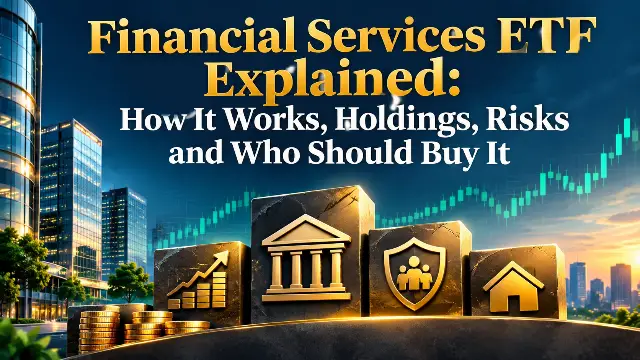
India’s financial sector sits at the centre of economic activity. Banks provide credit to households and businesses, insurers manage financial risks, housing finance companies support property ownership, and capital-market institutions connect investors with investment opportunities. A Financial Services Exchange-Traded Fund (ETF) allows investors to participate in this ecosystem through a single investment.
However, financial services ETFs are not the same as diversified market ETFs. Their performance depends heavily on lending growth, interest rates, asset quality, regulation and financial-sector valuations. Understanding these factors matters more than simply choosing a fund based on recent returns.
In simple words
A Financial Services ETF invests in a basket of listed financial companies by tracking a financial-sector index. Investors can buy and sell its units on stock exchanges like ordinary shares, gaining exposure to multiple financial businesses without purchasing each stock individually.
What Is a Financial Services ETF?
A Financial Services ETF is a passive investment fund designed to replicate the performance of a financial-sector benchmark, such as the Nifty Financial Services Total Return Index.
Unlike an actively managed mutual fund, where a fund manager selects companies based on research and expectations, an ETF generally follows predetermined index rules. Its objective is to track the benchmark rather than outperform it through stock selection.
Financial services ETFs can offer broader exposure than banking ETFs because their underlying indices may include insurance companies, non-banking financial companies (NBFCs), housing finance businesses and capital-market institutions alongside banks.
Nevertheless, a broader collection of financial businesses does not automatically create balanced exposure. Large banks can dominate the portfolio because index weights frequently depend on free-float market capitalisation.
Also Read: Liquid ETF Explained: How Liquid ETFs Work in India, Returns, Risks and Who Should Buy Them
How Is a Financial Services ETF Built?
An index provider first establishes eligibility rules covering factors such as company classification, listing history, liquidity and investable market capitalisation. Eligible financial-sector companies are selected and assigned weights according to the index methodology.
The ETF’s asset management company then purchases the underlying securities in proportions intended to closely match the benchmark. Larger index constituents generally receive larger allocations, subject to applicable index limits.
When the benchmark undergoes periodic rebalancing, the ETF adjusts its portfolio accordingly. Corporate actions, stock-price movements and changes in index composition can also alter portfolio weights.
ETF units are created and redeemed in large blocks through authorised participants or market makers using the fund’s prescribed creation and redemption mechanism. This process helps keep exchange-traded prices reasonably close to the underlying portfolio value.
Also Read: Liquid ETF Explained: How Liquid ETFs Work in India, Returns, Risks and Who Should Buy Them
Retail investors normally trade existing ETF units through their brokerage accounts rather than directly participating in this creation and redemption process.

What Companies Does a Financial Services ETF Hold?
The portfolio depends on the index being tracked. A typical Indian financial services benchmark may include established private banks, public sector banks, diversified lenders, insurance companies and other financial institutions.
Examples of financial-sector companies include HDFC Bank, ICICI Bank, State Bank of India, Axis Bank, Kotak Mahindra Bank, Bajaj Finance, Shriram Finance, Bajaj Finserv and SBI Life Insurance.
These are illustrative companies, not guaranteed holdings of every ETF. Investors should examine the latest portfolio disclosure to understand actual exposure.
| Financial segment | Important performance drivers |
|---|---|
| Private and public banks | Loan growth, deposits, margins and asset quality |
| NBFCs | Funding costs, lending demand and collections |
| Housing finance | Mortgage demand, borrowing costs and defaults |
| Insurance | Premium growth, persistency and investment income |
| Capital-market businesses | Trading volumes, investor participation and regulation |
The distinction matters because businesses within the same sector can respond differently to economic conditions. Banks may benefit from improving credit demand while insurers face pressure from claims or distribution expenses.
What Determines Financial Services ETF Returns?
Credit growth is an important driver. When businesses expand and households borrow for housing, vehicles or consumption, lenders can benefit from increased loan demand. However, aggressive lending can create problems if borrowers subsequently struggle with repayments.
Interest rates also influence profitability. Higher borrowing costs can pressure lending margins and credit demand, particularly for finance companies dependent on wholesale funding. Lower rates may support borrowing activity, although their effect on bank margins varies.
Asset quality deserves particular attention. Rising non-performing assets, higher credit costs and inadequate provisions can weaken profitability even when loan books continue growing.
Also Read: Railway and Capital Goods ETF Explained: How It Works, Holdings, Risks and Who Should Buy It
Financial-sector valuations provide another important consideration. Strong earnings growth does not guarantee attractive investment returns when shares already trade at demanding valuations.
Costs, Tracking Difference and Liquidity
Financial services ETFs generally have relatively low management expenses compared with many actively managed equity funds, but their total ownership cost extends beyond the expense ratio.
| Cost or measure | What investors should examine |
|---|---|
| Expense ratio | Annual fund operating expenses deducted from assets |
| Brokerage | Charges applied when purchasing or selling units |
| Bid-ask spread | Difference between the available buying and selling prices |
| Tracking difference | Gap between ETF returns and benchmark returns |
| Tracking error | Consistency of the ETF’s return differences from its benchmark |
| Premium or discount | Difference between market price and underlying NAV |
An ETF with a low expense ratio may still prove costly if trading volumes are thin and bid-ask spreads are wide.
For example, repeatedly buying and selling units can increase brokerage and spread costs. Long-term investors should therefore evaluate both recurring fund expenses and transaction costs.
Key Risks Investors Should Understand
Sector concentration is the biggest structural risk. Financial companies are interconnected through lending, funding markets and economic conditions. A broad deterioration in credit quality can affect several portfolio holdings simultaneously.
Concentration within the index creates another challenge. If large banks represent substantial index weight, their share-price movements can dominate ETF returns despite the presence of other financial businesses.
Regulatory changes involving lending practices, capital requirements, insurance distribution or financial-market operations can also affect profitability.
Liquidity risk deserves attention during volatile sessions. Thinly traded ETFs may experience wider spreads, making transactions more expensive.
Also Read: Bharat 22 ETF Explained: How It Works, Holdings, Risks and Who Should Buy It
Finally, passive investing does not provide downside protection. An ETF continues tracking its benchmark during market declines rather than shifting defensively into cash.
Who Should Buy a Financial Services ETF?
Financial services ETFs may suit investors with a long investment horizon, a positive but measured view of India’s financial-sector development, and an existing diversified equity portfolio.
They are better considered as satellite investments rather than the foundation of an equity portfolio. Investors already holding Nifty 50 or diversified equity funds should examine overlapping bank exposure before adding a sector ETF.
They may be unsuitable for investors requiring near-term liquidity, seeking capital protection or unwilling to tolerate prolonged sector underperformance.
Also Read: CPSE ETF Explained: How India’s PSU Enterprise ETF Works, Holdings, Risks and Who Should Buy It
An investor’s allocation should depend on overall portfolio concentration, financial goals and risk tolerance, not simply expectations of higher returns.
How to Buy a Financial Services ETF in India
Investors generally need a demat account and trading account with a registered broker. They can search for the ETF’s exchange symbol, review its benchmark and factsheet, and examine available market liquidity before placing an order.
A limit order allows investors to specify the maximum purchase price instead of accepting whatever price is available through a market order.
Before investing, compare the ETF’s expense ratio, tracking performance, underlying holdings, trading volumes and bid-ask spread. Also consider the indicative NAV where available.
After purchasing, review the investment periodically. Rebalancing may be appropriate if financial-sector exposure becomes disproportionately large relative to the overall portfolio.
Key Takeaways
- Financial Services ETFs provide diversified company exposure within a concentrated economic sector.
- Banks, NBFCs, insurers and housing finance businesses may form part of the portfolio.
- Credit growth, interest rates, asset quality and valuations influence returns.
- Expense ratios alone do not capture all ETF ownership costs.
- Sector ETFs generally work better as supplementary holdings alongside diversified investments.
- Investors should examine portfolio overlap, tracking performance and exchange liquidity before buying.
Financial Disclaimer
This article is intended for educational and informational purposes only. It does not constitute investment advice or a recommendation to buy or sell any security or ETF. Equity investments involve market risk, including potential capital loss. Investors should evaluate their financial goals, risk tolerance and investment horizon and consult a qualified financial adviser when necessary.

Keep learning with OneTrader
Explore structured lessons and practical guides to build your market knowledge.

Need a laugh after all that money talk?
Paisa LOL: India's funniest finance page, with memes, comics, jokes and long funny stories.
