
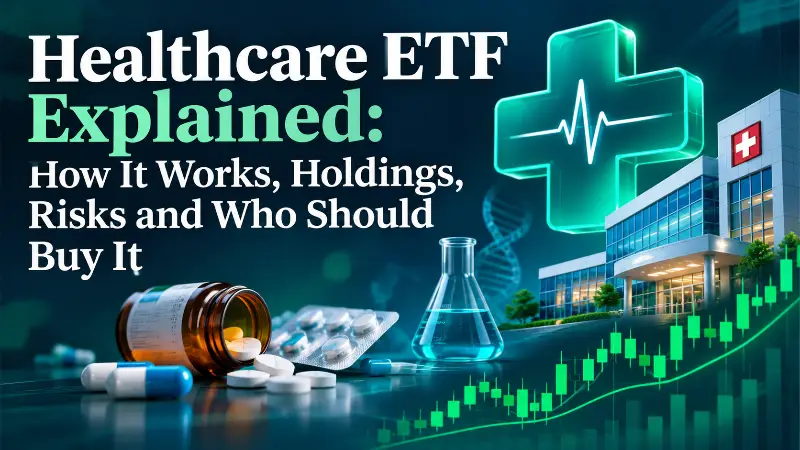
Healthcare is one of India’s important long-term growth sectors, supported by rising medical expenditure, increasing demand for quality healthcare, pharmaceutical innovation and expanding hospital infrastructure. For investors looking to participate in this growth, a Healthcare Exchange Traded Fund (ETF) offers an opportunity to invest in a basket of healthcare companies through a single stock exchange-listed investment.
However, healthcare is a broad industry covering pharmaceutical manufacturers, hospitals, biotechnology companies and healthcare service providers. Understanding what an ETF actually holds, how its benchmark works and what risks it carries is essential before investing.
In simple words
A Healthcare ETF invests in a basket of listed healthcare companies and aims to replicate the performance of a healthcare index. Instead of selecting individual pharmaceutical or hospital stocks, investors get exposure to multiple companies through one ETF. Its returns depend on the underlying stocks, expenses and tracking performance.
What Is a Healthcare ETF?
A Healthcare ETF is an exchange-traded fund that invests in companies operating in the healthcare industry. Most Indian healthcare ETFs follow a particular index, such as the Nifty Healthcare Index, and attempt to deliver returns similar to that benchmark, subject to tracking error.
Unlike actively managed mutual funds, these ETFs generally follow a passive investment strategy. The fund manager does not regularly select stocks based on personal market views. Instead, the portfolio is adjusted according to changes in the underlying index.
Investors can purchase and sell ETF units on the stock exchange during trading hours, just like shares. A demat and trading account is required.
How Does a Healthcare ETF Work?
The process is relatively straightforward. An index provider selects eligible healthcare companies based on its methodology, including factors such as market capitalisation, liquidity and sector classification.
Also Read: Liquid ETF Explained: How Liquid ETFs Work in India, Returns, Risks and Who Should Buy Them
The ETF invests in these companies in proportions designed to match the benchmark index. When constituent stocks increase in value, the ETF’s net asset value generally rises. When healthcare stocks decline, the ETF can lose value.
For example, if an ETF tracks an index containing pharmaceutical companies and hospital operators, its performance will reflect the combined movement of those businesses rather than the performance of one particular stock.
ETF investors should also understand three important terms:
- Expense ratio: The annual cost charged by the fund for managing the scheme.
- Tracking error: The difference in return behaviour between the ETF and its benchmark.
- Liquidity: How easily investors can buy or sell ETF units at reasonable prices.
What Does a Healthcare ETF Hold?
Healthcare ETFs in India typically provide exposure to several segments of the industry. However, the exact portfolio depends on the benchmark being tracked.
Also Read: Liquid ETF Explained: How Liquid ETFs Work in India, Returns, Risks and Who Should Buy Them

| Healthcare segment | Examples of business activities |
|---|---|
| Pharmaceuticals | Manufacturing and selling medicines |
| Biotechnology | Drug discovery and biological products |
| Hospitals | Multi-speciality and specialised healthcare services |
| Diagnostics | Medical testing and diagnostic services |
| Contract research | Clinical research and pharmaceutical development |
Some major Indian companies that investors may find in healthcare ETF portfolios include Sun Pharmaceutical Industries, Dr. Reddy’s Laboratories, Cipla, Divi’s Laboratories, Apollo Hospitals, Max Healthcare and Fortis Healthcare.
An important distinction is that not every healthcare ETF has identical holdings. A Nifty Healthcare ETF and a Nifty 500 Healthcare ETF can follow different indices and therefore offer different portfolio compositions.
Investors should examine the latest factsheet to understand the largest holdings, sector allocation and concentration in individual companies.
Why Do Investors Consider Healthcare ETFs?
India’s healthcare industry has several long-term growth drivers.
First, rising income levels and greater awareness of preventive healthcare are increasing demand for medical services. Second, India’s pharmaceutical industry has an established presence in domestic and international markets. Third, hospital chains are expanding their capacity to serve growing patient demand.
Biotechnology, specialised treatments, medical research and diagnostics also create opportunities for businesses operating across the healthcare ecosystem.
A Healthcare ETF allows investors to participate in these developments without having to identify individual winners. It also offers diversification across several companies within the selected index.
However, industry growth does not automatically translate into attractive stock returns. Valuations, competition and company-specific execution remain important.
Also Read: Railway and Capital Goods ETF Explained: How It Works, Holdings, Risks and Who Should Buy It
What Are the Risks of Healthcare ETFs?
Despite its growth potential, a Healthcare ETF is not a low-risk investment.
1. Sector concentration: Unlike a Nifty 50 ETF, a healthcare ETF concentrates its investments in one industry. A prolonged slowdown in healthcare stocks can affect the entire portfolio.
2. Regulatory risk: Pharmaceutical pricing restrictions, drug approval decisions and changes in healthcare regulations can influence company profitability.
3. Research and development risk: Drug development involves substantial investment, and unsuccessful trials or delayed approvals can hurt pharmaceutical companies.
4. Valuation risk: Popular healthcare companies can trade at expensive valuations. Even businesses with strong growth prospects can experience share price corrections.
5. Liquidity and tracking risk: Some ETFs have relatively low trading volumes. Wider bid-ask spreads can increase transaction costs, while tracking differences can reduce actual returns compared with the benchmark.
Investors should also remember that international exposure, currency movements and overseas regulatory requirements can affect companies with significant export operations.
Healthcare ETF vs Pharmaceutical ETF
These two investment categories are related but not identical.
Also Read: Bharat 22 ETF Explained: How It Works, Holdings, Risks and Who Should Buy It
| Feature | Healthcare ETF | Pharmaceutical ETF |
|---|---|---|
| Exposure | Broader healthcare industry | Pharmaceutical companies |
| Holdings | Pharma, hospitals and other healthcare businesses, depending on index | Primarily drug manufacturers |
| Diversification | Across eligible healthcare segments | Within pharmaceuticals |
| Main drivers | Healthcare spending and medical demand | Drug sales, research and exports |
A healthcare ETF may offer broader industry exposure, while a pharmaceutical ETF provides a more focused investment in drug manufacturing businesses.
Who Should Buy a Healthcare ETF?
Healthcare ETFs may suit investors who:
- Have a long-term investment horizon of at least five years.
- Want additional exposure to India’s healthcare industry.
- Already have a diversified core equity portfolio.
- Understand sector-specific volatility and concentration risk.
- Prefer passive investing rather than selecting individual healthcare stocks.
They may not be appropriate for investors seeking guaranteed returns, stable income or short-term capital protection.
For most investors, a broad-market index fund or diversified equity mutual fund is better suited to form the core of an equity portfolio. A Healthcare ETF can be considered as a supplementary sector allocation, depending on risk tolerance and overall portfolio exposure.
Also Read: CPSE ETF Explained: How India’s PSU Enterprise ETF Works, Holdings, Risks and Who Should Buy It
Before investing, compare expense ratios, assets under management, trading volumes, tracking differences, benchmark methodology and portfolio concentration. Also check whether the ETF consistently trades close to its indicative net asset value.
Key Takeaways
- Healthcare ETFs provide exposure to multiple healthcare companies through one exchange-traded investment.
- Holdings can include pharmaceutical manufacturers, hospitals, biotechnology and healthcare services.
- Different healthcare ETFs can follow different indices and have different portfolios.
- Sector concentration, regulation, valuations and liquidity are important risks.
- Healthcare ETFs are generally better suited to long-term investors with an existing diversified portfolio.
- Fund selection should consider costs, liquidity, tracking performance and underlying holdings.
Financial Disclaimer: This article is for educational purposes only and should not be considered investment advice. Healthcare ETFs are subject to market risks, including the possibility of capital loss. Investors should read the scheme information document and assess their financial objectives and risk tolerance before investing.



Keep learning with OneTrader
Explore structured lessons and practical guides to build your market knowledge.

Need a laugh after all that money talk?
Paisa LOL: India's funniest finance page, with memes, comics, jokes and long funny stories.
