
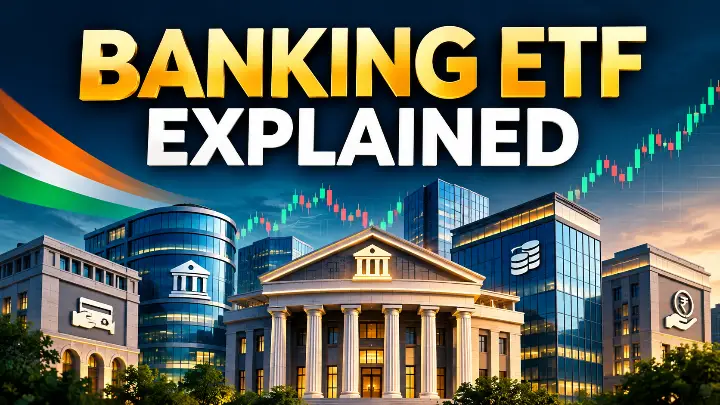
Banking is one of the most influential sectors in the Indian stock market. Banks play a central role in economic growth, credit expansion, deposits, consumption and business investment. Their performance can also influence the direction of benchmark indices, making the banking sector an important area for investors to understand.
For investors who want exposure to banking stocks without researching and purchasing individual bank shares, banking Exchange Traded Funds (ETFs) offer an alternative. These funds track banking-sector indices, allowing investors to participate in the performance of a group of listed banks through a single investment.
In simple words
A banking ETF is an exchange-traded fund that invests in a basket of banking stocks and aims to track a banking index. Instead of buying shares of individual banks such as HDFC Bank, ICICI Bank or SBI, investors can purchase one ETF unit to gain exposure to several banking companies.
What Is a Banking ETF?
A banking ETF is a type of passive investment fund that follows a banking-sector index. Its objective is to deliver returns broadly in line with the index it tracks, before expenses and tracking differences.
In India, banking ETFs commonly track indices such as the Nifty Bank. The fund holds shares of the banks included in its benchmark, generally in proportions reflecting their index weights.
Unlike actively managed mutual funds, these ETFs do not depend on a fund manager selecting stocks based on individual investment opinions. Their portfolios are designed to replicate the underlying index.
Banking ETFs are listed on stock exchanges, allowing investors to buy and sell units during market hours through a demat and trading account, just like shares.
Also Read: Liquid ETF Explained: How Liquid ETFs Work in India, Returns, Risks and Who Should Buy Them
How Does a Nifty Bank ETF Work?
The Nifty Bank index represents major and liquid banking companies listed on the National Stock Exchange. It provides a benchmark for understanding the performance of India’s banking industry.
A Nifty Bank ETF invests in the constituent stocks of this index. When banking shares rise collectively, the ETF’s value generally increases. When the underlying banking stocks decline, the ETF usually falls as well.
For example, if HDFC Bank and ICICI Bank account for relatively large portions of the index, their price movements can have a meaningful influence on the ETF. Smaller-weighted constituents generally have a comparatively lower impact.
The ETF attempts to mirror the index rather than outperform it. However, expenses, cash holdings, portfolio adjustments and trading differences can cause its returns to vary slightly from the benchmark.
Also Read: Liquid ETF Explained: How Liquid ETFs Work in India, Returns, Risks and Who Should Buy Them
What Stocks Do Banking ETFs Hold?
The holdings depend on the underlying index and the ETF’s portfolio. A Nifty Bank ETF typically provides exposure to large private-sector banks and public-sector lenders.
Common constituents include:

- HDFC Bank
- ICICI Bank
- State Bank of India
- Axis Bank
- Kotak Mahindra Bank
- IndusInd Bank
- Bank of Baroda
- Punjab National Bank
- Canara Bank
The index composition and weightings can change during periodic reviews. Investors should examine the latest portfolio disclosure rather than assume every banking ETF has identical holdings.
An important distinction is that a Nifty Bank ETF is not necessarily the same as an ETF tracking the broader financial services sector. The latter may also include insurance companies, non-banking financial companies and other financial businesses.
Banking ETF vs Individual Banking Stocks
Buying individual banking shares gives investors control over which institutions they own. However, it also requires company-level research into loan growth, asset quality, capital adequacy, profitability and management.
A banking ETF offers diversified exposure across multiple banks through one instrument. It reduces dependence on the performance of a single lender, although it does not eliminate sector-wide risk.
| Factor | Banking ETF | Individual bank stocks |
|---|---|---|
| Diversification | Multiple banks | Depends on holdings |
| Research | Index-based exposure | Company-level research |
| Management | Passive | Investor-controlled |
| Trading | Exchange-listed | Exchange-listed |
| Risk | Banking-sector concentration | Company and sector risks |
Advantages of Investing in Banking ETFs
Banking ETFs offer several practical advantages for investors seeking sector exposure.
Diversification within banking: Investors gain exposure to multiple lenders instead of depending entirely on one bank. Problems affecting an individual institution may have a smaller impact than in a concentrated single-stock portfolio.
Also Read: Railway and Capital Goods ETF Explained: How It Works, Holdings, Risks and Who Should Buy It
Convenient access: Buying one ETF unit provides exposure to a basket of banking stocks. Investors do not need to purchase every constituent separately.
Transparency: Passive ETFs disclose their underlying holdings and benchmark, making it easier to understand where the investment is allocated.
Lower research burden: Investors do not need to continuously evaluate every bank’s financial performance to maintain broad exposure to the sector.
Trading flexibility: ETF units can be bought and sold during exchange trading hours, subject to market liquidity and prevailing prices.
Risks of Banking ETFs
Despite their convenience, banking ETFs are not low-risk investments. Their performance depends heavily on the health of the banking industry and the broader economy.
Sector concentration: A banking ETF concentrates investment in one industry. Even though it holds multiple stocks, it does not provide the broad diversification of a Nifty 50 ETF.
Interest rate changes: Changes in interest rates can influence banks’ borrowing costs, lending margins, deposit rates and credit demand. The impact varies across institutions.
Asset quality deterioration: Rising bad loans and loan defaults can increase provisioning requirements and reduce banking profitability.
Also Read: Bharat 22 ETF Explained: How It Works, Holdings, Risks and Who Should Buy It
Economic slowdown: Weak economic activity can affect credit growth, repayment capacity and demand for loans, potentially putting pressure on banking stocks.
Concentration in large banks: Heavier index weightings in a few major lenders mean their performance can disproportionately influence ETF returns.
Tracking error and liquidity: Differences between ETF returns and index performance, along with low trading volumes or wide bid-ask spreads, can affect investor outcomes.
Banking ETF vs Nifty 50 ETF
A Nifty 50 ETF provides exposure to companies across several industries, including banking, information technology, energy, automobiles and consumer businesses.
Also Read: CPSE ETF Explained: How India’s PSU Enterprise ETF Works, Holdings, Risks and Who Should Buy It
A Nifty Bank ETF focuses specifically on banking companies. This makes it a more concentrated investment that may perform strongly during favourable banking cycles but can also experience sharper declines when the sector faces difficulties.
Investors seeking core equity exposure may prefer a diversified index ETF, while banking ETFs can serve as a supplementary sector allocation.
Who Should Invest in Banking ETFs?
Banking ETFs may suit investors who understand the banking sector and want to participate in its long-term growth without selecting individual lenders.
They may be considered by:
- Investors expecting sustained growth in India’s banking and credit markets.
- Long-term investors looking for targeted banking-sector exposure.
- Investors who already hold diversified equity funds and want a limited sector allocation.
- Experienced investors who understand sector cycles and can tolerate volatility.
However, beginners should be careful about making a banking ETF their primary equity investment. A sector-specific fund is generally better treated as a satellite allocation alongside diversified investments.
How to Choose a Banking ETF in India
Before investing, compare the following factors:
- Underlying index: Understand whether the ETF tracks Nifty Bank or another banking or financial services index.
- Expense ratio: Lower recurring costs can help improve long-term returns, all else being equal.
- Tracking error: Check how closely the ETF follows its benchmark.
- Assets under management: Larger funds may offer better trading activity, although size alone does not guarantee liquidity.
- Trading volume and spreads: Examine exchange liquidity to avoid unnecessary transaction costs.
- Portfolio holdings: Review the latest constituent weights and concentration.
Investors should also compare the ETF’s market price with its indicative or underlying net asset value before placing orders.
Key Takeaways
- Banking ETFs provide exposure to multiple banking stocks through one exchange-traded investment.
- Nifty Bank ETFs track the performance of a banking-sector index.
- Their returns depend on the performance of underlying banks, not the entire stock market.
- Diversification across banks does not eliminate sector concentration or economic risks.
- Expense ratio, tracking error, liquidity and index composition deserve attention.
- Banking ETFs are generally more suitable as a supplementary allocation than a replacement for a diversified equity portfolio.
Financial Disclaimer
This article is for educational purposes only and should not be considered investment advice or a recommendation to buy or sell any ETF or security. Investments in banking ETFs are subject to market risks, including sector concentration and volatility. Investors should assess their financial goals, risk tolerance and investment horizon before making investment decisions.
Also Read: Nifty 50 Equal Weight ETF Explained: How It Works, Holdings, Risks and Who Should Buy It




Keep learning with OneTrader
Explore structured lessons and practical guides to build your market knowledge.

Need a laugh after all that money talk?
Paisa LOL: India's funniest finance page, with memes, comics, jokes and long funny stories.
