
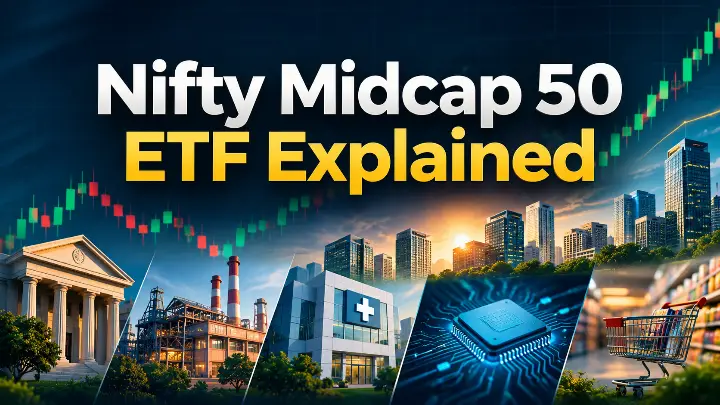
The Indian stock market offers investors several ways to participate in the growth of mid-sized companies. While large-cap stocks are generally associated with established businesses, mid-cap companies can offer exposure to businesses expanding their operations, entering new markets and building their competitive positions. However, identifying individual winners in this segment requires research, patience and the ability to handle considerable price fluctuations.
A Nifty Midcap 50 ETF offers an alternative. Instead of selecting individual mid-cap shares, investors can purchase a single exchange-traded fund that tracks 50 companies included in the Nifty Midcap 50 Index. It provides diversified exposure to a selected group of mid-sized businesses through one investment, although it does not eliminate the risks associated with equity markets.
In simple words
A Nifty Midcap 50 ETF is an exchange-traded fund that invests in companies belonging to the Nifty Midcap 50 Index. Buying one unit gives investors exposure to a basket of 50 mid-cap stocks without having to purchase each company separately.
What Is the Nifty Midcap 50 Index?
The Nifty Midcap 50 Index is designed to represent a segment of India’s mid-cap stock market. It consists of 50 companies selected from the Nifty Midcap 150 universe, with selection based on market capitalisation and liquidity-related criteria. Preference is also given to companies whose stocks are available for derivatives trading on the NSE.
The index follows a free-float market capitalisation weighting methodology. This means companies with larger publicly available shareholdings generally receive higher weights in the index. Consequently, the performance of larger constituents can have a greater influence on the overall index movement.
The index undergoes periodic rebalancing, helping its composition reflect changes in company size, liquidity and eligibility. It is important to understand that the Nifty Midcap 50 is a focused selection of 50 mid-cap companies, not the entire mid-cap market.
How Does a Nifty Midcap 50 ETF Work?
A Nifty Midcap 50 ETF is a passive investment product designed to replicate the composition and performance of its underlying index.
Also Read: Liquid ETF Explained: How Liquid ETFs Work in India, Returns, Risks and Who Should Buy Them
The fund house collects money from investors and uses it primarily to purchase the stocks included in the Nifty Midcap 50 Index in approximately the same proportions as their index weights. When the index changes its constituents or adjusts stock weights, the ETF also makes corresponding portfolio changes.
Unlike a conventional mutual fund, an ETF trades on the stock exchange throughout market hours. Investors can purchase or sell units through a demat and trading account, just like ordinary shares.
For example, if an investor wants exposure to all 50 companies, purchasing an ETF unit provides indirect participation in the entire portfolio through a single transaction.
However, the ETF’s market price can differ slightly from its net asset value (NAV). Trading liquidity, demand and supply, transaction costs and market conditions can influence this difference.
Also Read: Liquid ETF Explained: How Liquid ETFs Work in India, Returns, Risks and Who Should Buy Them
Nifty Midcap 50 ETF Holdings: Which Companies Are Included?
The ETF holds companies representing different parts of India’s economy. Its portfolio can include businesses from banking, financial services, pharmaceuticals, automobiles, capital goods, technology, consumer products and other industries.
Some companies that have featured among the index constituents include:

- BSE Ltd.
- Federal Bank
- Multi Commodity Exchange of India
- Hero MotoCorp
- Suzlon Energy
- PB Fintech
- Lupin
- AU Small Finance Bank
- Bharat Heavy Electricals
- Persistent Systems
These are examples of constituents, not a permanent list. Companies and their portfolio weights can change during index rebalancing.
The sector allocation is another important consideration. Financial services, industrial businesses, healthcare and other sectors can have meaningful representation. Therefore, investors should examine the latest portfolio and sector allocation before investing rather than assuming that the ETF provides equal exposure to every industry.
Benefits of Investing in a Nifty Midcap 50 ETF
1. Exposure to mid-cap growth: Investors gain access to businesses that may benefit from India’s economic expansion, increasing consumption, infrastructure investment and industrial development.
2. Diversification: The ETF spreads investments across 50 companies instead of concentrating the entire investment in one or two individual stocks.
3. Lower-cost passive investing: Since the fund follows an index rather than relying on active stock selection, its operating expenses can be relatively competitive.
4. Transparency: Investors can examine the underlying index constituents, portfolio allocation and fund performance.
Also Read: Railway and Capital Goods ETF Explained: How It Works, Holdings, Risks and Who Should Buy It
5. Exchange-traded flexibility: ETF units can be bought and sold during trading hours, providing flexibility compared with traditional mutual fund transactions.
Risks of Nifty Midcap 50 ETFs
Despite their advantages, mid-cap ETFs are not low-risk investments.
Higher volatility: Mid-cap companies can experience sharper price movements than established large-cap businesses. During market corrections, these stocks can fall substantially.
Valuation risk: Popular mid-cap companies may trade at expensive valuations. Even businesses with strong growth prospects can deliver disappointing investment returns when purchased at excessive prices.
Concentration risk: Although the ETF holds 50 stocks, investments are weighted by free-float market capitalisation. Larger companies and certain sectors can therefore influence performance disproportionately.
Liquidity risk: Some ETF units may have limited trading volumes. Wide bid-ask spreads can increase the actual cost of buying or selling units.
Tracking difference: The ETF may not deliver exactly the same returns as its benchmark because of expenses, cash holdings, transaction costs and portfolio replication differences.
Market risk: There is no capital protection. Investors can lose money, particularly when they need to sell during an unfavourable market period.
Also Read: Bharat 22 ETF Explained: How It Works, Holdings, Risks and Who Should Buy It
Nifty Midcap 50 ETF vs Nifty Midcap 150 ETF
Both products provide exposure to mid-cap companies, but their underlying indices differ.
| Particulars | Midcap 50 ETF | Midcap 150 ETF |
|---|---|---|
| Underlying index | Nifty Midcap 50 | Nifty Midcap 150 |
| Number of stocks | 50 | 150 |
| Portfolio breadth | Narrower | Broader |
| Company selection | Selected mid-cap companies | Wider mid-cap universe |
| Diversification | Relatively concentrated | More diversified |
A Midcap 50 ETF offers exposure to a smaller selection of companies, whereas a Midcap 150 ETF spreads investments across a broader range of businesses. Neither automatically guarantees better returns. The choice depends on an investor’s preferred exposure and risk tolerance.
How to Choose the Right Nifty Midcap 50 ETF
Before investing, compare the following factors:
- Expense ratio: Check the annual operating cost. Lower expenses can improve long-term returns when other factors are comparable.
- Tracking difference: Examine how closely the ETF has followed its benchmark over different periods.
- Tracking error: Lower tracking error generally indicates more consistent index replication.
- Trading liquidity: Check average trading volumes and bid-ask spreads to avoid unnecessary transaction costs.
- Fund size: Consider assets under management and the fund’s operational track record.
- Premium or discount to NAV: Avoid paying an excessive premium over the underlying portfolio value.
Investors should also review the latest factsheet and portfolio disclosures rather than making decisions based only on recent returns.
Also Read: CPSE ETF Explained: How India’s PSU Enterprise ETF Works, Holdings, Risks and Who Should Buy It
Who Should Buy a Nifty Midcap 50 ETF?
A Nifty Midcap 50 ETF may suit investors who want long-term exposure to India’s mid-cap segment without researching and purchasing individual stocks.
It can be considered by investors with a relatively long investment horizon, the ability to tolerate market corrections and an existing diversified equity portfolio.
However, it may not be appropriate for investors who need their money within a short period, cannot tolerate significant fluctuations or are looking for guaranteed returns.
Investors who already have substantial exposure to mid-cap mutual funds should also examine portfolio overlap before adding another mid-cap investment.
For beginners, allocating a smaller portion of the overall equity portfolio to mid-caps while maintaining a broader large-cap or diversified equity allocation can help manage concentration risk.
Key Takeaways
- Nifty Midcap 50 ETFs provide exposure to 50 selected Indian mid-cap companies.
- They follow a passive investment strategy based on the underlying index.
- Investors can purchase and sell units through a stock exchange.
- Mid-cap exposure offers growth opportunities but comes with higher volatility.
- Expense ratio, tracking difference, liquidity and NAV premiums deserve attention.
- These ETFs are better suited to investors with long investment horizons and higher risk tolerance.
A Nifty Midcap 50 ETF can be a useful component of a diversified equity portfolio. However, investors should understand its concentrated mid-cap exposure and avoid treating recent market performance as a guarantee of future returns.
Financial Disclaimer
This article is intended for educational and informational purposes only and should not be considered investment advice. Mutual funds and ETFs are subject to market risks. Investors should read the relevant scheme documents, evaluate their financial objectives and risk tolerance, and consult a qualified financial adviser before making investment decisions.
Also Read: Nifty 50 Equal Weight ETF Explained: How It Works, Holdings, Risks and Who Should Buy It




Keep learning with OneTrader
Explore structured lessons and practical guides to build your market knowledge.

Need a laugh after all that money talk?
Paisa LOL: India's funniest finance page, with memes, comics, jokes and long funny stories.
