
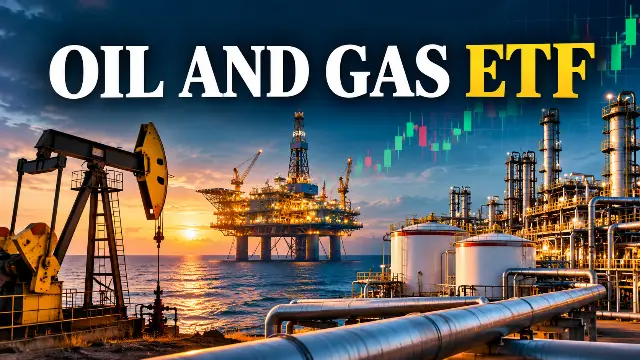
Oil and gas remain central to the global economy, powering transportation, manufacturing, electricity generation and countless industrial activities. Despite the gradual shift towards renewable energy, demand for conventional energy continues to influence economic growth, inflation, corporate profitability and financial markets. This makes the energy sector an important area for investors to understand.
For investors who want exposure to the oil and gas industry without researching and purchasing individual energy stocks, an Oil and Gas Exchange Traded Fund (ETF) offers a convenient alternative. These funds provide access to multiple companies through a single investment, although their performance depends on the underlying businesses, commodity prices and broader market conditions.
In simple words: An Oil and Gas ETF invests in a basket of companies involved in oil exploration, production, refining, transportation and natural gas distribution. Instead of purchasing individual energy stocks, investors can own ETF units representing exposure to several businesses in the industry.
What Is an Oil and Gas ETF?
An Oil and Gas ETF is an exchange-traded investment fund that tracks an index representing companies operating in the energy industry. In India, such funds can follow indices covering businesses across the domestic oil and gas value chain.
Rather than depending on a fund manager to select stocks actively, most sector ETFs follow a passive investment approach. They aim to replicate the performance of their underlying index by holding its constituent shares in corresponding proportions.
For example, an investor purchasing an Oil and Gas ETF may indirectly gain exposure to exploration companies, integrated energy businesses, petroleum refiners and natural gas distributors through one investment.
How Do Oil and Gas ETFs Work?
An Oil and Gas ETF collects money from investors and uses it to purchase shares of companies included in its benchmark index. The fund creates units representing ownership in its portfolio and lists them on stock exchanges.
Investors can purchase and sell these units through a trading and demat account during market hours, similar to buying regular shares. The ETF’s market price changes throughout the session according to movements in its underlying holdings and market demand.
Also Read: Liquid ETF Explained: How Liquid ETFs Work in India, Returns, Risks and Who Should Buy Them
The fund attempts to deliver returns close to its benchmark, but expenses, cash holdings, transaction costs and portfolio adjustments can create tracking differences.
What Companies Do Oil and Gas ETFs Hold?
The underlying index determines the companies included in an ETF. A typical Indian oil and gas portfolio can cover several segments of the industry.
| Industry segment | Business activity |
|---|---|
| Exploration and production | Discovering and extracting crude oil and natural gas |
| Refining | Converting crude oil into petrol, diesel and other petroleum products |
| Integrated energy | Operating across multiple stages of the energy value chain |
| Gas distribution | Supplying natural gas to households, industries and vehicles |
| Pipelines | Transporting oil and gas across regions |
| Oil marketing | Distributing and selling petroleum products |
The allocation is not necessarily equal. Market-capitalisation-based indices generally assign larger weights to companies with higher eligible market values, subject to their index methodology and applicable weight limits.
Consequently, a few large companies can influence the ETF’s performance significantly. Investors should examine the latest portfolio and benchmark methodology rather than assuming equal exposure across all segments.

Also Read: Liquid ETF Explained: How Liquid ETFs Work in India, Returns, Risks and Who Should Buy Them
What Factors Affect Oil and Gas ETF Performance?
Several interconnected factors influence the performance of energy-sector ETFs.
Crude oil prices: Higher crude prices can improve the earnings prospects of certain exploration and production businesses. However, refiners and fuel retailers may face higher input costs or pressure on margins, depending on pricing conditions.
Natural gas demand: Industrial consumption, electricity generation, household connections and transportation requirements influence the prospects of gas-related businesses.
Government policies: Fuel pricing regulations, taxation, subsidies, environmental rules and energy policies can directly affect operating margins and business expansion.
Global economic growth: Strong industrial activity and transportation demand can support energy consumption, while economic slowdowns may weaken commodity demand.
Geopolitical developments: International conflicts, sanctions and supply disruptions can cause sudden changes in crude oil and natural gas prices.
Major Benefits of Oil and Gas ETFs
Oil and Gas ETFs offer several advantages for investors seeking sector exposure.
- Diversification within the industry: One investment provides exposure to multiple energy companies instead of depending on a single stock.
- Convenience: Investors can access several segments of the oil and gas industry through exchange-traded units.
- Transparency: Portfolio holdings and index information help investors understand where their money is invested.
- Trading flexibility: ETF units can be bought or sold during market hours.
- Potential income: Some underlying energy companies distribute dividends, although distributions from the ETF depend on its structure and policy.
However, diversification across energy companies does not eliminate the risks associated with investing in a single industry.
Also Read: Railway and Capital Goods ETF Explained: How It Works, Holdings, Risks and Who Should Buy It
Risks of Investing in Oil and Gas ETFs
Oil and gas investments can experience substantial volatility. Commodity price movements, regulatory decisions and international developments can affect company earnings and valuations.
Sector concentration is another important concern. An ETF tracking a narrowly defined energy index may remain heavily exposed to a handful of large companies.
There is also tracking error risk, where the ETF’s returns differ from its benchmark. Low trading volumes can create wider bid-ask spreads, increasing transaction costs for investors.
The long-term energy transition presents an additional challenge. Renewable energy adoption, electric mobility and changing environmental regulations could influence the future growth prospects of traditional oil and gas businesses.
Oil and Gas ETF vs Crude Oil ETF
These two investment products are not interchangeable.
| Feature | Oil and Gas ETF | Crude Oil ETF |
|---|---|---|
| Investment exposure | Energy company shares | Usually crude oil futures |
| Main performance drivers | Company earnings and valuations | Oil futures prices |
| Dividends | Possible | Generally not from commodity exposure |
| Additional risks | Equity and sector risks | Futures rollover and tracking risks |
| Typical use | Sector investment | Commodity price exposure |
Futures-based products can experience rollover costs when replacing expiring contracts. Consequently, their returns may differ significantly from the movement in spot crude oil prices, particularly over longer periods.
Who Should Buy Oil and Gas ETFs?
Oil and Gas ETFs may suit investors who understand commodity-related businesses and want dedicated exposure to the energy sector.
They can be considered by investors with a longer investment horizon, an ability to tolerate sector-specific volatility and an existing diversified portfolio. Investors expecting energy demand to remain relevant during economic expansion may also find this category worth researching.
Also Read: Bharat 22 ETF Explained: How It Works, Holdings, Risks and Who Should Buy It
However, these funds are generally better treated as satellite investments rather than replacements for diversified equity index funds. Investors seeking predictable returns, capital protection or short-term liquidity should carefully consider whether the sector’s volatility matches their requirements.
Before investing, compare the underlying index, top holdings, expense ratio, tracking difference, trading liquidity and portfolio concentration.
Key Takeaways
- Oil and Gas ETFs provide exposure to multiple energy companies through a single exchange-traded investment.
- Their holdings can include exploration companies, refiners, integrated energy businesses and gas distributors.
- Crude prices, natural gas demand, government policies and global economic conditions influence performance.
- These ETFs carry sector concentration and commodity-related risks.
- Oil and Gas ETFs are different from futures-based crude oil investment products.
- Investors should consider them as part of a diversified portfolio rather than relying on them as a standalone investment.
Financial Disclaimer: This article is for educational purposes only and should not be considered investment advice or a recommendation to buy or sell any ETF. Investments in equity markets and sector-specific funds are subject to market risks. Investors should evaluate their financial goals, risk tolerance and investment horizon before making investment decisions.
Also Read: CPSE ETF Explained: How India’s PSU Enterprise ETF Works, Holdings, Risks and Who Should Buy It




Keep learning with OneTrader
Explore structured lessons and practical guides to build your market knowledge.

Need a laugh after all that money talk?
Paisa LOL: India's funniest finance page, with memes, comics, jokes and long funny stories.
