
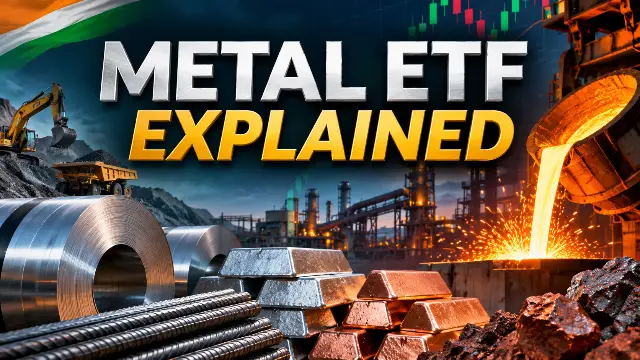
Metal stocks occupy an important position in India’s industrial and economic growth story. From steel and aluminium to copper, zinc and iron ore, these businesses supply essential materials to infrastructure, construction, automobiles, manufacturing and renewable energy industries. When demand for these materials rises, metal companies can benefit from higher production, improved realisations and stronger profitability. However, investing in individual metal stocks requires understanding their businesses and exposure to commodity cycles.
A Nifty Metal ETF offers investors another way to participate in this sector without selecting individual companies. Instead of purchasing shares of several metal manufacturers and mining companies separately, investors can buy a single exchange-traded fund that follows the Nifty Metal Index. Understanding its holdings, market behaviour and risks is important before adding this sector-focused investment to a portfolio.
In simple words
A Metal ETF is an exchange-traded fund that invests in a basket of metal and mining companies. A Nifty Metal ETF tracks the Nifty Metal Total Returns Index, providing exposure to multiple businesses through one investment. Its performance depends largely on the underlying companies and the broader metals industry.
What Is a Metal ETF?
A Metal ETF is a passive investment product designed to replicate the performance of a metal-sector stock market index. In India, Nifty Metal ETFs generally track the Nifty Metal Total Returns Index, which represents listed companies operating in the metals and mining industry.
Unlike actively managed mutual funds, these ETFs do not depend on a fund manager selecting stocks based on individual market predictions. Their objective is to maintain a portfolio that closely follows the underlying index.
Investors can purchase and sell ETF units through a stock exchange using a demat and trading account, just like ordinary shares. The market price changes throughout the trading session depending on demand, supply and the value of the underlying portfolio.
How Do Nifty Metal ETFs Work?
The Nifty Metal Index comprises up to 15 companies representing India’s metals and mining industry. Its constituents are selected using eligibility criteria and weighted primarily according to their free-float market capitalisation.
Also Read: Liquid ETF Explained: How Liquid ETFs Work in India, Returns, Risks and Who Should Buy Them
When an investor purchases a Nifty Metal ETF, the fund uses the collected money to invest in the index constituents in broadly similar proportions. The portfolio is periodically adjusted when the underlying index changes.
For example, if steel companies account for a significant portion of the index, the ETF will naturally have substantial exposure to steel manufacturers. If aluminium or mining companies gain weight, the fund’s portfolio adjusts accordingly.
The ETF aims to deliver returns close to its benchmark, although expenses, transaction costs and portfolio adjustments create differences.
Nifty Metal ETF Holdings: Which Companies Are Included?
The index provides exposure to different segments of the metals industry rather than concentrating exclusively on steel producers.
Also Read: Liquid ETF Explained: How Liquid ETFs Work in India, Returns, Risks and Who Should Buy Them
Typical constituents include:

| Company | Business exposure |
|---|---|
| Tata Steel | Steel manufacturing |
| Hindalco Industries | Aluminium and copper |
| JSW Steel | Steel manufacturing |
| Vedanta | Diversified metals and mining |
| Jindal Steel | Steel manufacturing |
| National Aluminium Company | Aluminium |
| NMDC | Iron ore mining |
| Hindustan Zinc | Zinc and silver |
| Hindustan Copper | Copper mining |
| APL Apollo Tubes | Steel tubes |
The actual holdings and weightages change following index reviews. Investors should examine the latest ETF factsheet before investing.
Importantly, a sector ETF does not provide equal exposure to every company. Larger constituents can influence overall performance considerably, making concentration an important consideration.
Why Do Investors Consider Metal ETFs?
The primary attraction is exposure to India’s industrial and infrastructure development without having to identify individual winners.
Growing infrastructure expenditure, housing construction, manufacturing expansion, automobile production and renewable energy installations can support demand for industrial metals.
Metal ETFs also offer diversification within the sector. Rather than depending entirely on one steel or aluminium company, investors gain exposure to several businesses with different operating characteristics.
Other advantages include exchange-traded liquidity, portfolio transparency and relatively straightforward access to a specialised industry.
However, diversification within one sector should not be confused with diversification across an entire investment portfolio.
Also Read: Railway and Capital Goods ETF Explained: How It Works, Holdings, Risks and Who Should Buy It
Major Risks of Investing in Metal ETFs
Metal ETFs can experience substantial price fluctuations because the underlying businesses operate in cyclical industries.
Commodity price volatility: International prices of steel, aluminium, copper and other metals influence company revenues and profitability. Falling commodity prices can negatively affect the entire sector.
Global economic slowdown: Weak industrial activity in major economies can reduce metal consumption, affecting Indian producers even when domestic demand remains relatively strong.
China’s influence: China plays a significant role in global metal production and consumption. Changes in its construction activity, industrial demand and export policies can influence international commodity prices.
High capital expenditure: Metal production requires substantial investments in factories, mining operations, machinery and infrastructure. High debt and rising financing costs can put pressure on profitability.
Sector concentration: A Metal ETF invests primarily in one industry. Therefore, it does not provide the broad diversification available through Nifty 50 or Nifty 500 ETFs.
Tracking and liquidity risks: Differences between the ETF and its benchmark can affect returns. Some ETFs may also experience lower trading volumes or market prices that differ from their indicative NAV.
Metal ETF vs Individual Metal Stocks
| Factor | Metal ETF | Individual metal stock |
|---|---|---|
| Investment exposure | Multiple companies | One company |
| Stock selection | Index-based | Investor decides |
| Company-specific risk | Comparatively diversified | Higher |
| Research requirement | Moderate | Higher |
| Trading | Stock exchange | Stock exchange |
A Metal ETF can simplify sector exposure, while individual stocks offer greater control over company selection and the potential to benefit from specific business developments.
Also Read: Bharat 22 ETF Explained: How It Works, Holdings, Risks and Who Should Buy It
Who Should Invest in Metal ETFs?
Metal ETFs may suit investors who understand commodity cycles and want dedicated exposure to India’s metals and mining industry.
They can also be considered by investors who expect long-term infrastructure and manufacturing growth but do not want to manage several individual metal stocks.
However, these products are generally better suited as satellite allocations rather than the foundation of a diversified investment portfolio. Investors should determine their allocation based on risk tolerance, investment horizon and existing exposure to cyclical businesses.
Short-term traders may also use Metal ETFs to participate in sector trends, although commodity-driven volatility can make timing difficult.
Also Read: CPSE ETF Explained: How India’s PSU Enterprise ETF Works, Holdings, Risks and Who Should Buy It
Investors seeking predictable returns, capital protection or regular income should approach these products cautiously.
How to Choose a Nifty Metal ETF
Before investing, compare the available ETFs using a few important parameters:
- Expense ratio: Lower recurring costs can help improve long-term net returns.
- Tracking error: Check how closely the ETF follows its benchmark.
- Tracking difference: Compare actual fund performance against the index over different periods.
- Trading liquidity: Examine average trading volumes and bid-ask spreads.
- Fund size: Consider the assets under management and the fund’s operating history.
- Portfolio holdings: Check the latest constituent allocation and concentration.
Investors should also compare the ETF’s market price with its indicative NAV rather than placing orders without considering the prevailing spread.
Key Takeaways
- Nifty Metal ETFs provide exposure to India’s metals and mining companies through one exchange-traded investment.
- Their performance follows the Nifty Metal Total Returns Index, subject to tracking differences and expenses.
- Holdings include steel, aluminium, copper, zinc and mining businesses.
- Commodity prices, global economic conditions and infrastructure demand influence returns.
- Sector concentration makes Metal ETFs riskier than diversified market index ETFs.
- Expense ratio, tracking error, liquidity and portfolio composition deserve attention before investing.
Metal ETFs offer a convenient way to participate in the metals industry, but their cyclical nature makes disciplined allocation essential. Investors should understand the risks, avoid excessive concentration and treat these funds as a specialised component of a broader investment strategy.
Financial Disclaimer: This article is for educational and informational purposes only and should not be considered investment advice. Investments in ETFs and equity markets are subject to market risks, including possible loss of capital. Investors should read the scheme documents carefully and evaluate their financial objectives and risk tolerance before investing.




Keep learning with OneTrader
Explore structured lessons and practical guides to build your market knowledge.

Need a laugh after all that money talk?
Paisa LOL: India's funniest finance page, with memes, comics, jokes and long funny stories.
