
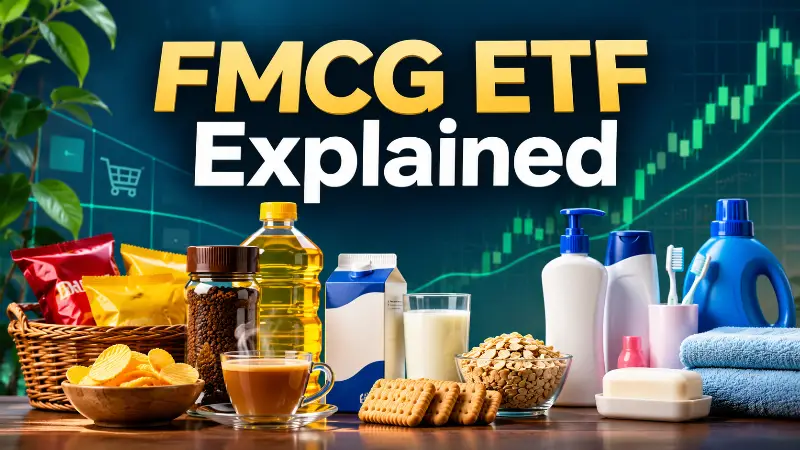
Fast-moving consumer goods (FMCG) companies occupy an important place in India’s economy. From packaged food and beverages to personal care, household products and everyday essentials, these businesses serve millions of consumers regardless of broader economic conditions. Their relatively consistent demand has made FMCG stocks an important consideration for investors seeking exposure to India’s consumption story.
An FMCG ETF offers a convenient way to invest in a basket of listed consumer goods companies without purchasing each stock individually. However, investing in a defensive sector does not automatically mean avoiding market losses. Understanding the ETF’s underlying holdings, concentration, valuation and investment risks is essential before committing money.
In simple words
An FMCG ETF is an exchange-traded fund that invests in companies operating in the fast-moving consumer goods sector. It allows investors to participate in the performance of multiple FMCG businesses through a single exchange-traded investment. Its returns depend on the underlying stocks, their valuations and the overall performance of the consumer sector.
What Is an FMCG ETF?
An FMCG ETF is a passive investment fund designed to track an FMCG-focused stock market index. In India, the Nifty FMCG Index is a commonly used benchmark for this investment theme.
The index represents listed companies involved in producing and selling everyday consumer products. It generally includes businesses from packaged foods, personal care, household products, beverages and other consumer categories.
Unlike a diversified equity ETF that spreads investments across several industries, an FMCG ETF concentrates its portfolio within one sector. This provides targeted exposure to consumer businesses but also increases sector-specific risk.
How Does an FMCG ETF Work?
An FMCG ETF collects money from investors and uses it to purchase shares of companies included in its underlying benchmark index. The fund attempts to replicate the index’s composition and performance.
Also Read: Liquid ETF Explained: How Liquid ETFs Work in India, Returns, Risks and Who Should Buy Them
For example, when an investor purchases units of an FMCG ETF through a stock exchange, the investment provides indirect exposure to several FMCG companies simultaneously.
These ETFs trade on stock exchanges like ordinary shares. Investors need a demat and trading account to purchase or sell units during market hours.
The fund’s value changes according to the prices of its underlying stocks. If the major companies in the index appreciate, the ETF generally benefits. Conversely, declining stock prices can reduce its market value.
FMCG ETF Holdings: Which Companies Are Included?
An FMCG ETF tracking the Nifty FMCG Index provides exposure to established Indian consumer businesses. The benchmark generally contains 15 companies selected using eligibility requirements and free-float market capitalisation.
Also Read: Liquid ETF Explained: How Liquid ETFs Work in India, Returns, Risks and Who Should Buy Them
Some prominent companies represented in this investment universe include:

| Company | Business segment |
|---|---|
| ITC | Consumer goods and packaged products |
| Hindustan Unilever | Personal care and household products |
| Nestlé India | Packaged foods |
| Britannia Industries | Biscuits and bakery products |
| Tata Consumer Products | Food and beverages |
| Varun Beverages | Beverages |
| Dabur India | Healthcare and personal care |
| Marico | Personal care and edible oils |
| Godrej Consumer Products | Household and personal care |
| Colgate-Palmolive | Oral care |
The exact holdings and weightages vary with index changes and fund portfolio adjustments.
A crucial point is that FMCG ETFs are not necessarily equally weighted. Larger companies can occupy significantly higher portfolio allocations, making their performance particularly influential.
Benefits of Investing in an FMCG ETF
1. Exposure to established consumer businesses
Investors gain access to companies with recognised brands, established distribution networks and recurring consumer demand.
2. Portfolio diversification within the sector
Instead of depending on one FMCG stock, investors gain exposure to multiple companies operating across different consumer categories.
3. Convenient stock market investment
Also Read: Railway and Capital Goods ETF Explained: How It Works, Holdings, Risks and Who Should Buy It
An ETF provides sector exposure through a single transaction. Investors do not need to research and purchase every underlying company separately.
4. Potential defensive characteristics
Demand for everyday essentials can remain relatively resilient during economic slowdowns. This can make FMCG companies comparatively defensive against some cyclical industries, although their share prices can still fall.
5. Transparent investment strategy
Passive ETFs follow a defined benchmark, making their investment approach relatively straightforward to understand.
Risks of FMCG ETFs
Despite their defensive reputation, FMCG ETFs carry meaningful investment risks.
Sector concentration: The portfolio remains dependent on one industry. Weak consumer spending or widespread pressure on FMCG companies can affect the entire ETF.
Valuation risk: Established consumer brands sometimes trade at premium valuations. Even fundamentally strong businesses can deliver disappointing returns when purchased at excessive prices.
Also Read: Bharat 22 ETF Explained: How It Works, Holdings, Risks and Who Should Buy It
Competition and changing preferences: New brands, private labels, changing consumer habits and aggressive pricing can affect established companies.
Input cost inflation: Higher prices for agricultural commodities, crude-linked materials, packaging and transportation can reduce profit margins.
Tracking error: An ETF may not perfectly replicate its benchmark because of expenses, cash holdings and portfolio adjustments.
Liquidity risk: Some ETFs have limited trading volumes. Investors should examine bid-ask spreads and avoid placing large market orders without checking liquidity.
Also Read: CPSE ETF Explained: How India’s PSU Enterprise ETF Works, Holdings, Risks and Who Should Buy It
FMCG ETF vs Individual FMCG Stocks
| Feature | FMCG ETF | Individual stocks |
|---|---|---|
| Investment | Basket of companies | One company |
| Diversification | Higher within the sector | Limited |
| Research required | Comparatively lower | Higher |
| Company-specific risk | Reduced | Higher |
| Returns | Sector performance | Company performance |
| Costs | Fund expenses and brokerage | Brokerage and other charges |
An ETF is useful for investors seeking broad sector exposure, while individual stocks offer greater control over company selection.
Who Should Buy an FMCG ETF?
FMCG ETFs may suit investors who:
- Want exposure to India’s consumer goods industry.
- Prefer passive investing over selecting individual stocks.
- Already hold diversified equity investments and want a sector allocation.
- Have a long-term investment horizon and can tolerate equity market volatility.
However, an FMCG ETF should not automatically become the core of an investor’s portfolio. A diversified equity fund or broad-market ETF generally provides wider exposure across industries.
Investors should also avoid concentrating their investments in multiple funds that hold substantially similar FMCG companies.
Key Takeaways
- FMCG ETFs provide exposure to a basket of listed consumer goods companies.
- The Nifty FMCG Index is an important benchmark for this investment category.
- Major holdings include businesses such as ITC, Hindustan Unilever, Nestlé India and Britannia.
- Sector concentration, expensive valuations and input cost inflation remain important risks.
- Investors should compare expense ratios, tracking differences, liquidity and portfolio holdings before selecting an ETF.
- FMCG ETFs are best considered as a sector allocation rather than a replacement for a diversified equity portfolio.
Financial Disclaimer
This article is for educational and informational purposes only and should not be considered investment advice. FMCG ETFs are subject to market risks, including sector concentration, valuation fluctuations and tracking differences. Investors should read the scheme information document and evaluate their financial objectives, risk tolerance and investment horizon before investing.



Keep learning with OneTrader
Explore structured lessons and practical guides to build your market knowledge.

Need a laugh after all that money talk?
Paisa LOL: India's funniest finance page, with memes, comics, jokes and long funny stories.
