
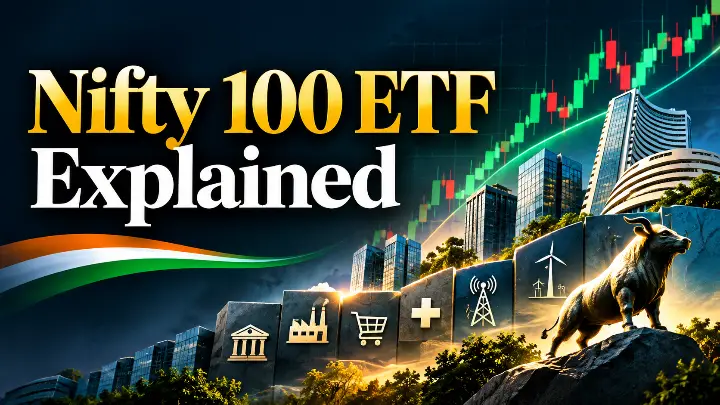
The Nifty 100 ETF gives investors exposure to 100 of India’s largest listed companies through a single exchange-traded investment. Instead of researching and purchasing individual shares, investors can buy units of a fund designed to track the Nifty 100 Index, covering businesses across banking, information technology, energy, automobiles, consumer goods and healthcare.
For long-term investors, this ETF offers a straightforward way to participate in India’s large-cap market. However, the number of companies alone does not determine diversification or investment quality. Understanding its index structure, sector concentration, costs and risks is essential before adding it to a portfolio.
In simple words
A Nifty 100 ETF is a listed investment fund that tracks an index of 100 large Indian companies. Investors buy and sell its units on the stock exchange, just like shares. It provides diversified large-cap exposure through one investment, but remains subject to stock market fluctuations.
What is the Nifty 100 Index?
The Nifty 100 is a broad-market index comprising 100 companies selected from the Nifty 500 universe. It combines the constituents of the Nifty 50 and Nifty Next 50, covering established market leaders as well as the next group of large businesses.
The index uses free-float market capitalisation weighting. This means companies receive weight according to the market value of shares available for public trading. Larger companies consequently have a greater influence on index performance. The index is reviewed periodically, allowing its constituents and weightings to change as businesses grow or fall in market value.
How does a Nifty 100 ETF work?
A Nifty 100 ETF is a passive investment fund that aims to replicate the performance of its benchmark. It generally purchases the index constituents in proportions similar to their respective index weights. When the index changes, the fund adjusts its portfolio accordingly.
Unlike actively managed funds, the ETF does not depend on a fund manager selecting stocks to outperform the market. Its objective is to deliver returns close to the benchmark, after accounting for expenses and tracking differences.
Also Read: Liquid ETF Explained: How Liquid ETFs Work in India, Returns, Risks and Who Should Buy Them
Investors purchase ETF units through a demat and trading account. Units are listed on a stock exchange and can be bought or sold during market hours. Their prices fluctuate according to market demand, supply and the value of the underlying portfolio.
Since ETFs trade like shares, investors should check the bid-ask spread, which represents the difference between buying and selling prices. A wider spread can increase transaction costs, particularly in ETFs with limited trading activity. Using limit orders can help investors control their execution price.
What does a Nifty 100 ETF hold?
The ETF aims to hold the companies included in the index, broadly following their market weightings. Its portfolio covers several important sectors, although allocations are not distributed equally. Financial services typically have a substantial presence, alongside energy, information technology, automobiles, consumer businesses, healthcare, metals and telecommunications.
Some prominent companies represented in the index include:

Also Read: Liquid ETF Explained: How Liquid ETFs Work in India, Returns, Risks and Who Should Buy Them
| Company | Business sector |
|---|---|
| HDFC Bank | Banking |
| ICICI Bank | Banking |
| Reliance Industries | Energy, retail and telecom |
| Bharti Airtel | Telecommunications |
| Larsen & Toubro | Engineering |
| Infosys | Information technology |
| State Bank of India | Banking |
| ITC | Consumer goods |
| Mahindra & Mahindra | Automobiles |
These are examples rather than a permanent list. Constituents and weightings change over time, so investors should examine the latest ETF factsheet before investing.
An important distinction is that 100 holdings do not mean 100 equal investments. Market-cap weighting gives larger companies greater influence. Consequently, the performance of a relatively small group of heavyweight stocks can significantly affect the ETF, particularly when financial services or other major sectors experience sharp movements.
Nifty 100 ETF versus Nifty 50 ETF
A Nifty 50 ETF tracks 50 large companies, whereas a Nifty 100 ETF includes those companies alongside the Nifty Next 50 constituents. The latter therefore provides exposure to a wider group of large Indian businesses.
The additional holdings can offer participation in companies that have not yet entered the top 50. However, broader coverage does not guarantee higher returns or lower risk. Performance depends on which group of companies leads the market during a particular period.
Investors should also distinguish the standard Nifty 100 from the Nifty 100 Equal Weight Index. The standard index assigns greater weights to larger companies, while the equal-weight version distributes exposure more evenly. Their sector allocations, volatility and returns can differ.
Costs and factors to compare before investing
The expense ratio represents the annual operating cost charged by the fund. It is reflected in the scheme’s NAV and directly affects investors’ returns over time. However, the expense ratio alone should not determine which ETF to choose.
Tracking difference measures how closely the fund’s actual returns match its benchmark over a period. Tracking error indicates how much that difference fluctuates. Both are important when comparing funds following the same index.
Before investing, examine these factors:
Also Read: Railway and Capital Goods ETF Explained: How It Works, Holdings, Risks and Who Should Buy It
- Expense ratio and historical tracking difference.
- Exchange trading volume and bid-ask spread.
- Assets under management and portfolio disclosures.
- Whether the ETF trades at a premium or discount to its underlying NAV.
A fund with a low expense ratio may still be less convenient if its exchange liquidity is poor. Investors should compare performance across multiple periods rather than selecting a scheme based only on recent returns.
Risks investors should understand
Market risk: The ETF is an equity investment. Its value can decline during market corrections, economic slowdowns, geopolitical uncertainty or periods of weak corporate earnings. Holding 100 companies cannot protect investors against a broad market decline.
Sector concentration: Financial services carry a substantial index weight. Weakness in banking and financial companies can therefore affect overall performance, even when other sectors remain relatively stable.
Company concentration: Market-cap weighting gives larger businesses greater influence. This means the portfolio may be more concentrated in heavyweight companies than the number of holdings initially suggests.
Tracking and liquidity risk: Fund expenses, cash balances, portfolio adjustments and transaction costs can create differences between ETF returns and benchmark performance. Limited exchange liquidity and wide bid-ask spreads can also increase buying and selling costs.
Investors should remember that equity ETFs are not suitable substitutes for emergency savings or money required in the near future. Market declines can last longer than expected, making investment horizon an important consideration.
Who should consider investing in a Nifty 100 ETF?
The Nifty 100 ETF may suit investors seeking long-term exposure to India’s large listed companies without researching individual stocks. It can serve as a core large-cap allocation for people who prefer passive investing and are comfortable with equity-market volatility.
It may also appeal to investors who want broader coverage than the Nifty 50 while remaining focused on large companies. A systematic investment approach can help spread purchases across different market conditions, although ETF units generally need to be purchased through the stock exchange rather than through the conventional mutual fund SIP process.
Also Read: Bharat 22 ETF Explained: How It Works, Holdings, Risks and Who Should Buy It
However, investors already holding Nifty 50 funds, large-cap mutual funds or several heavyweight index constituents should examine portfolio overlap. Adding another ETF with similar holdings may increase concentration rather than improve diversification.
The product is less appropriate for investors seeking guaranteed returns, capital protection or short-term liquidity. The right allocation depends on financial goals, existing investments, risk tolerance and the time available to remain invested.
Key Takeaways
- The Nifty 100 combines the Nifty 50 and Nifty Next 50, covering 100 large Indian companies.
- A Nifty 100 ETF tracks the index and trades on stock exchanges like an ordinary share.
- Holdings are weighted by free-float market capitalisation rather than equally.
- Financial services and heavyweight companies can significantly influence returns.
- Expense ratio, tracking difference and trading liquidity matter when selecting an ETF.
- It may suit long-term investors seeking passive large-cap exposure, but offers no capital protection.
Financial Disclaimer: This article is for educational and informational purposes only. It does not constitute investment advice or a recommendation to buy or sell any security or mutual fund. Mutual fund investments are subject to market risks, including possible loss of principal. Investors should read scheme documents carefully and assess their financial objectives, risk tolerance and investment horizon before investing.
Also Read: CPSE ETF Explained: How India’s PSU Enterprise ETF Works, Holdings, Risks and Who Should Buy It


Keep learning with OneTrader
Explore structured lessons and practical guides to build your market knowledge.

Need a laugh after all that money talk?
Paisa LOL: India's funniest finance page, with memes, comics, jokes and long funny stories.
