
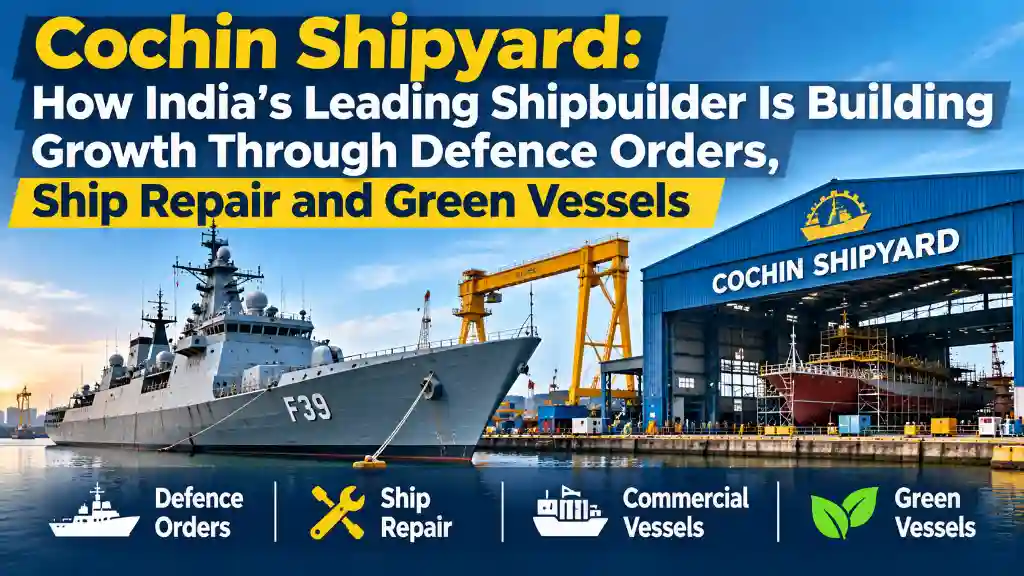
Explore Cochin Shipyard's defence order book, ship repair margins, commercial vessel contracts, green shipping technology, financial performance and ₹6,500
- Cochin Shipyard operates through two principal businesses: shipbuilding and ship repair.
- Cochin Shipyard’s unexecuted order book stands at approximately ₹21,900 crore.
- Ship repair is one of the most important opportunities in Cochin Shipyard’s business strategy.
Cochin Shipyard is one of India’s most important shipbuilding and ship repair companies, with operations spanning defence vessels, commercial ships, refits and vessel life extension. Incorporated in 1972 and headquartered in Kochi, the government-controlled company has Mini-Ratna status and has exported approximately 45 ships. Its position in the maritime industry is supported by its ability to build different types of vessels and undertake complex repair and maintenance projects.
The company’s growth strategy is evolving beyond conventional shipbuilding. A substantial defence order book provides long-term project visibility, while ship repair offers a higher-margin business opportunity. Cochin Shipyard is also exploring hybrid, methanol-capable and electric vessels as the global shipping industry moves towards cleaner technologies. Its challenge will be executing a large project pipeline while protecting profitability.
In simple words
Cochin Shipyard makes ships and repairs vessels for defence and commercial customers. Its growth opportunity comes from a strong order book, expanding ship repair operations and new-generation green vessels. Ship repair generates higher margins, while large shipbuilding contracts provide revenue visibility over several years.
Also Read: Vedanta: How Commodity Prices, Higher Volumes and Debt Reduction Drive Its Business
How Cochin Shipyard Makes Money
Cochin Shipyard operates through two principal businesses: shipbuilding and ship repair.
Shipbuilding involves constructing defence vessels and commercial ships for domestic and international customers. Ship repair includes refits, maintenance, re-powering and extending the operational life of existing vessels.
The company has developed capabilities across different vessel categories, giving it exposure to both government and commercial maritime demand. Its export experience also provides an opportunity to participate in international shipbuilding requirements.
| Business | Main activities | Management margin outlook |
|---|---|---|
| Shipbuilding | Defence and commercial vessels | 10-12% |
| Ship repair | Refits, repairs and life extension | 22-24% |
Management expects the long-term revenue mix to remain approximately 70% shipbuilding and 30% ship repair. The repair business is smaller but offers considerably higher margins, making it strategically important.
A Large Order Book Provides Revenue Visibility
Cochin Shipyard’s unexecuted order book stands at approximately ₹21,900 crore. Defence projects account for the largest portion, while commercial exports provide another significant growth opportunity.
| Order book category | Value |
|---|---|
| Defence | ₹11,900 crore |
| Domestic commercial | ₹1,600 crore |
| Commercial exports | ₹7,200 crore |
| Ship repair | ₹1,200 crore |
| Total | ₹21,900 crore |
The defence order book provides visibility over future execution, while commercial export contracts diversify the company’s customer base.
However, shipbuilding projects generally involve long execution periods. Revenue recognition, project costs and profitability can vary depending on construction milestones and delivery schedules.
Ship Repair Could Become a Major Profit Driver
Ship repair is one of the most important opportunities in Cochin Shipyard’s business strategy.

The segment contributed approximately one-third of FY26 operating revenue. Its higher margin profile makes it valuable for improving the company’s overall profitability.
Management has set a target of achieving ₹2,500 crore in ship repair revenue by 2029. To support this ambition, the company plans to invest in additional shipbuilding and ship repair capacity.
The higher profitability of repair work means that expanding this business could improve the company’s earnings quality even without shipbuilding becoming a substantially larger part of revenue.
Defence Orders Strengthen the Business Pipeline
Defence shipbuilding remains a core part of Cochin Shipyard’s operations. The company recently secured a ₹498 crore Ministry of Defence contract on November 11, 2026, for the refit and re-powering of INS Betwa, a Brahmaputra-class frigate.
Also Read: Siemens Energy India: How Power Transmission, Generation and Project Backlogs Drive Its Business
The project highlights the importance of maintenance and refit work alongside new vessel construction. Defence vessels require periodic maintenance and upgrades, creating opportunities beyond their original construction contracts.
With approximately ₹11,900 crore of defence orders in its unexecuted order book, the company has significant exposure to government maritime requirements.
However, dependence on large defence contracts also creates execution and order concentration risks.
Green Vessels and International Expansion
Cochin Shipyard is exploring opportunities in next-generation commercial vessels as shipping companies increasingly consider alternative propulsion technologies.
Also Read: Shree Cement: How Premium Products, Sales Growth and Cost Management Drive Its Business
On November 19, 2026, the company signed an agreement with Dutch shipbuilder Damen to explore hybrid, methanol-capable and electric vessels. The collaboration could help it develop capabilities in newer vessel technologies.
Another important commercial opportunity comes from CMA CGM. The company signed a letter of intent in October 2025 for six LNG-capable container vessels, with deliveries scheduled between 2029 and 2031.
Its subsidiary, Hooghly Cochin Shipyard, will also build two luxury river cruise vessels for Heritage River Journeys, expanding its participation in specialised passenger vessel construction.
These developments provide exposure to different maritime segments rather than relying entirely on conventional defence shipbuilding.
Technology and Manufacturing Capabilities
Cochin Shipyard’s collaboration with SFO Technologies resulted in the unveiling of India’s first indigenously designed Hybrid Laser Arc Welding technology.
The system combines a 12 kW fibre laser, a six-axis robotic arrangement and Metal Inert Gas welding. It can achieve welding speeds of up to two metres per minute.
This technology is relevant to shipbuilding because welding quality, production speed and manufacturing efficiency influence project execution. Developing advanced manufacturing capabilities can support the company’s competitiveness as it expands its production activities.
₹6,500 Crore Capex Plan to Expand Capacity
Cochin Shipyard plans to invest approximately ₹6,500 crore over the next three to five years to expand shipbuilding and ship repair capacity.
The investment is intended to support larger project execution, increase repair capabilities and prepare the company for future commercial and defence opportunities.
Also Read: PFC: How Power Sector Financing and Renewable Energy Loans Drive Its Business
Management targeted FY27 revenue growth of around 12%, with potential to reach 15%.
| Growth initiative | Target or investment |
|---|---|
| Planned capital expenditure | ₹6,500 crore |
| Investment period | 3-5 years |
| Ship repair revenue goal | ₹2,500 crore by 2029 |
| FY27 revenue growth target | Around 12% |
| Potential FY27 growth | Up to 15% |
The success of this expansion will depend on how efficiently the company converts new capacity into revenue and profits. Capital expenditure also needs to generate adequate returns over time.
Ownership, Valuation and Returns
Cochin Shipyard is government-controlled, with promoters holding 63.33% of the company as of September 2026. Its market capitalisation is approximately ₹30,000 crore.
Its return ratios indicate moderate capital efficiency.
Also Read: Muthoot Finance: How Gold Loans, Rising Gold Prices and Lending Growth Drive Its Business
| Metric | Value |
|---|---|
| Market capitalisation | Approximately ₹30,000 crore |
| Promoter holding | 63.33% |
| Return on Equity (ROE) | 11.2% |
| Return on Capital Employed (ROCE) | Approximately 14.5% |
These ratios are important when evaluating the company’s expansion plans. Investors should monitor whether higher capacity utilisation and the increasing contribution from ship repair translate into improved returns on capital.
Business Risks Investors Should Watch
Despite its large order book and expansion opportunities, Cochin Shipyard faces several business risks.
- Margin pressure: Rising project costs can reduce profitability when revenue growth does not keep pace.
- Defence order dependence: A significant portion of the order book comes from defence contracts, increasing exposure to government project awards and execution schedules.
- Lumpy execution: Large shipbuilding contracts take time to complete, creating fluctuations in quarterly revenue and earnings.
- Capital expenditure risk: The ₹6,500 crore investment programme requires disciplined execution and sufficient returns.
These factors make project execution, cost management and the changing revenue mix important indicators to follow.
Key Takeaways
- Cochin Shipyard operates in two major businesses: shipbuilding and ship repair.
- Its approximately ₹21,900 crore order book provides substantial project visibility.
- Defence orders remain a major source of business, while commercial exports diversify its opportunities.
- Ship repair offers higher margins of 22-24%, compared with 10-12% for shipbuilding.
- The company aims to achieve ₹2,500 crore in ship repair revenue by 2029.
- Its ₹6,500 crore capex programme is designed to expand capacity and support future growth.
- Hybrid, methanol-capable and electric vessels provide exposure to emerging maritime technologies.
- Profitability remains a key concern, particularly when shipbuilding costs rise or project execution is delayed.
Financial Disclaimer: This article is intended for educational and informational purposes only. It does not constitute investment advice or a recommendation to buy, sell or hold Cochin Shipyard shares. Investors should independently evaluate the company’s financial performance, valuation, order book, execution risks and investment objectives before making any investment decision.
Also Read: Mazagon Dock: How Warships, Submarines and Defence Shipbuilding Drive Its Business








Keep learning with OneTrader
Explore structured lessons and practical guides to build your market knowledge.

Need a laugh after all that money talk?
Paisa LOL: India's funniest finance page, with memes, comics, jokes and long funny stories.
