
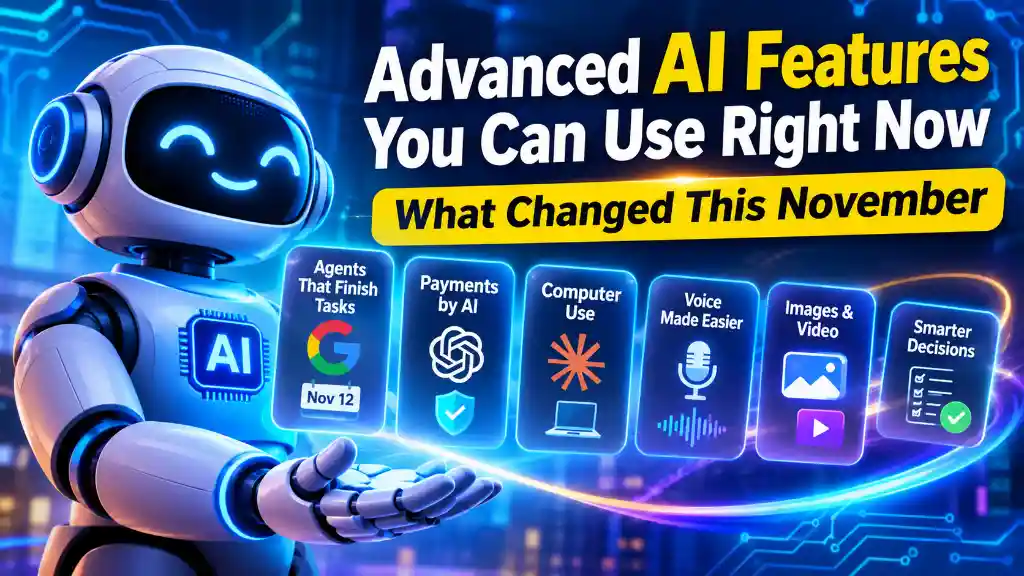
Artificial intelligence is moving beyond answering questions and generating text. In November 2026, major technology companies introduced features that allow AI assistants to make phone calls, operate desktop applications, handle payments, participate in meetings and complete multi-step tasks with less human intervention.
The latest developments from Google, OpenAI and Anthropic show how quickly AI is becoming part of everyday digital activities. Some features are already rolling out in India, while others remain limited to selected markets, business customers or beta users. Here are the important AI developments worth knowing this month.
In simple words
AI assistants are increasingly becoming digital agents that can take action instead of simply providing information. They can now perform tasks, interact with applications, process payments with security checks and create richer multimedia content.
Also Read: Ethereum News Today: Chainflip Loses $4.86 Million in Exploit as Security Concerns Hit DeFi
1. Google Gemini Can Make Calls and Complete Tasks
One of November’s most significant developments is Google’s upgraded Gemini experience, powered by Gemini 4 Hydrogen.
Launched on November 12, Gemini 4 Hydrogen is designed as a fast model for everyday coding and agent-based work, replacing Gemini 3.8 Flash. It is available across the Gemini app, Search, Sheets and Google’s business products.
One particularly interesting capability allows Gemini to call businesses to book appointments. The assistant identifies itself as AI before proceeding with the conversation. It can also help users pay bills and complete other tasks.
The rollout is free in India, the US, Canada, Japan, South Korea and Australia. However, some advanced capabilities are launching in the US first.
Also Read: Copper and Aluminium Extend Weekly Losses as Strong Dollar and AI Spending Worries Weigh on Metals
Google expanded its agent capabilities again on November 20, introducing a Gemini agent that can operate applications on a Mac. This moves Gemini further towards becoming an assistant capable of interacting directly with desktop software.
2. OpenAI Introduces AI-Powered Payments
OpenAI is taking another step towards autonomous AI agents with ChatGPT Wallet, launched on November 13.
The feature allows AI agents to make payments using payment tokens without accessing the user’s actual card number. A Face ID check is required for every purchase, adding an additional layer of authentication.
This development is important because payment capability could allow AI agents to move beyond research and recommendations towards completing transactions.
Also Read: Crude Oil Posts Third Weekly Decline as Strong Middle East Supply Outweighs Geopolitical Risks
OpenAI also began a beta rollout of Businesses in ChatGPT on November 10. It includes a Business Hub where businesses can claim their listings, alongside business agents designed for US stores.
Together, these developments point towards a future in which customers can discover businesses and complete purchases through AI-powered interfaces.
3. Anthropic Claude Can Operate Desktop Applications
Anthropic introduced a major computer-use capability for Claude on November 20.
Claude can now see a user’s screen and work within desktop applications that the user allows. The capability is available in beta for Team and Enterprise plans.

This means Claude can interact with permitted applications rather than being restricted to a conventional chat interface.
Another development arrived on November 12 with Claude Meetings, which entered beta. Claude can join Google Meet as a visible participant.
Anthropic also released Claude Fable 5.2 and Claude Mythos 5.2 on November 9 for difficult technical tasks, with agent orchestration built in.
For businesses that want greater control over their infrastructure, the company opened a private beta of self-hosted Claude Managed Agents on November 12. These agents run in the customer’s own cloud environment.
Also Read: Bitcoin News Today: BTC Reclaims $60,000 as Whales Withdraw More Than $1 Billion From Exchanges
4. ChatGPT Makes Voice Dictation More Practical
OpenAI introduced ChatGPT Live Dictation on November 20, making voice-based interactions more convenient.
The feature transcribes speech as users talk and displays editable text before submission. Importantly, it removes the previous 10-minute recording limit.
Live Dictation is rolling out globally across plans, making it useful for longer conversations, notes and instructions.
OpenAI has also made its GPT-Live-1.1 voice model available through its API. The model offers more consistent accents and a lower-cost standby mode.
These improvements could make voice a more practical way to interact with AI, particularly when typing is inconvenient.
5. Faster AI Image and Video Generation
AI-generated images and videos also received important improvements this month.
ChatGPT Images 2.6 reduced rendering times by approximately 50%. It also introduced vector SVG export, looping GIF creation and markup-guided editing.
These capabilities make AI image generation more useful for people who need editable graphics, visual content and repeated design adjustments.
Google’s Gemini Omni 1.2 Flash video model, launched on November 5, extended video generation from 10 seconds to 15 seconds.
Google also reduced the price of 720p video generation by 30%, bringing it to $0.07 per second.
The combination of longer clips, lower generation costs and improved image workflows could make AI-assisted content production more accessible.
6. Google Introduces an AI Decisions API
Google launched the Gemini Decisions API on November 11, introducing a different application of artificial intelligence.
Also Read: Cochin Shipyard: Q2 Profit Falls, Defence Refit and Damen Pact in Focus
Its Gemini Decision 1 model scores different options and returns a confidence score for each. It can process up to 1,000 judgments in a single pass.
This capability is particularly relevant to applications that need to evaluate multiple choices systematically.
Rather than simply generating a conversational response, the model is designed to compare alternatives and return structured decision scores.
7. Gemini 4 Carbon and Neon Expand Advanced AI Capabilities
Google also expanded its advanced model lineup during November.
Also Read: Top 10 Fresh Indian Market News Today, November 21, 2026
Gemini 4 Carbon became available to paying customers on November 10, followed by Gemini 4 Neon on November 18.
Both models are designed for complex coding and business workflows.
Their arrival adds to Google’s broader push towards AI systems that can handle demanding professional tasks rather than just everyday conversations.
Major AI Launches in November 2026
| Feature | Company | What it does |
|---|---|---|
| Gemini 4 Hydrogen | Faster everyday coding and AI agents | |
| Gemini Mac Agent | Operates applications on Mac | |
| ChatGPT Wallet | OpenAI | Enables token-based AI payments |
| Businesses in ChatGPT | OpenAI | Business listings and store agents |
| Claude Computer Use | Anthropic | Sees screens and operates permitted desktop apps |
| Claude Meetings | Anthropic | Joins Google Meet as a participant |
| Claude Fable 5.2 and Mythos 5.2 | Anthropic | Handles difficult technical tasks and agent orchestration |
| Live Dictation | OpenAI | Real-time speech transcription with editable text |
| ChatGPT Images 2.6 | OpenAI | Faster images, SVG export and looping GIFs |
| Gemini Omni 1.2 Flash | Longer and cheaper AI-generated videos | |
| Gemini Decisions API | Scores options with confidence estimates | |
| Gemini 4 Carbon and Neon | Complex coding and business workflows |
What It Means for Users and Investors
For everyday users, the biggest change is the move from conversational AI towards task completion. Booking appointments, handling desktop applications, participating in meetings and creating multimedia content are becoming practical AI-assisted activities.
Also Read: Indian Stock Market Closing Today, November 20, 2026: Sensex Jumps 898 Points, Nifty Crosses 25,800
For businesses, these developments could change how customer support, administration, content production and software workflows are managed. AI agents capable of interacting with existing applications may eventually reduce the number of manual steps involved in routine operations.
For investors, the developments highlight the growing competition between Google, OpenAI and Anthropic. The competition is no longer limited to building more capable language models. Companies are also competing on agent capabilities, computing infrastructure, payment integrations, enterprise adoption and the cost of running AI services.
However, the commercial impact will depend on how widely these features are adopted, how reliably they perform and whether businesses can turn them into sustainable products and services.
Key Takeaways
- Google Gemini is moving towards completing real-world tasks, including appointment bookings and desktop operations.
- OpenAI is introducing payment capabilities for AI agents through token-based transactions and Face ID authentication.
- Anthropic Claude can interact with permitted desktop applications and participate in online meetings.
- ChatGPT Live Dictation makes longer voice interactions more convenient.
- AI image and video tools are becoming faster, more capable and more affordable.
- Google’s Decisions API introduces structured option scoring for AI-powered applications.
- Competition is increasingly shifting towards useful AI agents, enterprise applications and real-world adoption.
Disclaimer: This article is for informational and educational purposes only. Technology capabilities, pricing and availability may change as companies continue their rollouts. Nothing in this article should be considered investment advice.
Also Read: Top 10 Fresh Indian Market News Today, November 20, 2026






Keep learning with OneTrader
Explore structured lessons and practical guides to build your market knowledge.

Need a laugh after all that money talk?
Paisa LOL: India's funniest finance page, with memes, comics, jokes and long funny stories.
