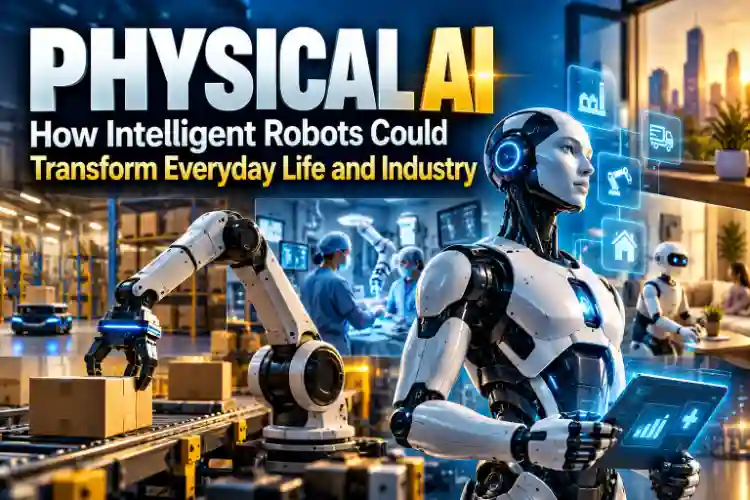
Artificial intelligence is beginning to move beyond computer screens and digital applications into the physical world. For years, the most visible advances in AI involved systems capable of understanding language, generating images, writing software and analyzing information. These technologies have changed how people interact with computers, but their influence has largely remained within digital environments. Physical AI represents the next stage of this evolution, combining artificial intelligence with robotics, sensors, advanced processors and mechanical systems to create machines that can perceive their surroundings, understand instructions and perform physical tasks. The development could eventually transform manufacturing, logistics, healthcare, agriculture, transportation and even everyday activities inside homes.
The importance of physical AI lies in the difference between understanding a task and physically completing it. A conventional AI assistant can explain how to organize a warehouse, repair equipment or prepare a meal, but it cannot perform those activities without a machine capable of interacting with the environment. Physical AI attempts to close that gap by connecting intelligent software with robots and autonomous systems. Companies including NVIDIA and Google DeepMind are developing technologies that allow robots to interpret visual information, reason about physical spaces and coordinate movements. Although truly general-purpose robots remain an ambitious goal, progress in robotic foundation models, simulation and machine learning is bringing more adaptable machines closer to practical deployment.
What Is Physical AI and How Does It Work?
Physical AI refers to artificial intelligence systems designed to understand and act within real-world environments. Unlike conventional software that primarily processes digital information, physical AI must interact with objects, people, surfaces and changing physical conditions. A robot operating in a warehouse, for example, needs to recognize products, estimate distances, avoid obstacles, determine how to grasp objects and adjust its movements when something unexpected happens. These activities require several technologies to work together, including computer vision, spatial reasoning, motion planning, sensors and mechanical control.
The intelligence behind such machines is increasingly being developed through models that combine vision, language and action. These systems can interpret camera images and human instructions before producing commands that control robotic movements. Other models provide higher-level reasoning, helping robots break complicated objectives into smaller steps and evaluate their progress. Google DeepMind’s Gemini Robotics research illustrates this approach by combining embodied reasoning with models that translate instructions and visual information into physical actions. The broader goal is to make robots less dependent on rigid programming and more capable of adapting to situations they have not encountered in exactly the same form before.
Also Read: Sensex, Nifty Today, October 28: IT Stocks Slide as Oil Prices Rise; L&T and Jio Stand Out
Why Traditional Robots Are Different From Intelligent Robots
Industrial robots have existed for decades, particularly in automobile manufacturing and other highly structured production environments. These machines are extremely useful because they can perform repetitive movements with speed, consistency and precision. However, many traditional robotic systems operate within carefully controlled conditions and require specialized programming when their tasks or environments change. A robotic arm designed to weld a particular component may perform that job efficiently but cannot automatically understand how to organize a cluttered storeroom or assist someone with an unfamiliar household task.
Physical AI aims to make robotic systems more flexible by giving them greater perception and decision-making capabilities. Instead of relying entirely on predefined movements, an intelligent robot could potentially recognize different objects, determine how to handle them and adapt when their positions change. This distinction matters because most real-world environments are unpredictable. Objects vary in size, shape and weight, people move unexpectedly, and tasks often involve several interconnected steps. A robot that can respond to those variations could become useful in a much wider range of industries than one limited to a fixed sequence of actions.
How Physical AI Could Change Everyday Life
The most visible long-term possibility is the development of robots capable of assisting people with everyday physical activities. Household robots could eventually help with cleaning, carrying objects, organizing rooms and performing selected routine chores. However, the challenge is considerably greater than it first appears. A typical home contains fragile objects, furniture, pets, people and constantly changing arrangements. Even apparently simple activities such as folding laundry or placing dishes into a cupboard require detailed perception, dexterity and judgment.
This explains why useful home robots are likely to emerge gradually rather than arriving as fully capable humanoid assistants overnight. Early systems may specialize in a limited number of activities or operate within carefully defined environments. As robotic models improve, machines could become better at combining tasks and responding to natural-language instructions. For older adults and people with mobility limitations, assistive robots may eventually provide meaningful support by retrieving objects, helping with routine activities or performing physically demanding tasks. Such systems would need strong safety controls and should complement rather than replace human care.
Also Read: GIFT Nifty Today, October 28, 2026: Opening Indication, Nifty Gap and Key Levels
Beyond homes, physical AI could also improve everyday services. Robots may increasingly assist with cleaning commercial buildings, moving supplies through hospitals, handling deliveries within controlled environments and maintaining infrastructure. These applications may become economically practical earlier than fully general-purpose household robots because workplaces can often be adapted to support robotic operations.
Humanoid Robots and the Future of Manufacturing
Manufacturing is one of the strongest potential markets for physical AI because factories already have experience deploying automation and measuring its economic value. Traditional industrial robots remain highly effective for repetitive production processes, but many manufacturing activities still require human workers to handle irregular objects, inspect components, move materials and respond to unexpected situations. More adaptable robots could help automate selected tasks that are difficult to address using fixed-purpose machinery.
Humanoid robots attract particular attention because their bodies are designed to operate in environments originally built for humans. Factories, warehouses and commercial buildings already contain doors, stairs, shelves, tools and workstations suited to human movement. A robot with human-like mobility and manipulation capabilities could potentially operate in some of these environments without requiring every facility to be redesigned. However, humanoid designs are not automatically the best solution for every task. Wheeled robots, specialized robotic arms and mobile manipulators may offer better efficiency, stability and cost advantages in many industrial applications.
The long-term opportunity is therefore broader than humanoid robotics alone. Physical AI could support an ecosystem of intelligent machines designed around different jobs, with shared advances in perception, planning and control making many types of robots more capable.

Also Read: Stocks to Watch Today, October 28, 2026: L&T, Maruti Suzuki, Waaree Energies and More
World Models Could Help Robots Understand Reality
One of the most important technologies behind physical AI is the development of world models. These AI systems attempt to represent how physical environments behave, allowing machines to predict what might happen when objects move or actions are performed. A robot needs more than the ability to recognize a cup on a table. It must understand where the cup is located, how it might move when touched, how much force may be appropriate and what could happen if the movement goes wrong.
Training robots to understand these relationships entirely through physical experimentation is expensive and time-consuming. Real-world testing can also damage equipment or create safety risks. Simulation offers an alternative by allowing developers to create virtual environments where robots can practice tasks, encounter varied conditions and learn from mistakes before operating in the physical world.
NVIDIA’s Cosmos and Isaac platforms are examples of technology designed to support this development through world modeling, simulated environments and robot-training workflows. Such systems could help developers generate training experiences and evaluate robotic behavior more efficiently. However, simulation cannot perfectly reproduce reality. Differences between virtual environments and physical conditions remain a major engineering challenge, making real-world validation essential.
Why AI Chips and Edge Computing Are Essential
A robot performing physical tasks must process information and respond quickly enough to operate safely. Sending every movement decision to a distant data center would introduce delays and create dependence on continuous connectivity. For this reason, physical AI will increasingly require powerful and energy-efficient computing hardware located directly inside robots and autonomous machines.
Also Read: S&P 500 Today, October 27, 2026: Technology Leads Gains Ahead of Fed Decision
On-device processors can help robots analyze sensor information, interpret their surroundings and execute time-sensitive control functions. Cloud infrastructure can still support large-scale training, fleet management and more demanding computational workloads, but immediate physical interactions often require local processing. This combination creates demand for specialized AI chips, sensors, memory, cameras, networking systems and power-management technology.
Energy efficiency is particularly important for mobile robots because battery capacity affects how long they can operate. More powerful computing hardware is useful only when its performance can be balanced against energy consumption, heat generation, weight and cost. Improvements in semiconductor design and AI-model efficiency will therefore influence how quickly advanced robotics becomes practical outside research laboratories.
Physical AI in Healthcare, Agriculture and Logistics
Some of the most valuable applications of physical AI may emerge in industries where repetitive physical work, difficult environments and labor constraints create strong demand for automation. In healthcare, intelligent robotic systems could support hospital logistics, equipment handling, rehabilitation and selected clinical workflows. Surgical robotics is already an established field, although more autonomous capabilities would require extensive validation, clinical evidence and regulatory oversight.
Agriculture presents another important opportunity. Farms often require labor-intensive activities such as crop inspection, harvesting, sorting and monitoring plant health. AI-enabled machines could combine cameras, sensors and robotic mechanisms to identify crops, detect problems and perform selected agricultural tasks. The economic value would depend on reliability across changing weather, terrain and crop conditions, making agricultural robotics a demanding but potentially significant market.
Also Read: US Stocks to Watch Today, October 27, 2026: Boeing, Coca-Cola, UPS, Celestica and Visa in Focus
Logistics and warehousing may provide some of the clearest near-term opportunities. Robots can already transport goods in structured facilities, and advances in physical AI could improve their ability to recognize unfamiliar packages, manipulate objects and coordinate activities. More intelligent systems may help warehouses handle changing product mixes and operational demands without requiring every action to be individually programmed.
The Business Opportunity Behind Physical AI
Physical AI could create a major new technology ecosystem because intelligent robots require much more than mechanical hardware. The industry combines semiconductor design, artificial intelligence, industrial automation, simulation software, sensors, motors, batteries, connectivity and manufacturing expertise. Companies participating in these areas may find new opportunities as robotic systems become more capable and commercially viable.
NVIDIA is positioning its computing platforms, simulation tools and robotics models as infrastructure for physical AI development. Google DeepMind is advancing robotic intelligence through models that combine reasoning, visual understanding and physical action. Industrial automation companies such as ABB, FANUC and Yaskawa bring established expertise in robotics, manufacturing systems and factory integration, while specialized robotics developers are exploring humanoid and other general-purpose machines.
The economic opportunity will depend on more than technological demonstrations. Businesses must evaluate the total cost of purchasing, maintaining and operating robots against the value of the work they perform. Reliability, utilization, integration expenses, energy consumption and safety requirements will all influence adoption. The companies that benefit most may not necessarily be those producing the most visually impressive robots, but those capable of delivering dependable systems that solve real operational problems.
Safety, Employment and the Challenges of Mass Adoption
Physical AI introduces challenges that differ from those associated with software-only artificial intelligence. An incorrect chatbot response can create confusion, but an incorrect robotic action may damage property or physically injure someone. Robots operating around people must therefore be designed to recognize hazards, respect operating limits and respond safely when conditions become uncertain.
Robotic intelligence must also cope with unpredictable environments. Objects may slip, sensors may fail, surfaces may be uneven and human behavior may be difficult to anticipate. These limitations make extensive testing, monitoring and appropriate human supervision essential. Cybersecurity will become increasingly important because connected robots could be vulnerable to unauthorized access or manipulation.
Employment is another important consideration. Greater automation may reduce demand for certain repetitive tasks while creating opportunities in robot maintenance, systems integration, supervision and technical services. The impact will vary across industries and regions, and workers may need new skills as businesses adopt more advanced machines. The transition is likely to be uneven rather than an immediate replacement of large categories of human employment.
The Future of Physical AI Over the Next Decade
The next decade could bring substantial improvements in how robots perceive, reason and interact with their surroundings, but progress is unlikely to occur at the same pace across every application. Structured industrial environments may continue to adopt advanced robotics faster than homes because businesses can standardize tasks, control operating conditions and measure productivity gains more directly.
As AI models become more capable, developers may be able to transfer learned skills between different robotic platforms more efficiently. Improvements in simulation, world models and real-world training could also reduce the time required to teach machines new activities. Over time, robots may become less dependent on narrow programming and better able to handle changing tasks, although achieving broad human-level physical competence remains a major scientific and engineering challenge.
The most important long-term shift is the expansion of artificial intelligence from generating information to interacting with the physical world. AI agents may help people complete digital tasks, while physical AI could eventually allow intelligent systems to perform selected actions in factories, hospitals, farms, warehouses and homes. Together, these developments suggest a future in which artificial intelligence becomes increasingly integrated into both software and physical infrastructure.
Physical AI is not simply about building robots that look or behave like humans. Its greater significance lies in making machines more adaptable, useful and capable of working safely in real environments. If advances in robotic intelligence, semiconductor technology, sensors and mechanical engineering continue, intelligent machines could gradually become an important part of everyday economic activity. The transformation may take years and involve considerable technical and social challenges, but physical AI has the potential to become one of the defining technology developments of the next generation.
Disclaimer: The content on Onetrader is for educational/informational purposes only. Not SEBI registered advisors.
Also Read: Sensex, Nifty Today: IT Stocks Fall, Broader Markets Gain








Keep learning with OneTrader
Explore structured lessons and practical guides to build your market knowledge.