
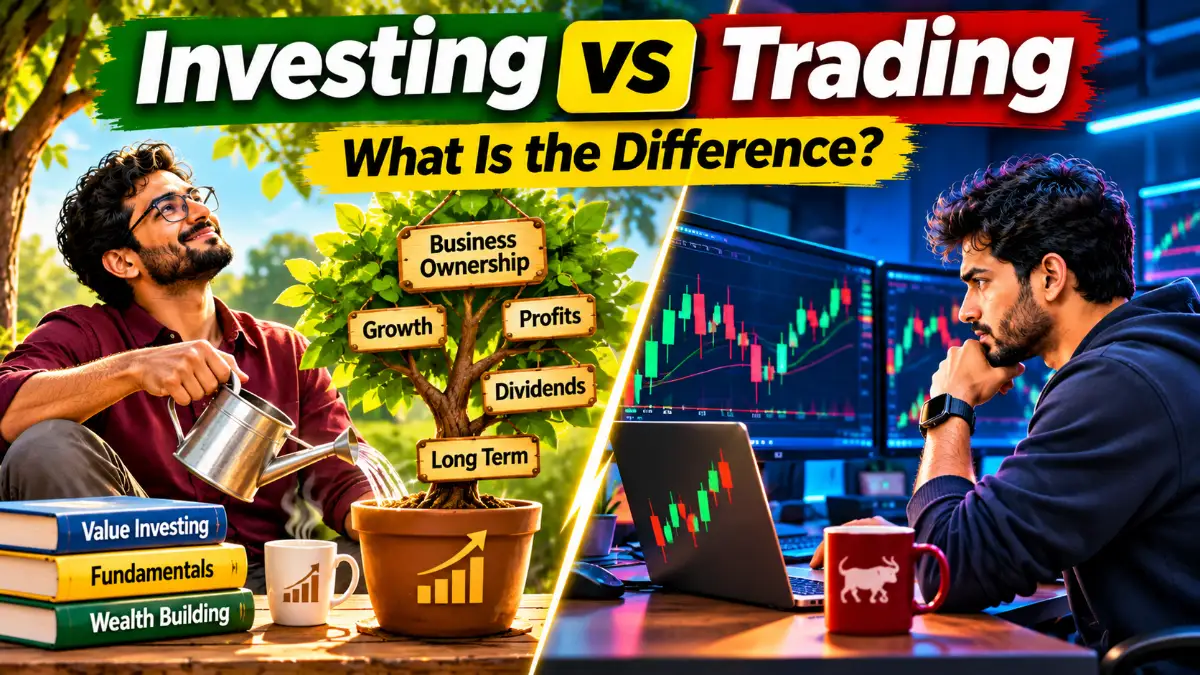
Investing and trading are two popular ways of participating in the stock market, but they are built around different objectives. Both involve buying and selling financial instruments, analysing market information and taking financial risks. However, the way investors and traders approach these activities is fundamentally different.
An investor generally looks at the value of a business and its ability to create wealth over time. A trader focuses more on price movements and opportunities created by changing market conditions. Although both may purchase shares of the same company, their reasons for entering a position, evaluating success and making decisions can be completely different.
Understanding this distinction is important for anyone entering the financial markets. Many beginners use the terms investing and trading interchangeably, which can lead to confusion about their objectives, expectations and approach to risk.
In Simple Words
Investing means purchasing an asset because you believe it can create value and generate returns in the future. Trading means buying or selling an asset to benefit from changes in its market price. Investors primarily focus on business value, while traders primarily focus on price behaviour and market opportunities.
Also Read: Investing vs Trading: Lessons from Well-Known Investors and Traders
1. The Main Difference: Building Wealth vs Capturing Price Movements
The biggest difference between investing and trading is the objective behind the decision.
Investing is generally about building wealth by owning assets that have the potential to grow in value. When someone purchases shares of a fundamentally strong company, the expectation is that the business will expand, generate profits, improve its competitive position and potentially become more valuable. The investor participates in the company’s financial journey through share ownership.
Trading has a different objective. A trader looks for opportunities created by price movements. These opportunities may arise when a stock breaks out of a trading range, reacts to company announcements, experiences changes in market sentiment or follows a particular chart pattern.
For a trader, the quality of the underlying business may be less important for a particular trade than the expected price movement. A stock can become a trading opportunity even when the trader does not consider it suitable for long-term ownership. This does not mean investors ignore prices or traders ignore businesses. The difference is which factor takes priority in their decisions.
Also Read: Investing vs Trading: Can You Do Both?
2. Ownership Mindset: Becoming a Business Owner vs Participating in Market Movements
Investing involves an ownership mindset. When an individual purchases shares of a company, they become a shareholder and own a proportionate interest in that business. Their investment value is connected to the company’s performance, financial strength and future prospects.
An investor may examine how a company earns revenue, manages expenses, uses capital, competes with other businesses and creates value for shareholders. The objective is to own a business that can become more valuable through its operations and growth.
Trading involves a market participation mindset. A trader purchases or sells financial instruments based on an expected price movement. The primary focus is not necessarily on becoming a long-term owner of a business but on identifying an opportunity and managing the resulting position.
For example, someone may purchase shares of a company because its earnings potential and business prospects look attractive. Another person may purchase the same shares because the stock has broken above an important resistance level with strong trading activity.
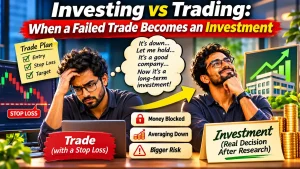
Also Read: Investing vs Trading: When a Failed Trade Becomes an ‘Investment’
Both individuals own the shares after purchasing them, but their intentions are different. One is interested in participating in the company’s growth, while the other is interested in the price opportunity.
3. How Investors and Traders Make Decisions
Investors and traders use different types of analysis because they are trying to answer different questions.
An investor wants to understand whether a business is financially healthy and whether its current market valuation is reasonable compared with its potential. Fundamental analysis becomes an important part of this process.
This involves studying financial statements, revenue growth, profitability, debt, cash flows, management quality, competitive advantages and the broader industry. Investors also consider whether the company’s business model can remain successful as market conditions change.

Also Read: Investing vs Trading: Which Suits a Working Person?
A trader generally wants to understand what the market is doing and whether a particular price movement offers a favourable opportunity. Technical analysis is commonly used to study price charts, trading volume, support and resistance, candlestick patterns, momentum and market structure. Traders may also follow economic announcements, company developments and broader market sentiment because these factors can influence prices.
| Decision factor | Investing | Trading |
|---|---|---|
| Primary focus | Business value | Market price |
| Common analysis | Fundamental analysis | Technical analysis |
| Important information | Financial performance and business prospects | Price action, volume and market behaviour |
| Main question | Is this a valuable asset to own? | Is there a trading opportunity? |
| Evaluation | Business progress and investment performance | Trade execution and market outcome |
These are common approaches rather than strict boundaries. Investors may use charts to improve their entry decisions, while traders may study company fundamentals to understand events affecting a stock.
4. Where Do Returns Come From?
Another important difference is how investors and traders expect to generate returns.
Investors can benefit from capital appreciation when the value of an asset increases. Shareholders may also receive dividends when a company distributes part of its profits. In some cases, the reinvestment of dividends can contribute to the growth of an investment portfolio.
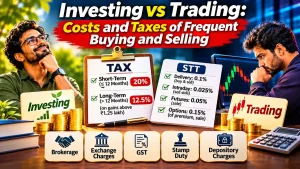
Also Read: Investing vs Trading: Costs and Taxes of Frequent Buying and Selling
For example, consider an illustrative investment of ₹1,00,000 in a company’s shares. If the value of those shares increases by 20%, the investment becomes worth ₹1,20,000, excluding dividends, taxes and transaction costs. The gain comes from the increase in the market value of the ownership stake.
Traders primarily seek returns from price changes between their entry and exit. They may attempt to benefit from rising prices through long positions or falling prices through short positions, where permitted by the relevant market and product rules.
Consider an illustrative trade in which a trader purchases shares worth ₹50,000 and exits when their value reaches ₹52,000. The gross trading profit is ₹2,000, before brokerage, taxes and other costs.
Unlike investing, trading does not necessarily depend on receiving dividends or participating in the long-term growth of a business. The central objective is to identify and capture a market movement. Neither approach guarantees positive returns. Asset values can decline, businesses can underperform and market movements can go against a trader’s expectations.
Also Read: Investing vs Trading: Risk and Position Size Explained
5. Effort and Risk: Different Responsibilities, Different Challenges
Both investing and trading require knowledge, research and discipline, but the nature of the work is different.
Investing requires understanding businesses and continuously evaluating whether the original investment reasoning remains valid. Investors need to examine financial performance, industry developments, competitive conditions and changes that could affect the company’s future value.
Trading requires a different kind of preparation. Traders must identify opportunities, understand market behaviour, plan entries and exits, manage risk and evaluate whether their decisions follow a repeatable process.
The risks also differ in important ways. An investor may face business-related risks such as declining profitability, excessive debt, poor management decisions or changes in industry demand. Even a fundamentally strong company can experience a significant fall in its share price.
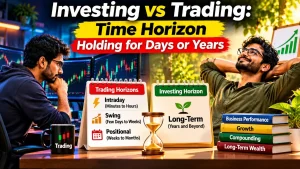
Also Read: Investing vs Trading: Time Horizon, Holding for Days or Years
A trader faces risks related to incorrect market expectations, sudden price movements, poor execution, liquidity conditions and emotional decisions. Leverage and certain derivatives can increase the potential financial impact of adverse movements.
It is important not to assume that investing is automatically safe or trading is automatically dangerous. Both involve the possibility of capital loss. The actual risk depends on the asset, market conditions, strategy and decisions made by the participant.
6. Investing vs Trading: A Complete Comparison
The following table brings together the central differences between the two approaches.
| Feature | Investing | Trading |
|---|---|---|
| Main objective | Build wealth through ownership | Capture price movements |
| Mindset | Business ownership | Market participation |
| Primary focus | Value and business growth | Price and market behaviour |
| Common analysis | Fundamental analysis | Technical analysis |
| Returns | Capital appreciation and possible dividends | Gains from favourable price changes |
| Decision basis | Business quality and valuation | Market setup and price behaviour |
| Research emphasis | Financial statements and business prospects | Charts, volume and market conditions |
| Main challenge | Identifying valuable assets and evaluating business performance | Making consistent decisions under changing market conditions |
| Risk sources | Business, valuation and market risks | Price movement, execution and strategy risks |
The table describes the general distinction. Actual approaches can overlap, and neither category follows one universal method.
Also Read: How to Build a Beginner Investment Portfolio in India: Asset Mix, Funds and Simple Rules
7. Can Someone Be Both an Investor and a Trader?
Yes. Investing and trading are not mutually exclusive activities. An individual can participate in both, provided the objectives and decision-making processes remain clearly separated.
For example, someone may hold shares of a company as a long-term investment because they believe in its business prospects. The same individual may also trade a different stock based on a technical setup.
The important distinction is the purpose of each position. A long-term investment should not automatically become a trade simply because its price falls. Similarly, a trading position should not suddenly become an investment merely because the original trade moves into a loss.
Confusing these objectives can create poor decisions. A trader who refuses to exit a failed setup may begin searching for fundamental reasons to justify holding the position. An investor may unnecessarily react to short-term price movements even when the original business thesis remains intact. Keeping the reasoning behind each position clear helps avoid this confusion.
Also Read: Index Funds vs ETFs: Which Is Better for Long-Term Investing?
Key Takeaways
- Investing and trading both involve participating in financial markets, but their primary objectives are different.
- Investors focus on owning assets and participating in their potential long-term value creation.
- Traders focus on identifying and capturing opportunities created by market price movements.
- Fundamental analysis is commonly associated with investing, while technical analysis is widely used in trading.
- Investors may earn returns through capital appreciation and dividends, while traders primarily seek gains from price changes.
- Both approaches involve financial risk and require knowledge, discipline and research.
- One individual can be both an investor and a trader, provided each activity has a clearly defined purpose.
- Understanding the difference helps prevent confusion between business ownership and short-term market participation.
Final Thought
Investing and trading are not competing ideas. They are two different ways of participating in the same financial markets.
An investor looks at a business and asks whether it can create value. A trader looks at the market and asks whether a price movement offers an opportunity. Both require careful thinking, but the questions guiding their decisions are different.
The biggest mistake beginners make is entering the market without understanding which activity they are actually pursuing. Once the objective becomes clear, it becomes easier to choose the appropriate research methods, evaluate decisions and understand the risks involved. Before learning how to invest or trade, understand why you are participating in the market. A clear objective is the foundation of a sensible financial approach.
More in This Series
- Investing vs Trading: Time Horizon: Days or Years
- Investing vs Trading: Risk and Position Size
- Investing vs Trading: Costs and Taxes
- Investing vs Trading: Which Suits a Working Person?
- Investing vs Trading: When a Failed Trade Becomes an Investment
- Investing vs Trading: Can You Do Both?
- Investing vs Trading: Lessons from Well-Known Investors and Traders
Disclaimer: This article is for educational and informational purposes only. It does not constitute investment advice or a recommendation to buy or sell any financial instrument. Investing and trading involve market risks, including the possible loss of capital. Readers should understand the products they participate in and evaluate their financial circumstances before making investment or trading decisions.
Also Read: How Much SIP Is Needed to Build ₹1 Crore?





Keep learning with OneTrader
Explore structured lessons and practical guides to build your market knowledge.
