
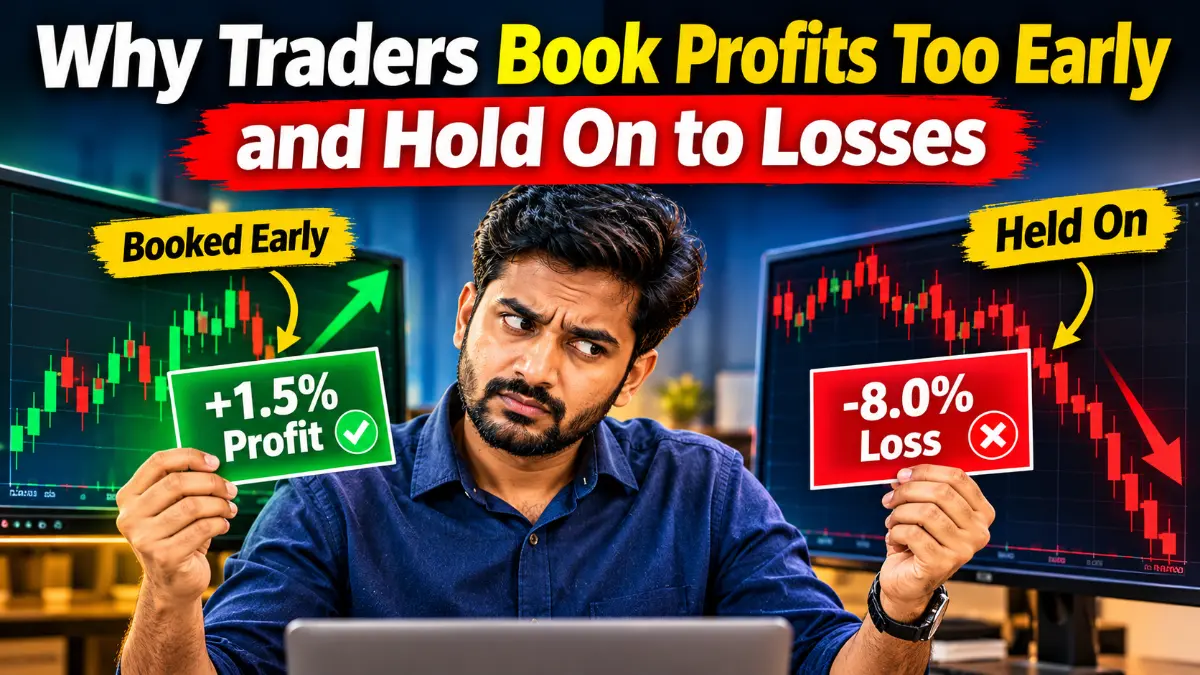
One of the most frustrating habits in trading is that traders often do the opposite of what a profitable trading strategy requires. When a trade moves into profit, they become impatient and close it quickly. But when a trade starts losing money, they wait, hoping the market will reverse and bring them back into profit. The result is a small gain booked too early and a potentially much larger loss allowed to grow.
This behaviour is surprisingly common across trading styles, including intraday trading, swing trading and positional trading. The problem is not always a lack of market knowledge or technical skills. Often, it comes from how the human mind reacts to uncertainty, profits and losses. Understanding this behaviour is important because even a technically sound trading strategy can struggle when the trader repeatedly makes emotional exit decisions.
In Simple Words
Traders often want to protect a small profit because they are afraid of losing what they have already earned. At the same time, they avoid closing losing positions because accepting a loss feels painful. This combination creates an unhealthy pattern in which profits remain small while losses become increasingly large.
1. Why Small Profits Feel So Satisfying
Imagine entering a trade and seeing the position move into profit. Even if the original plan was to hold the trade until a particular target, the moment the screen displays a green number, the trader starts thinking about protecting that money. What if the market reverses? What if the profit disappears? What if a winning trade becomes a losing trade?
Also Read: Thought Series: Why Most Traders Quit in the First Year and What the Survivors Do Differently
These thoughts create pressure to close the position immediately. Booking a profit provides instant emotional satisfaction because the trader gets a confirmed positive result. Holding the position requires patience and accepting the possibility that some of the unrealised profit may disappear.
This is why traders sometimes exit profitable positions even when the original trading setup remains valid. They are no longer managing the trade according to their plan. They are managing their fear of giving back money.
2. Why Traders Refuse to Accept Losses
The opposite reaction happens when a trade moves against the trader.
Instead of closing the position at the planned stop-loss, the trader starts looking for reasons to continue holding it. They may believe the stock has fallen enough, that support will hold, or that a reversal is just around the corner. The original stop-loss begins to feel like an unnecessary restriction. The trader may even move it further away to give the position more room.
Also Read: Got Your Salary? Done Your SIP Yet?
The psychological difficulty is that closing a losing trade makes the loss real. As long as the position remains open, there is still a possibility of recovery. This creates a dangerous illusion that waiting is better than accepting the loss. But the market does not know the trader’s entry price, purchase quantity or financial expectations. It has no obligation to return to the entry level.
3. The Psychology Behind This Behaviour
Two powerful psychological tendencies contribute to this problem.
Loss aversion: People generally experience the pain of losing money more strongly than the satisfaction of gaining an equivalent amount. Consequently, a trader may become extremely protective of a small profit while avoiding the emotional discomfort of booking a loss.
Disposition effect: This refers to the tendency to sell winning investments or positions too early while holding losing ones for too long. It is a recognised behavioural pattern in financial markets.
Also Read: No Trade Day’ on August 12: Why Indian Traders Are Boycotting the Markets
There is another important factor: ego. Booking a loss can feel like admitting that the original decision was wrong. Instead of treating the loss as a normal part of trading, some traders begin defending their entry decision.
A professional approach requires separating the quality of a trading decision from its eventual outcome. A good trade can lose money, and a poor trade can make money. Neither outcome alone proves whether the decision-making process was correct.
4. How Small Profits and Large Losses Damage Trading Performance
The real danger becomes clear when we examine the relationship between average profits and average losses.
Consider the following illustrative example:
Also Read: Content Creator Bill in India – Impact on Education, Future & Risks

| Trading result | Amount |
|---|---|
| Average winning trade | ₹500 |
| Average losing trade | ₹1,500 |
| Number of winning trades | 6 |
| Number of losing trades | 4 |
| Total profit | ₹3,000 |
| Total loss | ₹6,000 |
| Net result | -₹3,000 |
The trader wins 60% of the trades but still loses ₹3,000 because the average loss is three times the average profit. This demonstrates why a high winning percentage does not automatically mean a profitable trading strategy.
Now consider a different approach:
| Trading result | Amount |
|---|---|
| Average winning trade | ₹1,500 |
| Average losing trade | ₹500 |
| Number of winning trades | 4 |
| Number of losing trades | 6 |
| Total profit | ₹6,000 |
| Total loss | ₹3,000 |
| Net result | +₹3,000 |
Here, the trader wins only 40% of the trades but generates a positive result because winning trades are larger than losing trades. Both examples are illustrative and exclude brokerage, taxes, slippage and other transaction costs.
The important lesson is that trading profitability depends on the combination of win rate, average profit, average loss and trading costs. Winning frequently is not enough if losses are allowed to become disproportionately large.
Also Read: 50 Stock Market Truths Every Trader Must Know – OneTrader by Rajkumar
5. Why Traders Abandon Their Original Trading Plan
Many traders enter positions with clearly defined targets and stop-loss levels. However, their behaviour changes once the trade becomes active.
A profitable position may be closed before reaching its target because the trader fears a reversal. A losing position may remain open beyond its stop-loss because the trader expects a recovery. This creates a situation where the trading plan exists only before entering the market. Once real money is involved, emotions take control.
A trading plan should not be treated as a rough suggestion. It should establish the conditions under which a position will be managed or closed. If those conditions change because of new market information, adjustments may be justified. But changing the plan simply because a trade is showing a temporary profit or loss is emotional decision-making.
6. Practical Ways to Stop Booking Profits Too Early
The solution is not to hold every profitable position longer. Sometimes booking an early profit is the correct decision, particularly when market structure changes or the original setup becomes invalid. The objective is to stop making exit decisions based entirely on fear.
Also Read: Are We Still Thinking — Or Just Consuming? | OneTrader Thought Series
Define the target before entering. Identify the potential exit level using the trading setup, market structure and risk-to-reward calculation. This reduces the temptation to make decisions based on every small price movement.
Use a trailing stop-loss when appropriate. Instead of closing a winning trade out of fear, traders can use a predefined trailing method to protect some gains while allowing the position to continue. The method should suit the trading timeframe and market conditions.
Avoid watching every price fluctuation. Constantly monitoring unrealised profits can increase emotional reactions. Once a trade is entered with a defined plan, unnecessary interference can do more harm than good.
Evaluate exits across multiple trades. Do not judge a strategy based on one trade that reversed after showing a profit. Review a meaningful sample to understand whether the exit method is helping or hurting overall performance.
Also Read: From Books to Reels – How We Lost a Generation | Onetrader Thought Series
7. Practical Ways to Stop Holding Losing Trades
Controlling losing positions requires a different kind of discipline. The trader must accept that being wrong is part of participating in financial markets.
Place the stop-loss before entering. Decide the maximum acceptable loss based on the setup and position size. Avoid entering a trade without knowing where the original trading idea becomes invalid.
Never move a stop-loss further away just to avoid booking a loss. A stop-loss adjustment should follow a predefined strategy, not the desire to postpone an uncomfortable decision.
Separate market analysis from personal expectations. If the stock breaks an important support level or the setup becomes invalid, reassess the position objectively. Do not continue holding simply because the entry price is higher.
Also Read: Why You Should Buy Term Insurance Before Anything Else (2025 Guide)
Do not average down without a tested plan. Buying more of a falling stock or adding to a losing position increases exposure. It should never be an automatic response to an unfavourable price movement.
Accept that small losses are normal. A controlled loss is part of trading expenses. Allowing a manageable loss to become a major capital setback is a much more serious problem.
8. A Simple Trading Rule: Manage Winners and Losers by Rules, Not Feelings
One useful exercise is to compare every exit decision with the original trading plan.
| Situation | Emotional reaction | Disciplined response |
|---|---|---|
| Trade moves into profit | Close immediately | Follow the planned exit |
| Trade moves slightly against you | Wait for recovery | Respect the stop-loss |
| Profit starts reducing | Panic | Follow trailing rules |
| Stop-loss is reached | Move it further away | Exit as planned |
| Stock reverses after exit | Re-enter immediately | Wait for a fresh setup |
This does not mean every trade must reach its original target or that every stop-loss must be placed at the same distance. Different strategies require different exit methods.
Also Read: QR Payments – The Funny Truth About How Our Salaries Vanish in Seconds
The principle is consistency. Exit decisions should be based on the trading setup, market conditions and predefined risk limits, not on the discomfort of seeing a changing profit or loss figure.
9. The Real Improvement Begins With Reviewing Exits
Many traders spend considerable time searching for better entry indicators, chart patterns and stock selection methods. But sometimes the biggest improvement comes from examining how they exit existing trades.
A trading journal should record not only entry prices and final results but also whether the position was closed according to the original plan. Traders should identify how often they booked profits early, how often they ignored stop-losses and whether these decisions affected their overall performance.
Over time, this review can reveal a pattern that may not be obvious during live trading. A trader might discover that the strategy itself is reasonable but emotional exits are reducing its effectiveness. Improvement begins when traders stop blaming every disappointing result on market conditions and start examining their own decision-making.
Also Read: 90s Kids’ Best Pen – The Legendary Cello Gripper That Wrote Our Childhood
Key Takeaways
- Traders often book profits early because they fear losing unrealised gains.
- They hold losing positions because accepting a loss creates emotional discomfort.
- Loss aversion and the disposition effect contribute to this behaviour.
- A high win rate does not guarantee profitability if average losses are significantly larger than average profits.
- Stop-losses and profit targets should be defined before entering a trade.
- Trailing stops can help manage profitable positions when used systematically.
- Moving stop-losses further away to avoid booking losses is dangerous.
- Trading journals help identify whether emotional exits are damaging performance.
- The objective is not to win every trade but to maintain a favourable overall trading process.
Final Thought
One of the hardest lessons in trading is learning to accept small losses while allowing profitable trades to develop according to a sound plan. Most traders understand this principle intellectually. The real challenge is following it when money is moving on the screen and emotions begin influencing decisions.
A trader does not need to predict every market movement correctly. What matters is knowing when the original trading idea is no longer valid, accepting the loss and giving profitable opportunities enough room to work.
The market will always offer another opportunity. But repeatedly protecting small profits and allowing large losses can gradually destroy the capital needed to participate in those opportunities.
Financial Disclaimer: This article is for educational and informational purposes only. It does not constitute investment advice or a recommendation to buy or sell any security. Trading in equities, futures, options and other financial instruments involves market risk and the possibility of losing capital. Readers should understand their risk tolerance, use appropriate risk management and consult a qualified financial adviser before making financial decisions.
Also Read: Why Banks Are Strict With Common People and Easy With the Rich | Onetrader View







Keep learning with OneTrader
Explore structured lessons and practical guides to build your market knowledge.
