
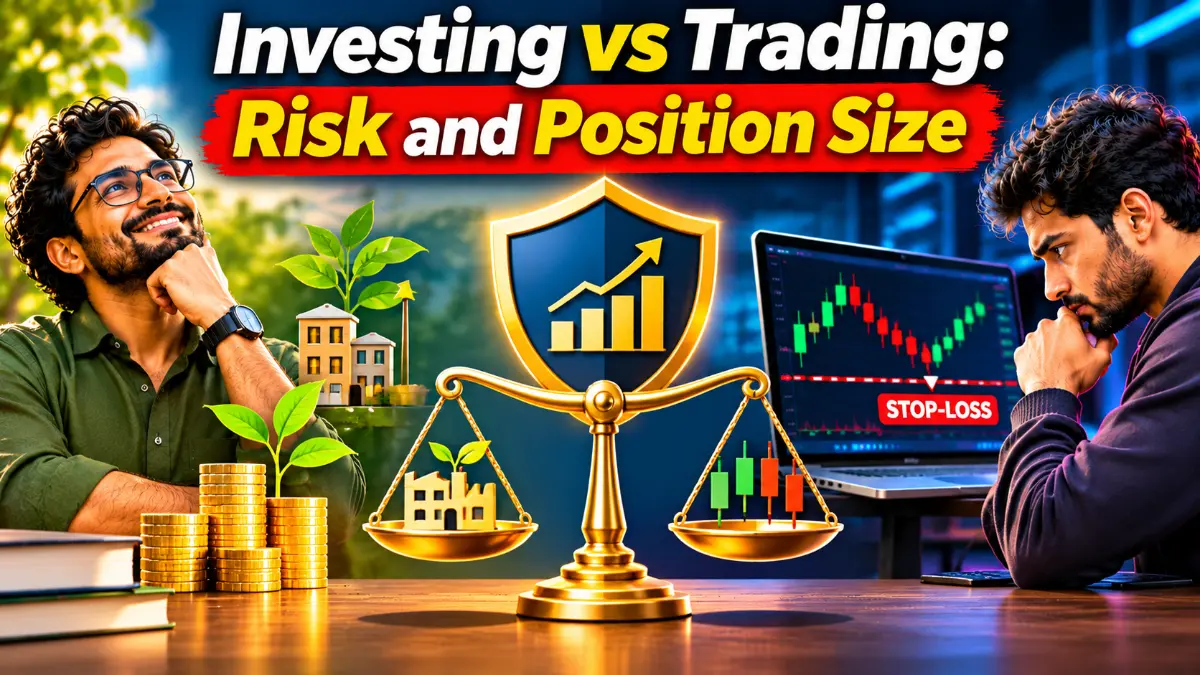
Risk is one of the most important differences between investing and trading. Both involve the possibility of losing money, but the way that risk develops and how market participants manage it can be very different.
An investor may lose money because a company fails to grow, its financial condition deteriorates or its shares were purchased at an unreasonable valuation. A trader may lose money because the market moves against the position, a stock opens sharply lower or leverage magnifies an unfavourable price movement. In both cases, the amount of money committed to a position can make the difference between a manageable setback and serious capital damage.
Understanding risk is not just about choosing the right stock. It is also about deciding how much capital should be exposed to one opportunity and how much loss can be tolerated if the decision goes wrong.
In Simple Words
Investors generally manage risk by controlling how much of their overall capital is allocated to individual companies and by diversifying their holdings. Traders manage risk by deciding how much they are willing to lose on a particular trade, using a stop-loss and calculating the appropriate position size.
Also Read: Investing vs Trading: Lessons from Well-Known Investors and Traders
1. What Risk Means for an Investor
For an investor, risk begins with the possibility that the business may not perform as expected. A company can lose customers, face stronger competition, accumulate excessive debt or experience declining profitability. In serious situations, business deterioration can permanently damage shareholder value.
Another important risk is overpaying. Even a good company can become a poor investment if its shares are purchased at an excessively high valuation. If the business does not deliver the growth already reflected in its share price, the market may reduce its valuation.
Concentration is another major concern. When a large portion of an investment portfolio depends on one company or industry, an unfavourable development can have a disproportionate effect on total wealth. An investor therefore needs to consider not only whether a company is attractive but also how much of the overall portfolio should depend on that particular business.
2. What Risk Means for a Trader
For a trader, risk is closely connected to the price movement of an open position.
Also Read: Investing vs Trading: Can You Do Both?
A stock may move against the expected direction after an unexpected announcement, a change in market sentiment or a breakdown in its technical structure. Even a carefully planned trade can produce a loss.
One particular danger is a gap movement. A stock may close at ₹500 and open at ₹470 after an unexpected development. A stop-loss placed at ₹490 cannot guarantee an exit at that exact price when the market opens below it. The actual execution may happen at a significantly worse level.
Leverage introduces another layer of risk. It allows traders to control a larger market exposure with a smaller amount of their own capital, but it can also magnify losses. A relatively small adverse price movement may have a substantial impact on the trader’s available capital. This is why traders need to understand their maximum planned loss before entering a position rather than focusing only on the potential profit.
3. How Investors Decide How Much to Put Into One Stock
Investors generally approach position size through portfolio allocation. Instead of asking only how many shares to purchase, they consider what percentage of their overall investment portfolio should be exposed to a particular company.
Also Read: Investing vs Trading: When a Failed Trade Becomes an ‘Investment’
For example, an investor with a portfolio of ₹10 lakh may decide that no single company should represent an excessively large portion of the portfolio. The allocation decision should consider the company’s financial strength, industry risks, valuation and the investor’s overall diversification.

There is no universal allocation percentage suitable for everyone. A concentrated portfolio can experience substantial damage if one major holding performs poorly, while spreading money across too many companies without understanding them can also create problems. The objective is to avoid allowing the performance of one business to determine the financial outcome of the entire portfolio.
4. How Traders Calculate Position Size Using Stop-Loss
Traders generally approach position size by first deciding how much money they are prepared to lose if the trade fails.
The stop-loss identifies the price at which the trading idea is considered invalid. The distance between the entry price and the stop-loss helps determine how many shares can be purchased within the planned risk limit.
Also Read: Investing vs Trading: Which Suits a Working Person?
Consider this clearly illustrative calculation:
- Trading capital: ₹2,00,000
- Maximum planned risk: 1% of capital
- Maximum loss allowed: ₹2,000
- Entry price: ₹500
- Stop-loss: ₹480
- Risk per share: ₹20
The position size is calculated as:
Quantity = ₹2,000 ÷ ₹20 = 100 shares
| Calculation | Amount |
|---|---|
| Total position value | ₹50,000 |
| Entry price | ₹500 |
| Stop-loss | ₹480 |
| Planned loss per share | ₹20 |
| Maximum planned loss | ₹2,000 |
If the stock reaches ₹480 and the stop-loss executes at that price, the planned loss is ₹2,000. The actual loss can be higher if the stock gaps below the stop-loss or execution occurs at a worse price. The important lesson is that position size should be calculated from the acceptable loss and stop-loss distance, not simply from how much capital is available.
Also Read: Investing vs Trading: Costs and Taxes of Frequent Buying and Selling
5. Diversification: Why One Stock Should Not Decide Everything
Diversification helps investors reduce dependence on a single company or business sector. Holding companies across different industries can reduce the impact of an isolated business problem on the overall portfolio.
However, diversification is not simply about owning a large number of stocks. If several companies depend on the same industry, economic conditions or market factors, their prices may decline together.
Traders also need to understand concentration. Taking multiple positions in different stocks does not necessarily mean risk has been diversified. If all positions depend on the same market direction or similar technical setups, they may suffer losses simultaneously. The purpose of diversification is to avoid excessive dependence on one source of risk, not to eliminate market risk completely.
6. Why an Emergency Fund Matters Before Taking Market Risk
An emergency fund and trading or investment capital should serve different purposes.
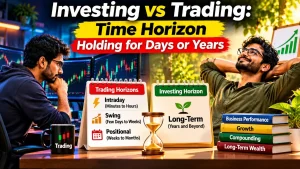
Also Read: Investing vs Trading: Time Horizon, Holding for Days or Years
Emergency savings are meant to cover essential expenses such as household needs, medical emergencies, unexpected repairs and temporary income disruptions. Market capital is money exposed to financial market uncertainty.
When people invest money needed for immediate expenses, they may be forced to sell during an unfavourable market condition. Traders facing financial pressure may also take unnecessary positions because they feel compelled to generate income. Keeping emergency savings separate provides financial breathing room. It reduces the possibility that a temporary market loss will interfere with essential household responsibilities. A stock market portfolio should not become a substitute for emergency savings.
Key Takeaways
- Investors face business failure, excessive valuation and portfolio concentration risks.
- Traders face adverse price movements, market gaps and additional risks from leverage.
- Investors manage exposure through allocation decisions and diversification.
- Traders calculate position size using their acceptable loss and stop-loss distance.
- A stop-loss does not guarantee execution at the specified price.
- Owning several stocks does not automatically create meaningful diversification.
- Emergency savings should remain separate from money exposed to market risk.
- Protecting capital is more important than maximising the size of every opportunity.
Final Thought
A common mistake in financial markets is focusing too much on how much money can be made and too little on how much can be lost.
Investors need to think about how much of their wealth depends on individual businesses. Traders need to understand how much capital is exposed to each trading decision. These are different approaches, but both begin with the same principle: control the risk before thinking about the reward.
Also Read: Investing vs Trading: What Is the Difference?
A good investment idea or trading setup cannot guarantee a successful outcome. But sensible allocation, disciplined position sizing, diversification and adequate emergency savings can help prevent one wrong decision from creating a much bigger financial problem.
More in This Series
- Investing vs Trading: What Is the Difference?
- Investing vs Trading: Time Horizon: Days or Years
- Investing vs Trading: Costs and Taxes
- Investing vs Trading: Which Suits a Working Person?
- Investing vs Trading: When a Failed Trade Becomes an Investment
- Investing vs Trading: Can You Do Both?
- Investing vs Trading: Lessons from Well-Known Investors and Traders
Disclaimer: This article is for educational and informational purposes only. It does not constitute investment advice or a recommendation to buy or sell any financial instrument. Investing and trading involve market risks, including the possibility of losing capital. Illustrative calculations do not guarantee actual execution prices or outcomes. Readers should understand their financial circumstances and the risks involved before making financial decisions.


Keep learning with OneTrader
Explore structured lessons and practical guides to build your market knowledge.
