

Having a full-time job does not mean someone cannot participate in the stock market. Many salaried professionals invest in shares while managing their regular employment, family responsibilities and personal commitments. Others are interested in trading because they enjoy studying charts and identifying market opportunities. The challenge is finding an approach that fits their actual lifestyle rather than forcing their daily routine around the market.
The important question is not whether investing or trading is better. It is whether the person has enough time, attention, knowledge and emotional capacity to follow the chosen approach consistently. A strategy that looks attractive on paper may become difficult to execute when office meetings, deadlines and unexpected responsibilities interrupt market hours.
In Simple Words
Investing can often fit more naturally into a working person’s routine because it does not generally require continuous market monitoring. Trading demands more active attention and a reliable way to manage positions while the market is open. The right choice depends on available time, temperament and willingness to learn.
1. The Biggest Challenge: Market Hours and Office Hours
The Indian stock market operates during regular weekday working hours, which overlap with the schedules of many salaried employees. This creates a practical problem for anyone who wants to participate actively in intraday trading.
Also Read: Investing vs Trading: Lessons from Well-Known Investors and Traders
Imagine someone working in an office where meetings begin in the morning and responsibilities continue throughout the day. Even if that person identifies an attractive trading setup before the market opens, they may not be available when the actual entry, exit or stop-loss decision becomes necessary. Missing a market opportunity is not necessarily a problem. The bigger concern is entering a position without being available to manage it according to the trading plan.
Investing generally offers more flexibility. A salaried individual can research companies outside working hours, review financial information and make investment decisions without needing to monitor every market movement.
2. Attention Is Different From Simply Having Time
Trading requires more than finding a few free minutes during office hours. It requires concentration when decisions need to be made.
A trader who frequently switches between office work and market charts may miss important price developments or make rushed decisions. Work-related stress can also influence trading behaviour, particularly when a position moves unexpectedly.
Also Read: Investing vs Trading: Can You Do Both?
Notifications and mobile trading applications make market participation convenient, but convenience should not be confused with proper attention. Checking prices between meetings does not necessarily provide enough time to analyse a setup or manage a position responsibly.
Investing also requires attention, but the nature of that attention is different. Research can be planned, financial information can be reviewed outside market hours, and portfolio decisions do not necessarily require continuous observation.
3. Skills and Learning Curve Matter
A working person should also consider how much time is available to develop the necessary skills.
Investing requires an understanding of financial statements, business models, company valuations, industry conditions and management quality. This knowledge can be developed gradually through structured reading and regular research.
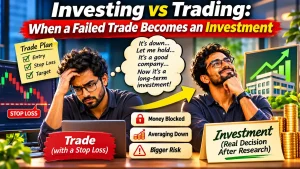
Also Read: Investing vs Trading: When a Failed Trade Becomes an ‘Investment’
Trading requires learning market behaviour, chart interpretation, technical setups, execution, trade management and emotional discipline. Understanding a chart is only one part of the process. Applying the knowledge consistently under live market conditions is another challenge. Neither approach should be treated as something that can be mastered simply by watching a few videos. Both require practice, review and continuous learning. The important consideration is whether the learning process can fit comfortably into an existing professional and personal routine.
4. Temperament: Patience or Active Decision-Making?
Some people enjoy analysing businesses and allowing their investment decisions to develop without reacting to every market fluctuation. Others prefer studying price movements, identifying patterns and making active market decisions.
A salaried professional who becomes anxious whenever a stock price changes may find frequent trading particularly stressful. Similarly, someone who constantly wants to take action may struggle with an investment approach that requires patience and limited intervention. The challenge is understanding personal behaviour rather than choosing an activity because it appears exciting.
A person should also consider how they respond when work pressure and market uncertainty occur together. If a difficult office day regularly leads to impulsive trading decisions, that is an important warning sign.

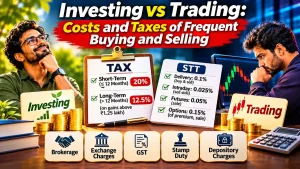
Also Read: Investing vs Trading: Costs and Taxes of Frequent Buying and Selling
5. A Practical Comparison for Working Professionals
| Factor | Investing | Active trading |
|---|---|---|
| Market-hour availability | Usually less demanding | Often important |
| Daily attention | Periodic research and review | More frequent monitoring |
| Learning focus | Businesses and valuations | Charts and market execution |
| Work interruption | Often easier to manage | Can disrupt decisions |
| Main personal challenge | Patience and research discipline | Concentration and emotional control |
This is a general comparison. Different investment strategies and trading styles have different requirements.
6. A Realistic Routine for a Salaried Investor
A working professional does not need to spend the entire evening studying the stock market. A simple, consistent research routine can be more practical than trying to follow every market development.
Before the working week, an investor can review the portfolio and identify important company announcements or financial developments. During the week, a short period after office hours can be used to read company updates, examine financial performance and understand changes in the business.
A more detailed review can be scheduled over the weekend. This provides time to study annual reports, quarterly results, industry developments and portfolio performance without the pressure of an active trading session.
Also Read: Investing vs Trading: Risk and Position Size Explained
The routine should also include checking whether the original investment reasoning remains valid. The objective is to make informed decisions rather than react to every movement in the share price.
7. Can a Working Person Trade Part-Time?
Yes, but part-time trading requires realistic expectations and clear boundaries.
Someone who cannot monitor the market continuously should avoid assuming that every trading strategy can be managed through occasional mobile checks. Intraday strategies that require quick decisions may be particularly difficult when professional responsibilities take priority.
A part-time trader should understand the exact management requirements of the chosen strategy before entering a position. Predefined alerts, planned exits and clearly documented rules can help, but they do not remove market risk or guarantee execution at intended prices.
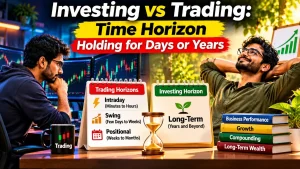
Also Read: Investing vs Trading: Time Horizon, Holding for Days or Years
It is also important not to let trading interfere with employment responsibilities. A salary provides financial stability, and taking unnecessary professional risks to follow market movements can create problems beyond the trading account. Most importantly, a part-time trader should be comfortable missing opportunities. The market will continue to offer new setups, but every opportunity does not need participation.
8. Honest Self-Check Questions Before Choosing
Before deciding between investing and trading, ask yourself:
- Can I regularly dedicate attention to the market during working hours without affecting my job?
- Do I enjoy studying businesses and financial performance, or do I genuinely enjoy analysing price movements?
- Can I follow a predefined plan when a market position moves against me?
- Am I comfortable waiting without feeling the need to participate in every market movement?
- Can I continue learning without expecting immediate financial results?
- Will market activity create unnecessary stress in my professional or personal life?
- Am I choosing trading because I understand its requirements or simply because quick profits appear attractive?
Honest answers are more useful than choosing an approach based on what other people are doing.
9. A Job Should Not Become an Obstacle to Financial Discipline
There is a tendency to believe that serious market participants must watch charts throughout the day. This is not true for every market participant. A working professional can develop financial knowledge, study businesses and build an investment process without making the stock market the centre of daily life.
Also Read: Investing vs Trading: What Is the Difference?
Trading can also be explored alongside employment, but the strategy must match the available attention and practical limitations. If the chosen method requires continuous monitoring that the person cannot provide, the problem is not necessarily a lack of discipline. The method may simply be unsuitable for that lifestyle. The objective should be to build a sustainable relationship with the market rather than allowing market activity to control the rest of life.
Key Takeaways
- Market hours overlap with the working schedules of many salaried professionals.
- Investing can often be managed through planned research outside office hours.
- Active trading requires sufficient attention and a reliable method of managing positions.
- Switching repeatedly between office responsibilities and trading decisions can affect concentration.
- Investing and trading require different skills and learning commitments.
- Personal temperament matters as much as market knowledge.
- Part-time traders should understand the management requirements of their chosen strategy.
- Employment responsibilities and financial stability should not be compromised for market participation.
Final Thought
A working person does not need to choose between a career and financial market participation. The important thing is choosing an approach that respects the realities of everyday life.
Investing may suit someone who enjoys understanding businesses and prefers planned research. Trading may appeal to someone who genuinely enjoys market analysis and can provide the attention their strategy requires.
There is no achievement in watching charts all day if it creates unnecessary stress or affects professional responsibilities. The better approach is the one that can be followed with knowledge, discipline and consistency without sacrificing other important parts of life.
Also Read: How to Build a Beginner Investment Portfolio in India: Asset Mix, Funds and Simple Rules
More in This Series
- Investing vs Trading: What Is the Difference?
- Investing vs Trading: Time Horizon: Days or Years
- Investing vs Trading: Risk and Position Size
- Investing vs Trading: Costs and Taxes
- Investing vs Trading: When a Failed Trade Becomes an Investment
- Investing vs Trading: Can You Do Both?
- Investing vs Trading: Lessons from Well-Known Investors and Traders
Disclaimer: This article is for educational and informational purposes only. It does not constitute investment advice or a recommendation to buy or sell any financial instrument. Investing and trading involve market risks, including the possibility of losing capital. Readers should assess their available time, financial circumstances and risk tolerance before participating in financial markets.





Keep learning with OneTrader
Explore structured lessons and practical guides to build your market knowledge.
