
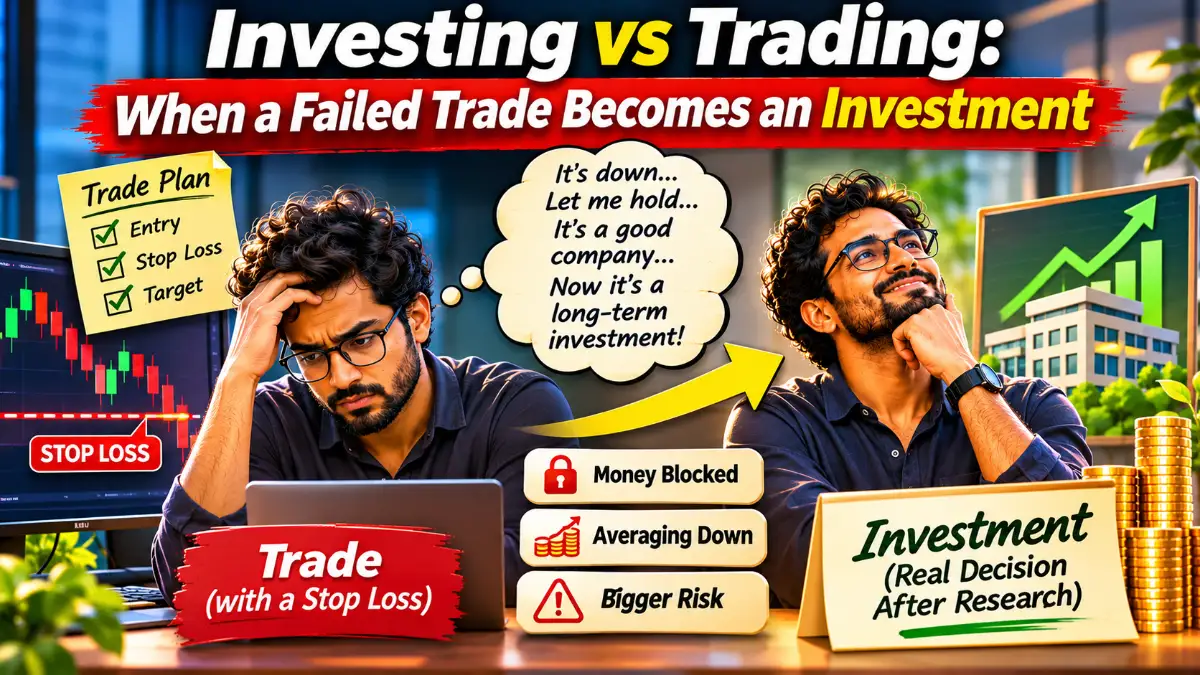
One of the most dangerous habits in the stock market is turning a failed trading position into a long-term investment without making a proper investment decision. A stock is purchased for a short-term price movement, the trade goes wrong, the stop-loss is ignored and the trader suddenly starts talking about the company’s long-term potential.
This change may sound reasonable, but there is an important difference between deliberately investing in a business and holding a losing trade because accepting the loss feels uncomfortable. When the original trading idea fails, changing the name of the position does not change the financial reality.
In Simple Words
A failed trade does not automatically become a good investment just because the trader decides to hold it. A genuine investment requires fresh research, independent reasoning and a separate decision about the business, its valuation and its future prospects.
1. How a Failed Trade Gets Relabelled
The process often begins with a straightforward trading decision. A trader identifies a breakout, enters a stock and defines a stop-loss based on the chart structure.
Also Read: Investing vs Trading: Lessons from Well-Known Investors and Traders
When the stock falls, the original setup starts weakening. Instead of exiting at the planned stop-loss, the trader waits for a recovery. If the price continues declining, the explanation changes.
The trader may start saying that the company is fundamentally strong, its business has a good future or the stock will eventually recover. What started as a short-term trading opportunity becomes a supposed long-term investment. The important point is that the original decision was not based on long-term ownership. The investment explanation appeared only after the trading decision failed.
2. Why This Change Feels Reasonable
Accepting a failed trade is uncomfortable. It means acknowledging that the original market expectation was incorrect.
Holding the stock offers psychological relief because the trader no longer needs to make an immediate exit decision. Instead of recognising a loss, they can tell themselves that they are now investing for the future. This reasoning becomes particularly attractive when the company is well known, has a recognisable brand or has performed well in the past. But a good company is not automatically a good investment at every price. Business quality, valuation and future expectations still need to be examined. The biggest warning sign is when the decision to become an investor happens only after the trading position moves into a loss.
Also Read: Investing vs Trading: Can You Do Both?
3. A Trading Decision and an Investment Decision Are Not the Same
A genuine investment decision should stand independently of an earlier trading loss.
An investor needs to examine the company’s financial health, revenue and profit trends, debt, cash generation, competitive position, management quality and valuation. The investment should make sense even if the person had never previously traded the stock.
A trader, on the other hand, entered because a particular market setup offered an opportunity. Once that setup becomes invalid, the original reason for holding the position no longer exists. The distinction is simple: would the person purchase the same stock today at its current price after conducting fresh research, even without the existing losing position? If the answer is no, the long-term investment explanation may simply be an excuse to avoid closing a failed trade.
4. The Hidden Cost: Money Gets Trapped
Holding a failed trade can block capital that could otherwise be available for other financial opportunities.
Also Read: Investing vs Trading: Which Suits a Working Person?
Suppose a trader enters a position expecting a short-term upward movement. The stock falls, the stop-loss is ignored and the position remains in the portfolio without a properly researched investment thesis. That money is now tied to a decision that may no longer have a valid reason behind it. The problem is not just the unrealised loss. It is also the opportunity cost of keeping capital committed to a position that the trader might not choose again independently. A portfolio can gradually fill with unwanted holdings simply because closing them would require acknowledging earlier mistakes.

5. Averaging Down Can Make the Problem Bigger
Another common response is buying more shares as the price falls. The trader believes that a lower average purchase price will make recovery easier. However, averaging down increases the amount of capital exposed to the same company. It does not repair the original trading setup or guarantee a recovery.
Consider this illustrative example:
- Initial purchase: 100 shares at ₹500 = ₹50,000.
- Original stop-loss: ₹480.
- Planned loss at stop-loss: ₹2,000.
- Market price subsequently falls to ₹400.
- Existing position value: ₹40,000.
- Unrealised loss: ₹10,000.
The trader then purchases another 100 shares at ₹400 for ₹40,000.
Also Read: Investing vs Trading: Costs and Taxes of Frequent Buying and Selling
| Detail | After averaging down |
|---|---|
| Total shares | 200 |
| Total investment | ₹90,000 |
| Average purchase price | ₹450 |
| Current market value | ₹80,000 |
| Unrealised loss | ₹10,000 |
The average purchase price has fallen from ₹500 to ₹450, but the trader now has ₹90,000 committed to the position instead of ₹50,000. A lower average price does not mean the investment has become safer. It means more capital is exposed to the outcome of the same business. Illustrative calculation, excluding brokerage, taxes and other charges.
6. Ask These Questions Before Calling It an Investment
Before converting a losing trading position into a long-term holding, ask:
- Would I purchase this company today if I had no existing position?
- Have I studied its financial statements and current business performance?
- Is the current valuation reasonable based on its prospects?
- Has the original trading setup become invalid?
- Am I holding because of genuine investment research or because I do not want to accept a loss?
- Am I adding more money because the business offers a researched opportunity or simply because the price has fallen?
- Does this holding deserve the capital currently committed to it?
Honest answers can reveal whether the position has a genuine investment thesis or is simply a failed trade being defended.
7. A Written Rule to Prevent This Mistake
Every position should have a clearly documented purpose before entering the market.
Also Read: Investing vs Trading: Risk and Position Size Explained
The OneTrader rule: A failed trade cannot become an investment automatically. If the original trading setup is invalidated, close or reassess the position according to the trading plan. Any decision to hold it as an investment must be treated as a completely new decision, supported by fresh fundamental research and an independent assessment of its current valuation. Never average down merely to reduce the displayed purchase price. This rule creates a clear separation between trading mistakes and genuine investment opportunities. It also prevents emotions from quietly changing the original reason for holding a stock.
Key Takeaways
- A failed trade does not automatically become a long-term investment.
- Relabelling often happens after a trader ignores the original stop-loss.
- A genuine investment requires independent research and valuation analysis.
- Holding unwanted positions can block capital and create opportunity costs.
- Averaging down increases exposure without guaranteeing recovery.
- A fresh investment decision should make sense even without the original trading position.
- Every position should have a clearly defined purpose and documented rules.
Final Thought
The market does not care whether a losing position is called a trade or an investment. Changing its name cannot reverse the price movement or repair a failed decision.
There is nothing wrong with owning a stock for the long term after conducting proper research. The problem begins when long-term investing becomes a convenient explanation for avoiding a trading loss.
A disciplined market participant must be willing to admit when the original idea has failed. Sometimes the best decision is not finding another reason to hold a stock, but recognising that the reason for entering it no longer exists.
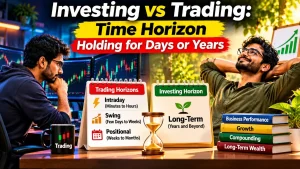
Also Read: Investing vs Trading: Time Horizon, Holding for Days or Years
More in This Series
- Investing vs Trading: What Is the Difference?
- Investing vs Trading: Time Horizon: Days or Years
- Investing vs Trading: Risk and Position Size
- Investing vs Trading: Costs and Taxes
- Investing vs Trading: Which Suits a Working Person?
- Investing vs Trading: Can You Do Both?
- Investing vs Trading: Lessons from Well-Known Investors and Traders
Disclaimer: This article is for educational and informational purposes only and does not constitute investment advice or a recommendation to buy or sell any security. Stock market investments and trading involve financial risks, including the possibility of capital loss. Readers should conduct independent research and assess their financial circumstances before making investment decisions.


Keep learning with OneTrader
Explore structured lessons and practical guides to build your market knowledge.
