

Many people enter the stock market with an interest in both investing and trading. They want to own quality businesses for wealth creation while also exploring shorter-term opportunities through active trading. These two activities can exist together, but combining them without clear boundaries can create confusion and unnecessary financial risk.
The challenge is not doing both. The challenge is managing them as two separate activities with different objectives, capital allocations, decision-making rules and performance expectations. Without that separation, money intended for long-term investments can gradually become trading capital, and trading losses can start influencing investment decisions.
In Simple Words
Yes, you can be both an investor and a trader. The key is to maintain separate capital, separate rules and separate records so that decisions in one activity do not damage the other.
1. When Does Doing Both Make Sense?
Doing both can make sense when someone genuinely understands the requirements of each activity and has sufficient financial resources to keep them separate.
Also Read: Investing vs Trading: Lessons from Well-Known Investors and Traders
For example, a person may want to build a portfolio of companies based on their business quality and financial performance. At the same time, they may enjoy studying charts and identifying short-term trading opportunities.
There is nothing inherently wrong with this combination. The problem begins when the person uses investment money to support trading activity or starts treating every trading opportunity as an investment.
Both activities should have independent objectives. Long-term investments should be evaluated on their own business and financial merits, while trading positions should be managed according to predefined trading rules.
2. Keep Investment Money and Trading Money Separate
The first practical step is separating the capital allocated to each activity. Investment capital should be reserved for the investment portfolio. Trading capital should be limited to the amount specifically allocated for active trading.
Also Read: Investing vs Trading: When a Failed Trade Becomes an ‘Investment’
Consider this clearly illustrative example of savings totalling ₹10 lakh:
| Allocation | Amount |
|---|---|
| Long-term investment portfolio | ₹6,00,000 |
| Trading capital | ₹2,00,000 |
| Emergency savings | ₹2,00,000 |
| Total | ₹10,00,000 |
This is only an example of how separate financial buckets can be maintained. It is not a recommended allocation, and actual requirements depend on individual financial circumstances. The important principle is that a trading loss should not automatically create a reason to withdraw money from the investment portfolio.
3. Use Separate Accounts or Portfolios
Maintaining separate investment and trading accounts or clearly separated portfolios can make financial discipline easier.
For example, one account can be used for long-term shareholdings, while another can be used for active trading. This helps distinguish the purpose of each position and makes it easier to review performance independently. Even when separate broker accounts are not practical, maintaining clearly labelled portfolios and accurate transaction records can achieve much of the same organisational benefit. A long-term investment should not be confused with an active trading position simply because both involve shares listed on the same exchange.
Also Read: Investing vs Trading: Which Suits a Working Person?
4. Create Separate Written Rules
Investment and trading decisions should follow different written frameworks.
An investment plan should explain why a company is being held, what financial and business developments matter, which risks could weaken the original investment reasoning and what conditions would justify reviewing or exiting the holding.
A trading plan should define the setup, entry conditions, stop-loss, exit conditions and maximum acceptable risk. Trading decisions should be evaluated against these rules rather than against the performance of the investment portfolio.

This separation prevents one activity from changing the logic of the other. It also makes it easier to identify whether a disappointing result came from investment research or trading execution. As discussed in Part 6, a failed trading position should never be quietly transferred into the investment portfolio to avoid recognising a trading mistake.
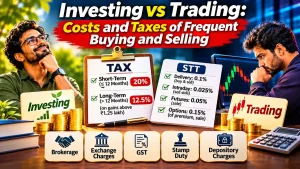
Also Read: Investing vs Trading: Costs and Taxes of Frequent Buying and Selling
5. Maintain Separate Records and Review Performance Independently
Combining all market activity into one profit-and-loss figure can hide important information. An investor needs to understand how individual businesses are performing, whether the original investment reasoning remains valid and how the portfolio is developing. A trader needs to examine trade execution, strategy performance, rule violations and the consistency of results.
Keeping separate records makes these reviews more meaningful. It also prevents a profitable investment from disguising poor trading performance or a temporary trading gain from creating false confidence about investment decisions.
A practical approach is to maintain separate monthly reviews. Investment reviews can focus on company developments and portfolio quality, while trading reviews can focus on execution and adherence to the trading plan.
6. Warning Signs That Trading Is Eating Into Your Investments
Doing both becomes dangerous when active trading starts consuming resources or attention that were originally intended for long-term financial goals. Watch for these warning signs:
Also Read: Investing vs Trading: Risk and Position Size Explained
- Regularly withdrawing investment money to recover trading losses.
- Selling long-term holdings to fund new trading opportunities.
- Increasing trading capital after every losing period without a planned review.
- Ignoring investment goals because daily trading activity feels more exciting.
- Using investment holdings as emotional support for unsuccessful trades.
- Mixing trading and investment records until it becomes difficult to identify actual performance.
- Depending on investment profits to cover repeated trading losses.
These behaviours indicate that the two activities are no longer operating independently. At that point, the entire financial arrangement needs to be reviewed.
7. Protect the Purpose of Each Rupee
Money should have a clearly defined purpose before entering the market. Investment capital exists to support the investment plan. Trading capital exists to support the trading plan. Emergency savings exist to handle unexpected financial requirements. When these boundaries are respected, an individual can participate in both activities without constantly transferring financial pressure from one to the other. The objective is not to make investing and trading compete for attention. It is to ensure that both operate within clearly defined financial limits.
Key Takeaways
- An individual can participate in both investing and trading.
- Each activity should have a separate financial purpose.
- Keep investment capital, trading capital and emergency savings clearly separated.
- Separate accounts or portfolios can improve financial organisation.
- Maintain independent written rules for investments and trades.
- Review investment performance and trading performance separately.
- Never use long-term investments as an automatic source of trading capital.
- Watch for signs that trading activity is interfering with financial goals.
Final Thought
Being an investor and a trader at the same time is possible, but it requires more discipline than simply participating in the stock market through two different methods.
The real challenge is protecting the purpose of each activity. An investment should not become a source of money for repeated trading mistakes, and trading should not be used to justify decisions that belong in a long-term portfolio. You do not have to choose only one identity in the market. But you must understand the responsibility that comes with each one.
Also Read: Investing vs Trading: Time Horizon, Holding for Days or Years
More in This Series
- Investing vs Trading: What Is the Difference?
- Investing vs Trading: Time Horizon: Days or Years
- Investing vs Trading: Risk and Position Size
- Investing vs Trading: Costs and Taxes
- Investing vs Trading: Which Suits a Working Person?
- Investing vs Trading: When a Failed Trade Becomes an Investment
- Investing vs Trading: Lessons from Well-Known Investors and Traders
Disclaimer: This article is for educational and informational purposes only and does not constitute investment advice or a recommendation to buy or sell any financial instrument. Investing and trading involve market risks, including the possibility of losing capital. The illustrative allocation is not a financial recommendation. Readers should assess their financial goals, emergency requirements and risk tolerance before allocating money to financial markets.





Keep learning with OneTrader
Explore structured lessons and practical guides to build your market knowledge.
