
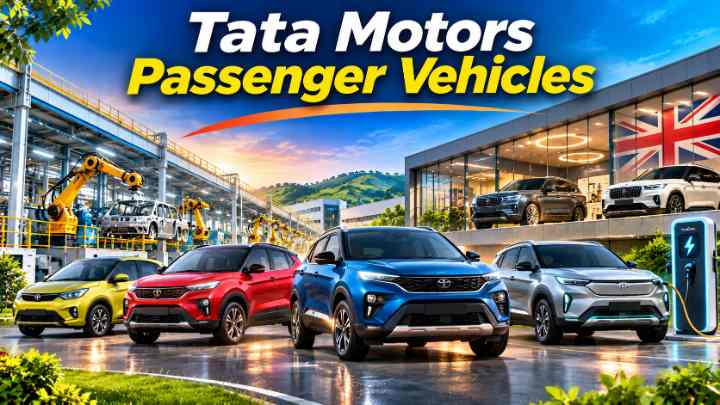
Explore Tata Motors Passenger Vehicles' business model, car and SUV portfolio, electric vehicle strategy, Jaguar Land Rover business, competition and long-term growth opportunities.
- Tata Motors Passenger Vehicles operates across three important areas: domestic passenger vehicles, electric mobility and luxury automobiles through Jaguar Land Rover.
- The company earns revenue primarily through manufacturing and selling passenger vehicles, electric cars and luxury automobiles.
- Tata Motors has developed a broad passenger vehicle portfolio covering different customer requirements.
Tata Motors Passenger Vehicles is one of India’s leading automobile businesses, with operations spanning passenger cars, sport utility vehicles (SUVs), electric vehicles and luxury vehicles through Jaguar Land Rover (JLR). Its portfolio serves customers across different price segments, from affordable personal cars and family SUVs to premium electric vehicles and luxury international brands. The company combines India’s growing passenger vehicle market with JLR’s global presence in the luxury automobile industry.
The business underwent a major structural change following the demerger of Tata Motors’ commercial vehicle operations. Effective October 1, 2025, the passenger vehicle business, electric vehicle operations and JLR were consolidated under Tata Motors Passenger Vehicles Limited, while the commercial vehicle business became a separate listed company under the Tata Motors name. The new structure allows the passenger vehicle business to focus on personal mobility, electric cars, SUVs and international luxury brands.
In simple words: Tata Motors Passenger Vehicles makes cars and SUVs for Indian customers, develops electric vehicles and owns Jaguar Land Rover’s luxury automobile business. It earns money through vehicle sales, premium products, electric mobility and international operations. Its growth depends on strengthening its Indian vehicle portfolio, expanding EV adoption and improving the performance of JLR.
What Tata Motors Passenger Vehicles Does
Tata Motors Passenger Vehicles operates across three important areas: domestic passenger vehicles, electric mobility and luxury automobiles through Jaguar Land Rover.
Its Indian portfolio includes hatchbacks, sedans, compact SUVs, mid-size SUVs and electric cars. The company competes across multiple price categories and offers petrol, diesel, CNG and electric powertrains.
Its electric vehicle business operates through Tata Passenger Electric Mobility, a subsidiary focused on developing and selling electric passenger vehicles.
Jaguar Land Rover adds an international luxury automobile business. Its brands include Range Rover, Defender, Discovery and Jaguar, each targeting different customer preferences within the premium vehicle market.
This combination gives the company exposure to India’s mass-market automobile industry and the global luxury vehicle segment.
How Tata Motors Passenger Vehicles Makes Money
The company earns revenue primarily through manufacturing and selling passenger vehicles, electric cars and luxury automobiles.
Its revenue model also includes vehicle-related services, spare parts, accessories, financing-related arrangements and other customer services.
| Business area | How it generates revenue |
|---|---|
| Tata passenger vehicles | Cars, SUVs and other personal vehicles |
| Electric vehicles | Electric cars and related products |
| Jaguar Land Rover | Luxury SUVs and premium vehicles |
| Spare parts and accessories | Replacement components and vehicle accessories |
| Vehicle services | Maintenance and after-sales support |
The domestic passenger vehicle business depends on vehicle volumes, model mix, pricing and manufacturing efficiency.
The EV business offers opportunities to increase participation in electric mobility, while JLR provides exposure to premium vehicle pricing and international markets.
Also Read: BSE Ltd: How Asia’s Oldest Stock Exchange Earns from Trading, Data, Listings and Derivatives
Product Portfolio and Customers
Tata Motors has developed a broad passenger vehicle portfolio covering different customer requirements.
| Product category | Representative models |
|---|---|
| Hatchbacks | Tiago, Altroz |
| Compact SUVs | Punch, Nexon |
| Mid-size SUVs | Harrier, Safari |
| Sedans | Tigor |
| Electric vehicles | Tiago.ev, Punch.ev, Nexon.ev, Curvv.ev |
| Luxury vehicles | Range Rover, Defender, Discovery, Jaguar |
The domestic business targets first-time car buyers, families, urban commuters, SUV customers and consumers shifting towards electric mobility.
JLR serves a different customer segment. Its vehicles appeal to premium and luxury buyers who value design, performance, technology, comfort and brand identity.
This combination gives the company access to customers across multiple income groups and geographical markets.
Growth Strategy: SUVs, Electric Cars and Premiumisation
Tata Motors Passenger Vehicles is focusing on three major growth opportunities: strengthening its SUV portfolio, expanding electric mobility and improving its premium vehicle business.
Strengthening the SUV portfolio
SUVs have become an important part of the Indian passenger vehicle market. Customers increasingly prefer vehicles with higher ground clearance, spacious interiors, modern features and road presence.
Tata Motors has built a strong SUV portfolio through models such as the Punch, Nexon, Harrier and Safari.

The strategy involves improving product design, safety, technology and powertrain choices while introducing new models to address different customer preferences.
Expanding electric mobility
Electric vehicles are a major part of Tata Motors’ long-term passenger vehicle strategy.
Through Tata Passenger Electric Mobility, the company has developed an EV portfolio covering different vehicle categories.
Its opportunities include expanding charging-related ecosystem support, improving battery technology, developing new electric platforms and making EV ownership more accessible.
The company can also benefit from its experience in electric vehicle manufacturing, distribution and customer servicing.
Developing new vehicle platforms
Modern vehicle platforms allow manufacturers to develop multiple models with shared engineering, technology and production capabilities.
Tata Motors can use platform development to improve manufacturing efficiency, introduce new vehicle categories and support different powertrain technologies.
Premiumisation
Customers are increasingly looking for better interiors, connected features, safety systems and advanced driving technology.
Tata Motors can improve its product mix by offering higher-value variants and premium features.
Also Read: Federal Bank: How the Lender Is Building Growth Through Retail Banking and Digital Finance
At the international level, JLR follows a premium and luxury positioning strategy through its distinct vehicle brands.
Jaguar Land Rover: The Global Luxury Business
Jaguar Land Rover is an important part of Tata Motors Passenger Vehicles because it provides access to the international luxury automobile market.
Its business operates through four distinctive brands.
| Brand | Market positioning |
|---|---|
| Range Rover | Luxury SUVs |
| Defender | Premium off-road vehicles |
| Discovery | Family-focused premium SUVs |
| Jaguar | Luxury performance vehicles |
JLR’s business model focuses on premium pricing, distinctive designs, advanced engineering and brand value.
Also Read: IDFC FIRST Bank: How the Lender Is Building Growth Through Retail Banking and Digital Finance
Its vehicles compete in markets where customers place significant importance on performance, technology, comfort and brand reputation.
The luxury business also provides geographical diversification. While Tata’s Indian passenger vehicle operations depend heavily on domestic demand, JLR serves customers across international markets.
However, premium automobile demand can be sensitive to economic conditions, currency movements, trade policies and changing consumer preferences.
Electric Vehicles: A Major Long-Term Opportunity
Tata Motors has been an important participant in India’s electric passenger vehicle market.
Also Read: IndusInd Bank: How the Lender Is Rebuilding Growth Through Retail Banking and Vehicle Finance
Its EV portfolio gives the company exposure to a market that could expand as battery costs, charging infrastructure and consumer acceptance improve.
The electric vehicle opportunity extends beyond vehicle manufacturing.
It includes battery technology, charging infrastructure, software, connected features, vehicle servicing and battery lifecycle management.
The company needs to keep improving vehicle range, charging convenience, affordability and battery performance to encourage wider adoption.
Competition is also increasing as domestic and international automobile manufacturers introduce new electric models.
Competition in the Indian and Global Automobile Markets
Tata Motors Passenger Vehicles competes with established automobile manufacturers in India and international luxury markets.
| Competitor | Main competitive strengths |
|---|---|
| Maruti Suzuki | Mass-market cars and distribution |
| Mahindra & Mahindra | SUVs and utility vehicles |
| Hyundai Motor India | Passenger cars and SUVs |
| Kia India | Feature-rich SUVs |
| Toyota Kirloskar Motor | Reliability and hybrid vehicles |
| MG Motor India | SUVs and electric vehicles |
| Global luxury brands | Premium and luxury automobiles |
Maruti Suzuki has a strong position in the mass-market passenger vehicle segment, supported by its distribution and service network.
Mahindra is a major competitor in SUVs, while Hyundai and Kia compete through product design, features and technology.
Also Read: Vedanta: How Commodity Prices, Higher Volumes and Debt Reduction Drive Its Business
In electric vehicles, Tata Motors faces increasing competition from manufacturers introducing new battery-powered models.
JLR competes separately against international luxury brands, where brand strength, product differentiation and customer experience are important.
The company’s competitive position will depend on product launches, pricing, manufacturing quality, technology and after-sales service.
Key Business Risks
The passenger vehicle and luxury automobile businesses face several risks that can influence demand and profitability.
Intense competition: Price reductions, new launches and promotional spending can affect market share and margins. EV adoption: Slower electric vehicle adoption can affect the returns expected from EV investments. Battery technology: Battery costs, performance, safety and supply chain requirements remain important considerations. Commodity costs: Steel, aluminium, battery materials and other components influence manufacturing expenses. JLR exposure: Weak luxury vehicle demand, international economic conditions and currency movements can affect the global business. Product execution: New vehicle launches must meet customer expectations for quality, reliability and technology. Regulatory requirements: Emission standards, safety rules and environmental regulations can require additional investment. After-sales service: Customer satisfaction depends on service availability, spare parts and maintenance quality.
The company must balance investments in electric mobility and new products with pricing discipline and operational efficiency.
What Investors Should Watch
SUV market position: Investors should monitor whether Tata Motors can maintain customer interest across its compact and premium SUV categories.
EV portfolio development: New models, battery technology, vehicle range and charging ecosystem improvements will influence its competitive position.
Domestic market share: Product acceptance, distribution strength and customer satisfaction can determine long-term passenger vehicle market performance.
JLR brand performance: The performance of Range Rover, Defender, Discovery and Jaguar will remain important to the overall business.
Product mix: Higher-value SUVs, premium variants and luxury vehicles can influence average selling prices and profitability.
Manufacturing efficiency: Capacity utilisation, production quality and supply chain management affect the cost of vehicle manufacturing.
Also Read: Siemens Energy India: How Power Transmission, Generation and Project Backlogs Drive Its Business
Technology investments: Connected vehicles, software, safety systems and electric powertrains require continuous investment.
Capital allocation: Investors should assess whether investments in new platforms, EVs and manufacturing facilities generate sustainable returns.
Key Takeaways
Tata Motors Passenger Vehicles combines India’s passenger vehicle business, electric mobility and Jaguar Land Rover. The commercial vehicle demerger became effective on October 1, 2025, creating a separate listed commercial vehicle company. Tata’s domestic portfolio includes hatchbacks, sedans, SUVs and electric cars. SUVs are an important part of its Indian growth strategy. Electric mobility offers long-term opportunities through new models, battery technology and charging infrastructure. JLR provides exposure to international luxury automobile markets through Range Rover, Defender, Discovery and Jaguar. Maruti Suzuki, Mahindra, Hyundai and other manufacturers are major competitors in India. EV adoption, competition, commodity costs and international luxury demand remain important business risks.
Tata Motors Passenger Vehicles has a diversified automobile business spanning mass-market cars, SUVs, electric vehicles and international luxury brands. Its growth opportunity comes from India’s expanding passenger vehicle market, rising SUV demand and the transition towards electric mobility. JLR adds an important international dimension, but also exposes the company to global luxury automobile cycles. The ability to develop competitive products, strengthen EV economics and maintain JLR’s premium positioning will shape its long-term business performance.
Also Read: Shree Cement: How Premium Products, Sales Growth and Cost Management Drive Its Business
Financial Disclaimer: This article is intended for educational and informational purposes only. It does not constitute investment advice or a recommendation to buy, sell or hold Tata Motors Passenger Vehicles shares. Investors should independently evaluate the company’s financial performance, valuation, product portfolio, competitive position, EV strategy and business risks before making any investment decision.








Keep learning with OneTrader
Explore structured lessons and practical guides to build your market knowledge.
