
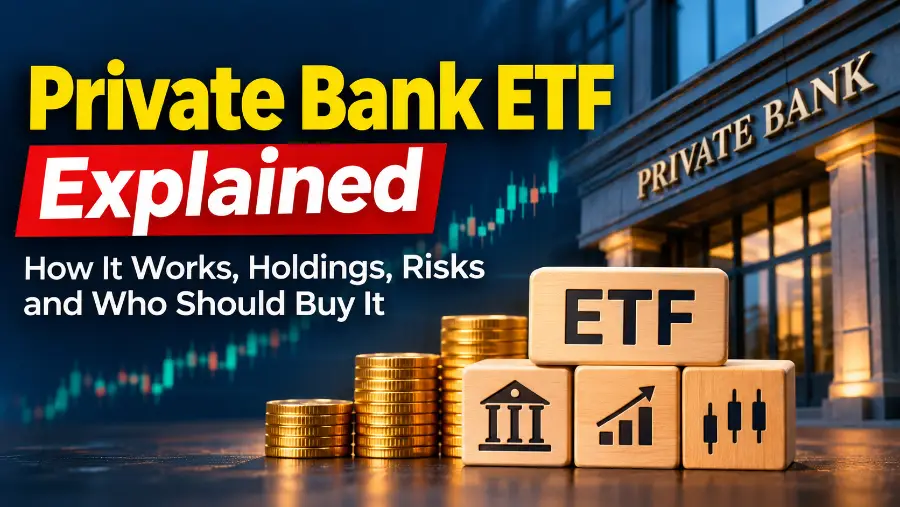
Private sector banks play an important role in India’s financial system, supporting retail lending, corporate finance, digital payments and the country’s expanding credit economy. For investors who want exposure to this segment without purchasing individual banking stocks, a Private Bank ETF offers a convenient way to invest in a basket of listed private sector banks through a single exchange-traded product.
However, investing in a banking ETF is different from buying a diversified market index. Its performance depends heavily on the banking industry’s growth, credit conditions, interest rates and the financial health of its underlying companies. Understanding its holdings, concentration and risks is essential before investing.
In simple words
A Private Bank ETF is an exchange-traded fund that tracks an index of selected private sector banks. Instead of buying shares of individual banks, investors purchase one ETF that provides exposure to several banking stocks. Its returns broadly follow the performance of the underlying index, after expenses and tracking differences.
What Is a Private Bank ETF?
A Private Bank ETF is a sector-specific exchange-traded fund that invests in shares of private sector banks. In India, such ETFs generally track the Nifty Private Bank Index, which represents selected private banking companies listed on the National Stock Exchange.
Unlike a Nifty 50 ETF, which provides exposure to companies across multiple sectors, this ETF concentrates entirely on private banking businesses. Investors therefore gain targeted exposure to the banking industry rather than the broader Indian equity market.
The underlying index selects eligible private banks using market capitalisation, liquidity and other eligibility criteria. It follows a capped free-float market capitalisation methodology, with periodic reviews to maintain its composition.
How Does a Private Bank ETF Work?
The fund house creates an ETF portfolio designed to replicate the underlying index. It purchases shares of the constituent banks in approximately the same proportions as their index weights.
Also Read: Liquid ETF Explained: How Liquid ETFs Work in India, Returns, Risks and Who Should Buy Them
Investors can buy and sell ETF units through a stock exchange during market hours, just like ordinary shares. A demat and trading account is generally required.
For example, if an investor purchases ₹10,000 worth of a Private Bank ETF, the investment provides exposure to the underlying banking portfolio rather than ownership of one particular bank.

The ETF’s market price changes throughout the trading session based on demand, supply and the value of its underlying holdings. Its net asset value (NAV) represents the per-unit value of the portfolio, while tracking error measures how closely the fund follows its benchmark.
What Are the Holdings of a Private Bank ETF?
An ETF tracking the Nifty Private Bank Index provides exposure to established private lenders as well as smaller banking institutions.
Also Read: Liquid ETF Explained: How Liquid ETFs Work in India, Returns, Risks and Who Should Buy Them
Its portfolio typically includes:
| Bank | Business focus |
|---|---|
| HDFC Bank | Retail and corporate banking |
| ICICI Bank | Universal banking and financial services |
| Axis Bank | Retail and corporate lending |
| Kotak Mahindra Bank | Banking and wealth management |
| Federal Bank | Retail and business banking |
| IndusInd Bank | Consumer and commercial banking |
| IDFC First Bank | Retail and digital banking |
| Yes Bank | Corporate and retail banking |
| RBL Bank | Cards and retail lending |
| Bandhan Bank | Microfinance and retail banking |
The exact holdings and weightages can change following index reviews. Importantly, the largest banks generally account for a substantial portion of the portfolio. Consequently, the ETF’s performance can be influenced disproportionately by a handful of major institutions.
What Drives Private Bank ETF Returns?
Several factors influence the performance of private banking stocks and, consequently, the ETF.
Credit growth: Rising demand for home loans, personal loans, business credit and corporate financing can support banks’ loan books and revenue growth.
Net interest margins: The difference between interest earned on loans and interest paid on deposits is important for bank profitability. Changes in lending and deposit rates can affect these margins.
Asset quality: Lower non-performing assets and controlled credit losses improve profitability. A rise in defaults can hurt earnings and investor confidence.
Deposit mobilisation: Banks need stable deposit growth to support lending. Intense competition for deposits can increase funding costs.
Economic conditions: Strong economic activity generally supports credit demand, while economic slowdowns can increase repayment difficulties.
Also Read: Railway and Capital Goods ETF Explained: How It Works, Holdings, Risks and Who Should Buy It
Risks of Investing in a Private Bank ETF
Despite offering multiple banking stocks in one investment, a Private Bank ETF carries meaningful risks.
- Sector concentration: The portfolio is restricted to banking stocks. Weakness across the banking industry can affect almost all its holdings simultaneously.
- Stock concentration: Larger banks command higher index weights, creating dependence on a few major institutions.
- Interest rate risk: Changes in interest rates can influence lending margins, borrowing demand and bank valuations.
- Credit risk: Rising loan defaults, unsecured lending stress or deteriorating asset quality can affect banking stocks.
- Market volatility: Banking stocks can experience sharp price movements during economic uncertainty or regulatory changes.
- Liquidity and tracking risk: Low ETF trading volumes, wider bid-ask spreads and tracking differences can increase investment costs.
An ETF does not eliminate the possibility of capital loss. Investors should also compare expense ratios, trading liquidity and tracking error before selecting a particular scheme.
Private Bank ETF vs Nifty 50 ETF
| Feature | Private Bank ETF | Nifty 50 ETF |
|---|---|---|
| Exposure | Private banks | Multiple sectors |
| Diversification | Sector-specific | Broad market |
| Risk | Concentrated | Relatively diversified |
| Growth drivers | Banking industry | Overall corporate economy |
| Portfolio role | Sector allocation | Core equity exposure |
A Private Bank ETF can complement a diversified portfolio, but it should not automatically replace a broad-market ETF.
Who Should Buy a Private Bank ETF?
This investment may suit investors who have a positive long-term outlook for India’s private banking industry and want sector exposure without selecting individual banking stocks.
It can also interest experienced investors looking to complement an existing diversified equity portfolio with a targeted banking allocation.
However, it may not suit beginners seeking broad diversification, investors with low risk tolerance or those who need their money in the short term.
Before investing, examine the ETF’s expense ratio, assets under management, trading volumes, bid-ask spread and tracking error. Using limit orders rather than blindly placing market orders can also help avoid unfavourable execution prices.
Key Takeaways
- A Private Bank ETF provides exposure to multiple listed private sector banks through one investment.
- Most Indian products in this category track the Nifty Private Bank Index.
- Returns depend on banking sector performance, credit growth, margins and asset quality.
- Concentration in a few large banks is an important portfolio risk.
- Compare liquidity, expenses and tracking error before choosing an ETF.
- Consider it a sector allocation rather than a complete equity investment strategy.
Financial Disclaimer: This article is for educational and informational purposes only and should not be considered investment advice. ETFs are subject to market risks, including the possibility of losing invested capital. Investors should evaluate their financial goals, risk tolerance and investment horizon before making investment decisions.
Also Read: Bharat 22 ETF Explained: How It Works, Holdings, Risks and Who Should Buy It




Keep learning with OneTrader
Explore structured lessons and practical guides to build your market knowledge.

Need a laugh after all that money talk?
Paisa LOL: India's funniest finance page, with memes, comics, jokes and long funny stories.
