
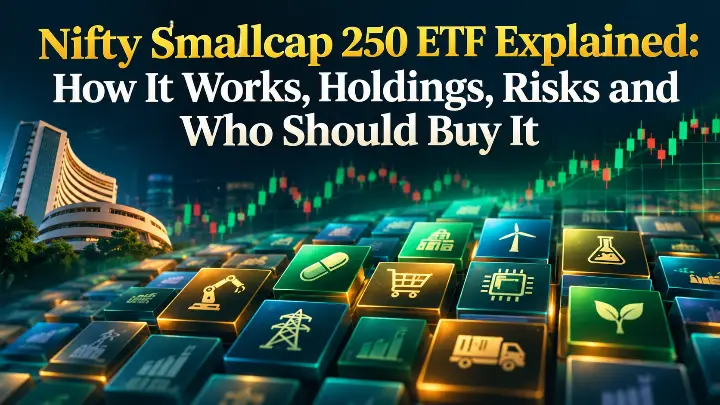
India’s small-cap market includes businesses that may benefit from rising consumption, infrastructure spending, manufacturing expansion and technology adoption. These companies can also be more vulnerable to economic slowdowns, funding pressures and changing investor sentiment.
The Nifty Smallcap 250 ETF offers exposure to this segment without selecting individual shares. It tracks an index of 250 small-cap companies through one exchange-traded investment. Investors should understand its construction, holdings and volatility before investing.
In simple words
A Nifty Smallcap 250 ETF is a passively managed fund that aims to follow the Nifty Smallcap 250 index. Investors buy and sell its units on the stock exchange, gaining exposure to a basket of small-cap shares rather than purchasing each company separately.
What Is the Nifty Smallcap 250 Index?
The Nifty Smallcap 250 measures the performance of 250 companies selected from the Nifty 500 universe. These are generally companies ranked from 251 to 500 by full market capitalisation, after accounting for the index’s eligibility rules. The index is designed to represent the smaller listed companies beyond the large-cap and mid-cap segments.
The index uses free-float market capitalisation weighting. In simple terms, a company’s weight depends on the market value of shares available for public trading, rather than its entire shareholding. Larger eligible companies therefore tend to have greater influence on index performance. The index is reviewed periodically, so constituents and their weights can change as companies grow, shrink or fall outside the selection criteria.
The index is commonly assessed through its Total Returns Index (TRI), which accounts for dividends from constituent companies as well as share-price movements. When comparing an ETF with its benchmark, investors should use the same return basis and matching periods. Comparing an ETF’s price return with the TRI can give a misleading impression of tracking performance.
How Does a Nifty Smallcap 250 ETF Work?
An ETF tracking this index pools investors’ money and holds the underlying shares in proportions intended to mirror the index. The fund does not try to identify the next multibagger or avoid companies based on a fund manager’s view. Its objective is to replicate the benchmark, subject to expenses and tracking differences.

Also Read: Liquid ETF Explained: How Liquid ETFs Work in India, Returns, Risks and Who Should Buy Them
ETF units trade on the stock exchange during market hours through a demat and trading account. Their prices move with the underlying portfolio but may differ from net asset value (NAV) because of demand, liquidity and the bid-ask spread. A ₹10,000 purchase provides exposure to the weighted portfolio, not equal ownership of all 250 shares.
What Does the ETF Hold?
The portfolio follows the index, so its constituents and weights change over time. The index can provide exposure to businesses across banking and financial services, pharmaceuticals, healthcare, capital goods, engineering, chemicals, automobiles, technology, logistics and consumer industries.
Companies that have featured among constituents at different times include Karur Vysya Bank, Navin Fluorine International, Delhivery, Central Depository Services and Aster DM Healthcare. These are examples, not a permanent holdings list. Investors should check the chosen ETF’s latest portfolio disclosure before investing because index reviews and market movements can change both membership and weightings.
Diversification across 250 companies reduces dependence on any one stock, but it does not make the investment low-risk. Small-cap companies can be affected by similar forces, such as tighter credit, weaker demand, rising input costs or a broad market sell-off. Several holdings may fall together during a difficult period.
Also Read: Liquid ETF Explained: How Liquid ETFs Work in India, Returns, Risks and Who Should Buy Them
Advantages and Risks to Consider
The main attraction is convenient, rules-based access to smaller listed businesses without researching and purchasing hundreds of individual shares. Passive management can also mean lower costs than many actively managed small-cap funds, although the actual expense ratio varies by scheme. Disclosed holdings add transparency, while exchange trading gives investors flexibility over execution.
However, the risks are substantial:
- Higher volatility: Small-cap shares can fall sharply during market corrections and may take longer to recover.
- Business risk: Smaller companies can have limited financial resources, concentrated customers or less established business models.
- Valuation risk: Investors may pay excessive prices during periods of strong enthusiasm, leaving shares vulnerable to corrections.
- Liquidity risk: Some underlying shares trade in lower volumes, making transactions more difficult in stressed markets.
- Tracking difference: Expenses, cash balances, trading costs and portfolio adjustments can cause ETF returns to differ from the index.
- Price versus NAV: Thin trading or wide bid-ask spreads can lead investors to buy above or sell below the portfolio’s indicative value.
An ETF spreads company-specific exposure, but it cannot protect investors from a broad decline in small-cap shares.
How to Choose a Nifty Smallcap 250 ETF
More than one fund house may offer an ETF tracking the same index. Their benchmark may be similar, but their costs, trading activity and ability to track the index can differ. Compare these factors before choosing:
| Factor | What to examine |
|---|---|
| Expense ratio | The annual cost charged by the scheme |
| Tracking difference | How closely returns follow the benchmark over time |
| Trading liquidity | Average exchange volumes and ease of execution |
| Bid-ask spread | The gap between buying and selling prices |
| Assets under management | The fund’s size and operating scale |
| Portfolio | Whether it follows the intended index |
A lower unit price does not make an ETF cheaper or better value. Check the latest NAV or indicative NAV, and avoid trading when the spread is unusually wide. Limit orders can help control execution prices.
Who Should Consider Investing?
The ETF may suit investors with a long investment horizon, a high tolerance for volatility and an existing diversified portfolio. It can provide a measured allocation to smaller Indian companies for those who do not want to select individual small-cap stocks.
It is unsuitable for near-term goals, emergency savings or investors unable to tolerate substantial temporary losses. Small-cap exposure should not replace an entire equity portfolio; the allocation should reflect financial goals, risk capacity and time horizon.
Monthly investing spreads purchases across market levels, while a lump sum provides immediate exposure and makes the entry point more important. Neither approach removes risk or guarantees returns. Review the allocation periodically so a rally does not leave small-cap exposure larger than intended.
Also Read: Railway and Capital Goods ETF Explained: How It Works, Holdings, Risks and Who Should Buy It
Key Takeaways
- The Nifty Smallcap 250 represents 250 eligible companies from the Nifty 500 universe.
- An ETF offers exchange-traded exposure to the index through one investment.
- Holdings span several industries, but constituents and weights change over time.
- Volatility, valuation, liquidity and tracking differences are important risks.
- Compare expense ratios, tracking performance, trading volumes and bid-ask spreads.
- Consider it only as part of a diversified portfolio and with a long-term horizon.
The Nifty Smallcap 250 ETF can provide convenient exposure to India’s smaller listed businesses, but it is not a shortcut to guaranteed growth. Investors should understand the possibility of deep declines, choose a fund carefully and keep the allocation consistent with their financial goals and ability to bear risk.
Financial Disclaimer
This article is for educational and informational purposes only and is not investment advice or a recommendation to buy or sell any ETF or security. Mutual fund investments are subject to market risks. Investors should read scheme-related documents carefully and assess their financial objectives, investment horizon and risk tolerance before investing. Past performance does not guarantee future returns.
Keep learning with OneTrader
Explore structured lessons and practical guides to build your market knowledge.

Need a laugh after all that money talk?
Paisa LOL: India's funniest finance page, with memes, comics, jokes and long funny stories.
