
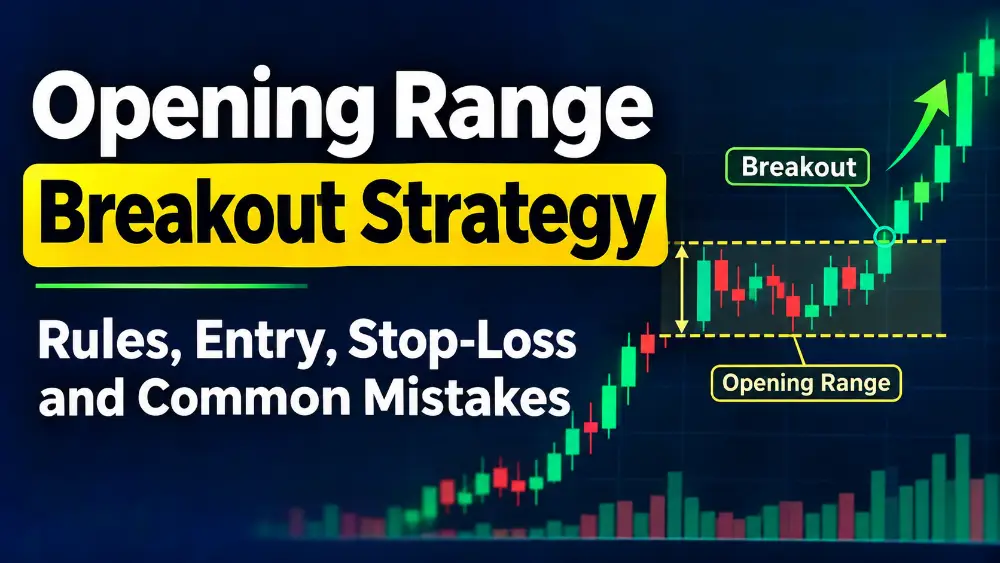
The Opening Range Breakout (ORB) strategy is a popular intraday trading method that focuses on the price movement during the first few minutes of a trading session. It helps traders identify early buying or selling pressure and participate when the market moves beyond its initial trading range.
The strategy is based on a simple idea: the high and low established shortly after the market opens can act as important reference levels. A decisive move beyond either level may signal the beginning of an intraday trend, provided the breakout receives proper confirmation.
In simple words
Opening Range Breakout involves marking the high and low of the first 15 minutes of trading. A trader considers buying when price breaks above the opening range high or selling when it breaks below the opening range low. Stop-loss and position size are decided before entering the trade.
Also Read: Consolidation and Range Trading: How to Spot Sideways Markets and Trade Them
What Is the Opening Range Breakout Strategy?
The opening range is the price zone established during the initial minutes of a trading session. For Indian stock markets, traders commonly use the first 5, 15 or 30 minutes after the NSE market opens at 9:15 AM.
The highest price during this period becomes the Opening Range High (ORH), while the lowest price becomes the Opening Range Low (ORL).
These two levels create a trading zone. A breakout above ORH indicates potential bullish momentum, while a breakdown below ORL indicates potential bearish momentum.
How to Identify the Opening Range
The first step is selecting a fixed opening range timeframe. Beginners can start with the 15-minute opening range because it provides more price information than a very short opening period.
Also Read: Sector-Wise ETF Swing Trading Strategy: 5% Target, 5% Stop Loss and Bulk Buying Plan
| Opening range | Trading characteristics |
|---|---|
| 5 minutes | Early signals, more false breakouts |
| 15 minutes | Balanced approach |
| 30 minutes | Fewer but potentially stronger setups |
For example, consider Nifty 50:
| Parameter | Example price |
|---|---|
| Opening price | 24,850 |
| Opening Range High | 24,900 |
| Opening Range Low | 24,820 |
| Range size | 80 points |
Once the first 15-minute candle closes at 9:30 AM, mark its high and low on the chart. These levels remain your reference points for the trading session.
Opening Range Breakout Entry Rules
A trader should avoid entering simply because price touches or briefly crosses the opening range. Confirmation is important.
1. Bullish breakout entry

Also Read: Pullback Trading Strategy: How to Trade Trend Retracements Using Price Action
- Price moves above the Opening Range High.
- A candle closes above the range high.
- The breakout candle shows reasonable momentum.
- Volume expansion can provide additional confirmation.
- Enter after confirmation or on a controlled retest of the breakout level.
2. Bearish breakdown entry
- Price moves below the Opening Range Low.
- A candle closes below the range low.
- Selling pressure supports the breakdown.
- Volume expansion can strengthen the setup.
- Enter after confirmation or a failed retest of the range low.
| Trade direction | Entry condition |
|---|---|
| Buy | Candle closes above ORH |
| Sell | Candle closes below ORL |
For beginners, waiting for a candle close is generally safer than entering during an unfinished candle.
Stop-Loss Placement in ORB Trading
Stop-loss placement should depend on the structure of the breakout rather than an arbitrary number of points.
For a bullish breakout, possible stop-loss locations include:
Also Read: Strategy #2: Trend Line Trading Strategy – How to Identify Trends, Entries and Breakouts
- Below the breakout candle’s low.
- Below the retest swing low.
- Below the opening range high when the retest setup supports it.
For a bearish breakdown, the reverse applies.
Consider this example:
| Trade parameter | Price |
|---|---|
| Opening Range High | 24,900 |
| Buy entry | 24,915 |
| Stop-loss | 24,885 |
| Risk per unit | 30 points |
| Target at 1:2 | 24,975 |
The trader risks 30 points to target 60 points.
Position size should be calculated according to the maximum rupee amount the trader is willing to lose.
Also Read: Liquidity Sweep Trading Strategy: How to Identify Stop-Loss Hunts and False Breakouts
Position size = Maximum permitted risk ÷ Risk per unit
Never increase position size simply because the breakout looks strong.
Best Time to Trade the Opening Range Breakout
The strategy is designed around the market opening period, but traders do not need to enter immediately after the opening range is established.
For Indian markets, the following timings can serve as a starting framework.
Also Read: Breakout Trading Strategy: How to Identify Real & False Breakouts
| Time (IST) | Activity |
|---|---|
| 9:15–9:30 AM | Identify opening range |
| 9:30–10:30 AM | Look for breakout opportunities |
| After 10:30 AM | Trade only if a clear setup develops |
The first few minutes can experience sharp price fluctuations due to overnight global developments, institutional orders and opening volatility.
Traders should avoid forcing trades when price remains inside the opening range.
How to Avoid False Breakouts
False breakouts are among the biggest challenges in ORB trading. Price can move beyond a range level, attract buyers or sellers and quickly reverse.
Some practical filters can improve trade selection:
Also Read: Volume Profile Trading Strategy for Better Trading
- Candle closing confirmation: Prefer a completed candle outside the opening range.
- Volume confirmation: Look for increased participation during the breakout.
- Retest confirmation: Wait for price to revisit the breakout level and hold it.
- Market direction: Check whether Nifty, Bank Nifty and the broader market support the trade direction.
- Avoid low-quality ranges: Extremely narrow or unusually wide opening ranges can produce poor risk-reward opportunities.
No confirmation method can eliminate false breakouts completely.
Common Opening Range Breakout Mistakes
| Mistake | Better approach |
|---|---|
| Entering on a price spike | Wait for candle close |
| Ignoring volume | Check breakout participation |
| Using a very tight stop-loss | Use market structure |
| Trading every breakout | Select quality setups |
| Increasing quantity after losses | Maintain fixed risk |
| Taking repeated trades | Set a daily trade limit |
| Ignoring market direction | Check broader market conditions |
Another common mistake is trading both sides of the opening range repeatedly. If the market is moving sideways, breakouts in either direction can fail. Recognising a choppy session and staying out is also an important trading decision.
Is Opening Range Breakout Suitable for Beginners?
ORB is relatively easy to understand because it uses clearly defined price levels and straightforward entry conditions. However, executing the strategy consistently requires patience, risk management and the ability to recognise false breakouts.
Beginners should initially practise on historical charts and paper trade the setup. They should record the opening range, entry, stop-loss, target and outcome for every trade.
The strategy can be applied to Nifty, Bank Nifty, liquid individual stocks and other actively traded instruments. However, transaction costs, slippage and market volatility can significantly affect actual results.
Key Takeaways
- Opening Range Breakout identifies potential intraday opportunities using the first few minutes of market activity.
- The 15-minute opening range is a practical starting point for beginners.
- A candle close beyond the range provides better confirmation than a temporary price spike.
- Volume and retest confirmation can improve trade selection.
- Stop-loss placement and position sizing are essential.
- Avoid trading during choppy market conditions.
- Consistency and capital protection matter more than the number of trades.
Financial Disclaimer: This article is intended for educational purposes only and should not be considered investment or trading advice. Intraday trading involves substantial financial risk, including the possibility of losing the entire trading capital allocated to a position. Traders should conduct their own research, follow disciplined risk management practices and consult a qualified financial advisor before making trading decisions.


Keep learning with OneTrader
Explore structured lessons and practical guides to build your market knowledge.

Need a laugh after all that money talk?
Paisa LOL: India's funniest finance page, with memes, comics, jokes and long funny stories.
