
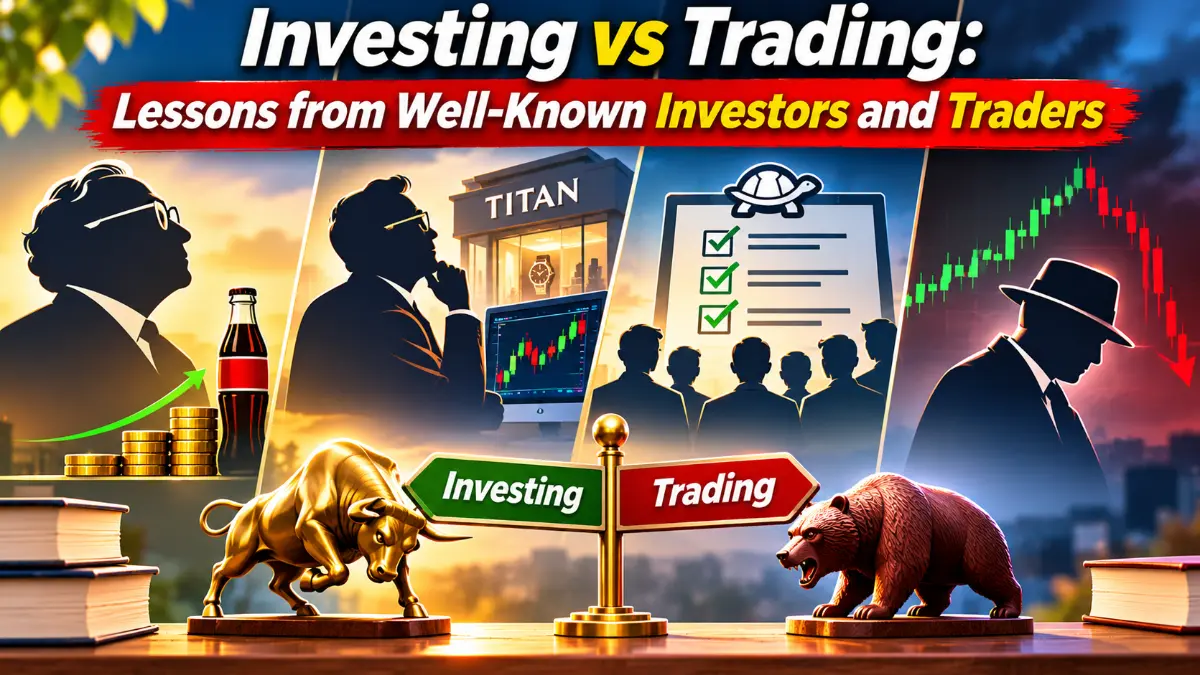
The difference between investing and trading becomes easier to understand when we look at how well-known market participants approached financial markets. Some built wealth by owning businesses and allowing them to grow, while others focused on identifying market opportunities through structured trading methods.
Their experiences offer valuable lessons about patience, discipline, risk management and decision-making. However, the objective is not to copy their portfolios or strategies. It is to understand the principles behind their approaches and recognise that successful outcomes in financial markets are never guaranteed.
In Simple Words
Investors generally focus on owning businesses and allowing value to develop, while traders focus on identifying market opportunities and following defined rules. The experiences of well-known market participants show that both approaches require discipline, but the nature of that discipline is different.
1. Warren Buffett: The Power of Business Ownership and Patience
One of the best-known examples of long-term investing is Warren Buffett’s investment in Coca-Cola through Berkshire Hathaway. Berkshire Hathaway began buying Coca-Cola shares in 1988 and has held the investment for decades.
Also Read: Investing vs Trading: Can You Do Both?
The important lesson is not simply that a famous investor purchased a popular company. It is the thinking behind the decision. The investment represented ownership in a business rather than an attempt to capture a short-term movement in its share price.
This approach highlights the importance of understanding a company’s business, its ability to generate value and the reasons for remaining invested. Patience becomes meaningful when it is supported by a sound investment thesis, rather than simply refusing to sell a declining stock.
Lesson: Long-term investing is about understanding what you own and allowing a sound business to create value.
2. Rakesh Jhunjhunwala: Keeping Investing and Trading Distinct
Rakesh Jhunjhunwala was known for both active trading and long-term investing. His long-held position in Titan is an example of his investment activity.
Also Read: Investing vs Trading: When a Failed Trade Becomes an ‘Investment’
His market approach offers an interesting lesson because it demonstrates that an individual can participate in both activities. Active trading and long-term investing do not have to be mutually exclusive, but they require different reasoning.
A trading opportunity should be evaluated according to its trading setup and rules. An investment should be supported by independent research and an understanding of the business. Mixing these purposes can create confusion and weaken decision-making.
Lesson: You can be both an investor and a trader, but each activity needs its own purpose and discipline.
3. Richard Dennis and William Eckhardt: The Importance of Written Rules
In 1983 and 1984, Richard Dennis and William Eckhardt trained a group of newcomers who became known as the Turtles. They taught them a structured approach based on written trading rules, and many went on to trade successfully.
Also Read: Investing vs Trading: Which Suits a Working Person?
The interesting part of this experiment is the emphasis on a systematic process. Trading was not presented simply as an ability to predict where prices would move. The participants were trained to follow defined rules rather than depend entirely on instinct or spontaneous decisions.

This offers an important lesson for beginners. A trading strategy needs clearly defined conditions and consistent execution. Without rules, decisions can easily become influenced by fear, excitement and changing market opinions.
Lesson: A structured trading process is more useful than repeatedly changing decisions according to emotions.
4. Jesse Livermore: Why Profits Without Risk Control Can Disappear
Jesse Livermore became famous for large trading gains, including those associated with the 1929 market crash. However, he later lost his fortune. His experience illustrates an important truth about financial markets: making large profits and preserving wealth are two different challenges.
Also Read: Investing vs Trading: Costs and Taxes of Frequent Buying and Selling
A trader may correctly identify major market movements and generate substantial gains, but without appropriate risk control, those gains can disappear. Market opportunities are uncertain, and no history of successful trades guarantees future results. This is particularly relevant to traders who focus heavily on potential returns while overlooking the possibility of large losses.
Lesson: Generating profits is only one part of trading. Protecting capital is equally important.
5. What These Four Experiences Teach Us
Although these market participants followed different approaches, their experiences reveal several principles worth understanding.
| Market participant | Main lesson |
|---|---|
| Warren Buffett | Patience and business ownership |
| Rakesh Jhunjhunwala | Keeping investing and trading distinct |
| Richard Dennis and William Eckhardt | Written rules and discipline |
| Jesse Livermore | Risk control and capital preservation |
These lessons are not instructions to reproduce their decisions. Each individual operated in different market conditions, with different knowledge, resources and circumstances. The useful approach is to understand the principles rather than imitate the outcomes.
Also Read: Investing vs Trading: Risk and Position Size Explained
6. Why Famous Success Stories Should Not Be Copied Blindly
Financial markets often celebrate extraordinary success stories. Investors hear about businesses that created enormous wealth, traders who identified major market movements and individuals who built substantial fortunes.
However, success stories do not show the complete picture of market participation. A famous investor’s ability to hold a business for decades does not mean every declining stock deserves patience. A successful trader’s strategy does not guarantee that another person will achieve similar results. Market conditions change, opportunities differ and individual circumstances are never identical.
Beginners should therefore focus on developing their own understanding of investing and trading. Learning from established principles is useful, but copying someone else’s portfolio, position or trading method without understanding its risks can be dangerous.
Key Takeaways
- Warren Buffett’s long-held Coca-Cola investment demonstrates patience and business ownership.
- Rakesh Jhunjhunwala’s investing and trading activities show the importance of keeping different market roles distinct.
- The Turtle experiment highlights the value of written trading rules and disciplined execution.
- Jesse Livermore’s experience demonstrates why profits without risk control may not last.
- Investing and trading require different methods of decision-making.
- Famous market success does not guarantee similar results for others.
- Understanding principles is more valuable than blindly copying successful individuals.
Final Thought
The Investing vs Trading series began with a simple question: what is the difference between owning a business and participating in its market price movements?
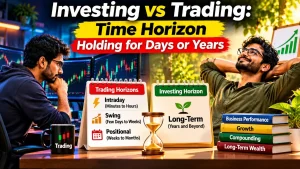
Also Read: Investing vs Trading: Time Horizon, Holding for Days or Years
The experiences of these well-known market participants bring that distinction into perspective. Buffett’s Coca-Cola investment highlights patience. Jhunjhunwala demonstrates that investing and trading can coexist. The Turtles show the importance of written rules, while Livermore’s experience reminds us that profits must be protected.
There is no need to become another famous investor or trader. The more meaningful goal is to understand your chosen approach, develop the necessary skills, follow a disciplined process and respect the risks involved.
Investing teaches you to understand what you own. Trading teaches you to manage the decisions you make. Both require knowledge, patience and discipline.
More in This Series
- Investing vs Trading: What Is the Difference?
- Investing vs Trading: Time Horizon: Days or Years
- Investing vs Trading: Risk and Position Size
- Investing vs Trading: Costs and Taxes
- Investing vs Trading: Which Suits a Working Person?
- Investing vs Trading: When a Failed Trade Becomes an Investment
- Investing vs Trading: Can You Do Both?
Disclaimer: This article is for educational and informational purposes only. It does not constitute investment advice or a recommendation to buy or sell any security. Historical examples are provided to explain market principles and do not guarantee future performance. Investing and trading involve financial risks, including the possibility of losing capital. Readers should conduct independent research and assess their financial circumstances before making financial decisions.
Also Read: Investing vs Trading: What Is the Difference?


Keep learning with OneTrader
Explore structured lessons and practical guides to build your market knowledge.
