
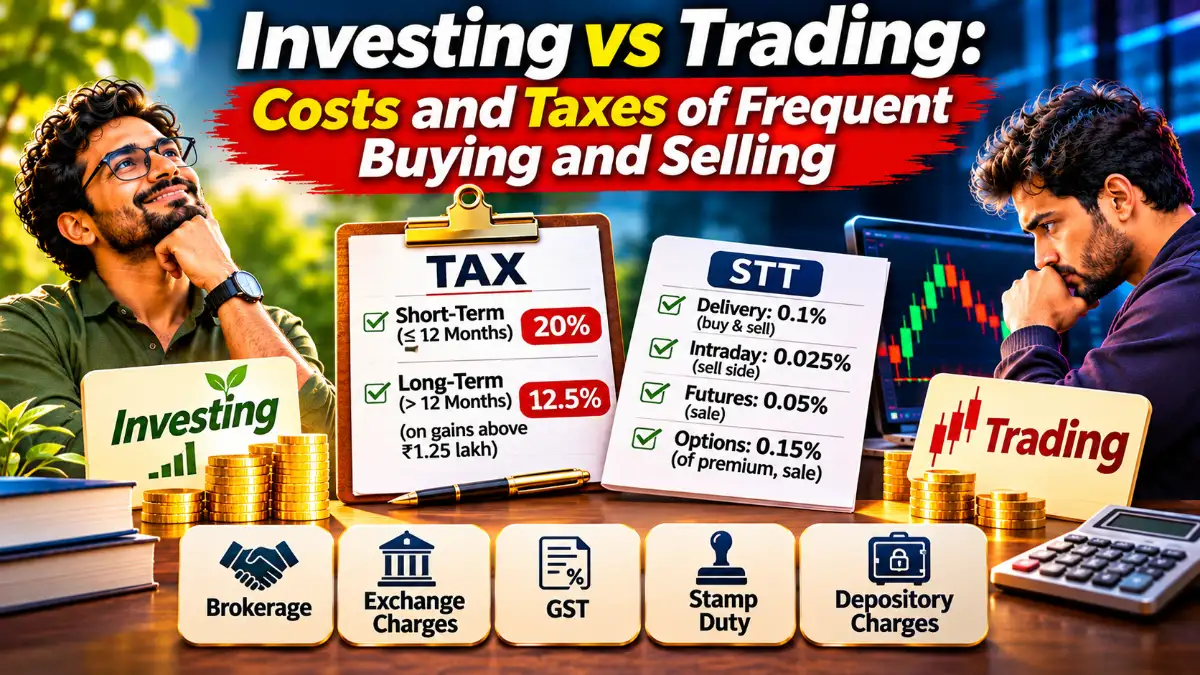
Buying and selling shares may look simple on a trading screen, but every transaction has a financial impact beyond the price at which a stock is purchased or sold. Brokerage, statutory charges, securities transaction tax and income tax can all affect the final amount an investor or trader keeps.
This is an important difference between investing and trading that beginners sometimes underestimate. An investor who makes relatively few transactions may have a different cost and tax experience from someone who frequently buys and sells shares. Understanding how Indian market charges and taxation work helps explain why frequent trading requires more attention to the money left after all expenses.
In Simple Words
Investing and trading both involve transaction costs and taxes, but the frequency and nature of transactions can change their overall impact. Frequent buying and selling can accumulate charges, while the tax treatment depends on whether the activity is classified as investment capital gains or business income.
1. Why Frequent Buying and Selling Can Become Expensive
Every stock market transaction can involve several charges. Brokerage is one component, but it is not the only expense. Investors and traders may also encounter exchange transaction charges, GST, stamp duty, securities transaction tax (STT) and depository charges. These expenses can reduce the net outcome even when a trade appears profitable on the screen. When transactions become frequent, the cumulative impact becomes more noticeable.
Also Read: Investing vs Trading: Lessons from Well-Known Investors and Traders
For example, a trader who repeatedly enters and exits positions may pay transaction-related charges across many orders. An investor making fewer transactions generally encounters fewer individual transaction events. This does not mean frequent trading is automatically unprofitable. It means that the strategy needs to generate enough returns to account for its overall expenses.
2. Securities Transaction Tax: How STT Differs
STT is a statutory charge applicable to specified securities transactions in India. Its rate depends on the type of transaction. The following are the applicable rates specified for November 2026:
| Transaction type | STT rate |
|---|---|
| Equity delivery, buy side | 0.1% |
| Equity delivery, sell side | 0.1% |
| Equity intraday, sell side | 0.025% |
| Equity futures, sale | 0.05% |
| Equity options, sale | 0.15% of premium |
The distinction matters because delivery, intraday and derivatives transactions do not all attract STT in the same way. In particular, intraday equity transactions attract STT on the sell side, while delivery transactions attract it on both sides.
An illustrative example of repeated delivery trades
Suppose someone completes ten delivery transactions. Each transaction involves purchasing shares worth ₹1,00,000 and later selling them for ₹1,00,000. For each completed transaction:
Also Read: Investing vs Trading: Can You Do Both?
- Buy-side STT: ₹1,00,000 × 0.1% = ₹100.
- Sell-side STT: ₹1,00,000 × 0.1% = ₹100.
- Total STT per completed transaction: ₹200.
- Total STT for ten transactions: ₹2,000.
Illustrative calculation. The example assumes equal purchase and sale values and excludes all other charges.
The important lesson is that even when the transaction values remain unchanged, repeating the same activity increases the cumulative STT paid. Other applicable transaction charges add to the overall expense.
3. Capital Gains Tax: Holding Period Matters
For listed equity shares, the holding period determines whether qualifying gains are classified as short-term or long-term capital gains. Under the applicable November 2026 rules, listed equity shares held for 12 months or less fall under short-term capital gains taxation at 20%.
Shares held for more than 12 months fall under long-term capital gains taxation at 12.5% on aggregate qualifying gains exceeding ₹1.25 lakh in a financial year. Applicable surcharge and cess are extra.
Also Read: Investing vs Trading: When a Failed Trade Becomes an ‘Investment’

| Capital gains category | Holding period | Tax rate |
|---|---|---|
| Short-term capital gains | 12 months or less | 20% |
| Long-term capital gains | More than 12 months | 12.5% above ₹1.25 lakh annual exemption |
These rates apply to qualifying listed equity transactions under the applicable tax provisions and conditions. The long-term exemption is an annual aggregate threshold, not a separate exemption for every stock. This distinction is particularly relevant when comparing frequent delivery-based investing with transactions that result in short-term capital gains.
4. Intraday Trading and F&O Have Different Tax Treatment
Not every market transaction is treated as capital gains. The classification of trading activity is important when calculating income tax. Equity intraday trading profits are classified as speculative business income. Profits from eligible futures and options transactions are classified as non-speculative business income. Both are taxed at the applicable income-tax slab rates rather than the capital gains rates discussed earlier. Loss treatment is also different.
- Speculative business losses can be set off only against speculative profits and can be carried forward for four years.
- Non-speculative F&O business losses can be carried forward for eight years, subject to applicable tax-return filing and other conditions.
This distinction matters because a loss from one type of trading activity cannot automatically be adjusted against every other category of income.
5. Why Investors and Traders Should Track Their Transactions Differently
Investors and traders both need accurate transaction records, but their records serve different purposes.
Also Read: Investing vs Trading: Which Suits a Working Person?
Investors should maintain purchase dates, acquisition values, sale values and relevant corporate action records to calculate capital gains correctly. They also need to distinguish qualifying short-term and long-term holdings.
Traders should maintain detailed records of intraday and derivatives transactions, including turnover, realised profits and losses, and relevant business expenses. Correct classification is important because speculative and non-speculative business income have different loss treatment rules. Relying only on the profit or loss displayed by a broker is not enough to understand the complete tax position.
6. The Real Cost Is More Than Brokerage
A common misconception is that a low brokerage rate means a low-cost trading strategy. In reality, the total transaction expense can include brokerage, exchange charges, GST, stamp duty, STT and depository charges, wherever applicable. These charges should be considered together rather than examined individually.
Frequent transactions create more opportunities for charges to accumulate. A strategy that looks profitable before expenses may produce a considerably different net result after all applicable costs and taxes are accounted for. For this reason, transaction frequency should be evaluated alongside actual trading performance.
Also Read: Investing vs Trading: Risk and Position Size Explained
Key Takeaways
- Frequent buying and selling can increase cumulative transaction expenses.
- Delivery equity transactions attract 0.1% STT on both purchase and sale.
- Intraday equity transactions attract 0.025% STT on the sell side.
- Qualifying listed equity short-term capital gains are taxed at 20%.
- Qualifying long-term capital gains are taxed at 12.5% above the annual ₹1.25 lakh threshold.
- Intraday equity profits are speculative business income, while F&O profits are non-speculative business income.
- Speculative losses have a four-year carry-forward period, while F&O business losses have an eight-year period, subject to applicable conditions.
- Brokerage is only one part of the total transaction expense.
- Proper transaction records are important for accurate tax reporting.
Final Thought
The difference between investing and trading is not limited to how frequently someone buys or sells shares. The financial impact of those decisions also depends on transaction charges, holding-period classification and the applicable income-tax treatment.
An investor should understand how capital gains are calculated, while a trader should pay particular attention to transaction frequency, business-income classification and the treatment of losses.
A profitable market activity should always be evaluated after considering its actual expenses and tax obligations. The amount earned on the trading screen is not necessarily the amount retained after everything is accounted for.
More in This Series
- Investing vs Trading: What Is the Difference?
- Investing vs Trading: Time Horizon: Days or Years
- Investing vs Trading: Risk and Position Size
- Investing vs Trading: Which Suits a Working Person?
- Investing vs Trading: When a Failed Trade Becomes an Investment
- Investing vs Trading: Can You Do Both?
- Investing vs Trading: Lessons from Well-Known Investors and Traders
Disclaimer: This article is for educational and informational purposes only and does not constitute investment, trading or tax advice. Tax provisions, eligibility conditions and statutory charges may change. The rates and rules discussed reflect the specified Indian framework for November 2026. Readers should verify their individual tax treatment and current regulations with a qualified tax professional before filing returns or making financial decisions.
Also Read: Investing vs Trading: Time Horizon, Holding for Days or Years






Keep learning with OneTrader
Explore structured lessons and practical guides to build your market knowledge.
