
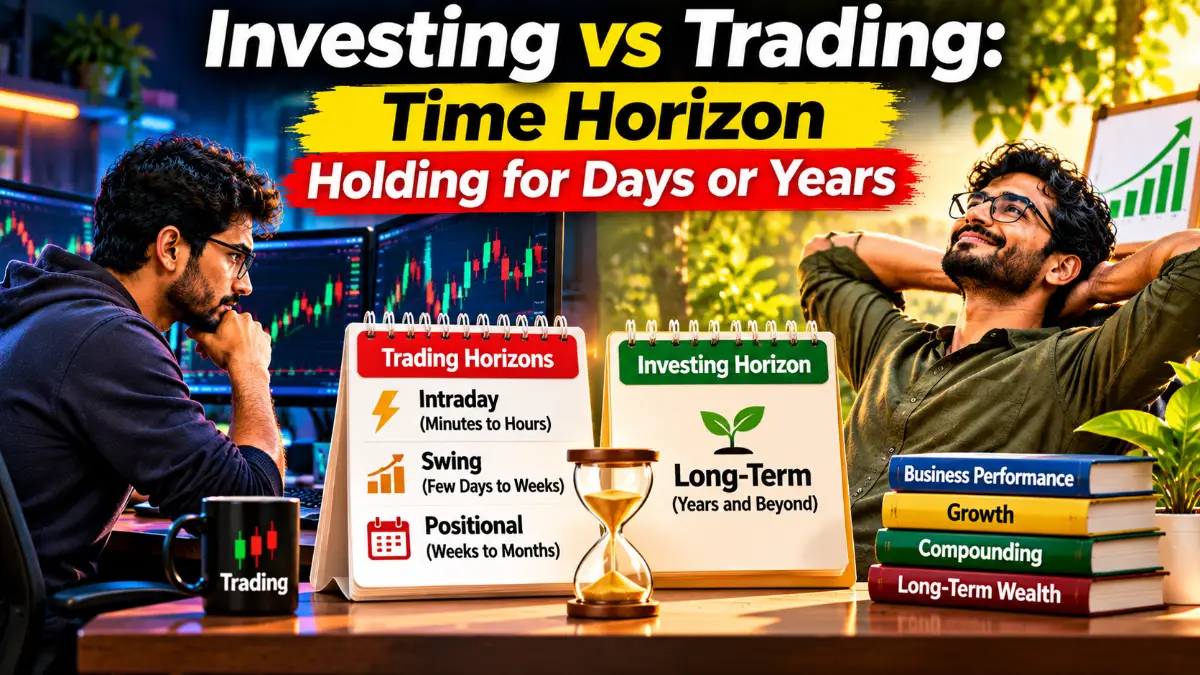
One of the biggest differences between investing and trading becomes clear when we look at how long people hold their market positions. Some market participants enter and exit a stock within minutes, while others remain invested in the same company for several years. Both approaches involve participating in the financial markets, but the passage of time changes how decisions are made and what information deserves attention.
The time horizon is not simply about how long someone wants to hold a stock. It influences how frequently a position needs to be reviewed, how much importance is given to short-term price movements and how the participant evaluates progress. Understanding this relationship is essential because a strategy designed for a few hours cannot automatically be applied to an investment intended to remain in a portfolio for years.
In Simple Words
A trading position may last a few minutes, several days or a few months, depending on the strategy. An investment may remain in a portfolio for years while the business develops and creates value. The right time horizon depends on the objective, the nature of the opportunity and when the money may be needed.
1. Intraday Trading: Positions That Begin and End on the Same Day
Intraday trading involves opening and closing a position during the same trading session. The objective is to identify price movements that may develop within the market’s operating hours.
Also Read: Investing vs Trading: Lessons from Well-Known Investors and Traders
An intraday trader may observe changes in momentum, trading volume, support and resistance, candlestick formations and market structure. Since the position is not intended to remain open overnight, the trader generally focuses on what is happening during the current session.
For example, a stock may break above an important resistance area after a period of consolidation. An intraday trader may identify the movement as an opportunity and participate in the price action, provided the setup meets the trading plan.
Intraday trading requires attention to changing market conditions. A price movement that looks promising in the morning may lose momentum later in the session. The trader therefore needs a clear method of evaluating whether the original opportunity remains valid. The defining feature is that the position is closed before the trading day ends, rather than being held as an overnight investment.
2. Swing Trading: Capturing Moves That Develop Over Several Days
Swing trading focuses on price movements that develop over multiple trading sessions. Instead of trying to capture every intraday fluctuation, swing traders look for opportunities that may take several days or weeks to develop.
Also Read: Investing vs Trading: Can You Do Both?
A trader might identify a stock recovering from an important support area, forming a breakout structure or showing improving momentum after a consolidation period. The expectation is that the price movement will continue beyond the current session.
Because the position remains open across trading days, swing traders often examine daily charts and may use shorter timeframes to improve their entries. They also need to consider whether the original market structure remains intact as new information enters the market.
The advantage of this approach is that traders do not need to monitor every movement throughout the day. However, holding a position across sessions means that market developments outside regular trading hours can also influence the next trading session. Swing trading therefore requires patience without losing sight of the conditions that originally justified the trade.
3. Positional Trading: Following a Larger Market Move
Positional trading involves holding a market position for several weeks or months, sometimes longer. The objective is to participate in a larger price movement rather than focusing on short-term fluctuations.
Also Read: Investing vs Trading: When a Failed Trade Becomes an ‘Investment’
A positional trader may identify a stock entering a strong trend after a prolonged consolidation period. Instead of exiting after a small upward movement, the trader may continue holding while the broader trend remains favourable. This approach often involves examining weekly charts, important price structures, broader market conditions and developments that could influence the stock over an extended period.

Positional traders need to distinguish between normal price fluctuations and a genuine change in the underlying market structure. A temporary decline does not necessarily mean that a trend has ended, but a significant breakdown in the original setup may require reassessment. The central challenge is allowing a larger opportunity to develop without becoming attached to a position after its original reasoning has changed.
4. Long-Term Investing: Giving Businesses Time to Grow
Long-term investing follows a different relationship with time. Instead of focusing primarily on the next price movement, investors examine how a business may perform over several years.
A company may expand its operations, introduce new products, improve profitability, enter new markets or strengthen its competitive position. These developments generally take time to influence the company’s financial performance and market valuation. An investor who understands the business may be willing to remain invested through periods of temporary market weakness, provided the original investment reasoning remains valid.
Also Read: Investing vs Trading: Which Suits a Working Person?
For example, a company may experience a disappointing quarter because of temporary demand weakness. Its share price may decline, but the investor’s decision depends on whether the business’s long-term prospects have genuinely deteriorated. This does not mean that every declining stock deserves patience. Long-term investing still requires reviewing the business and recognising when important assumptions are no longer valid. The central idea is to give business performance enough time to develop instead of judging an investment entirely through short-term market movements.
5. How Time Changes What Matters
The same stock can look very different depending on the period being examined.
A trader studying a five-minute chart may see a sudden fall and interpret it as a potential breakdown. Someone examining the weekly chart may see that the same movement is only a small fluctuation within a larger upward trend. Neither observation is automatically wrong. They are looking at different periods and answering different questions.
For shorter trading horizons, immediate price behaviour, momentum, volume and market structure become particularly important. As the holding period extends, broader trends and developments affecting the company’s business gradually become more relevant.
Also Read: Investing vs Trading: Costs and Taxes of Frequent Buying and Selling
This distinction also explains why investors should not automatically react to every short-term market fluctuation. A temporary change in market sentiment does not necessarily alter a company’s ability to generate revenue or grow its business. Equally, traders should not use a company’s long-term potential to justify holding a short-term trading position after the original setup has failed. The timeframe determines which information deserves the greatest attention.
6. Why Compounding Needs Time
Time plays an important role in wealth creation because returns can generate further returns when earnings are reinvested. This process is known as compounding. Instead of earning returns only on the original amount, an investor may gradually earn returns on previously accumulated gains as well.
The important point is that compounding becomes more powerful when money remains invested and returns are allowed to accumulate over time. It does not mean that returns arrive at a fixed rate every year. Actual market returns fluctuate, and investments can experience losses.
For long-term investors, patience allows business growth and reinvested returns to contribute to wealth creation. Frequently interrupting an investment without a meaningful reason can affect this process. However, time alone does not make a poor investment successful. The quality of the underlying asset and the price paid for it continue to matter.
Also Read: Investing vs Trading: Risk and Position Size Explained
7. How Often Should Positions Be Reviewed?
The frequency of reviewing a position should match the reason for holding it.
An intraday trader may need to monitor market developments during the session because the opportunity can change quickly. A swing trader may review the position around important daily price levels and significant developments. A positional trader may focus more on weekly market structure and changes affecting the broader trend.
Long-term investors generally do not need to react to every daily price movement. Their attention is better directed towards company performance, financial developments, competitive conditions and whether the original investment reasoning remains valid. This does not mean investors should ignore their portfolios for years. Important business developments can change the investment outlook, and periodic reviews remain necessary.
The mistake is using the wrong review frequency. Constantly checking a long-term investment can encourage unnecessary reactions, while reviewing a short-term trading position too infrequently can allow important changes to go unnoticed.
Also Read: Investing vs Trading: What Is the Difference?
8. Match the Time Horizon With When You Need the Money
One of the most important financial planning decisions is understanding when the money may be required.
Money intended for a near-term expense should not automatically be exposed to investments that may experience significant market fluctuations. Even a fundamentally strong company can see its share price decline at an inconvenient time.
For example, someone planning to use money for education fees, a house purchase or another important expense in the near future needs to consider the possibility that market values may fall just before the money is required. Longer-term financial goals may provide more time to withstand temporary market fluctuations, although they do not eliminate investment risk. The following framework illustrates how different objectives can influence the choice of horizon.
| Activity | Typical holding period | Main time-related focus |
|---|---|---|
| Intraday trading | Minutes to one session | Immediate price movement |
| Swing trading | Several days to weeks | Short-term market swings |
| Positional trading | Weeks to months | Larger market trends |
| Long-term investing | Several years or longer | Business development and compounding |
These periods are general descriptions, not strict rules. Actual holding periods depend on the strategy and the conditions surrounding each position.
Also Read: How to Build a Beginner Investment Portfolio in India: Asset Mix, Funds and Simple Rules
A useful principle is to avoid depending on volatile market investments for money that must be available at a fixed near-term date. Financial goals should determine the appropriate level of exposure, rather than forcing investments to meet an unrealistic deadline.
9. The Biggest Mistake: Using One Time Horizon to Manage Another
Confusion often develops when someone enters a position with one objective but starts managing it using a completely different timeframe.
A trader may enter a stock for a short-term breakout but continue holding it for months after the breakout fails. Instead of accepting that the trading opportunity has ended, the trader starts looking for long-term reasons to justify the position.
The opposite can happen with investing. Someone purchases shares because they believe in the company’s long-term prospects but becomes uncomfortable when the price declines over a few trading sessions. They may exit without examining whether the business outlook has actually changed. Both situations involve a mismatch between the original objective and subsequent decisions.
Also Read: Index Funds vs ETFs: Which Is Better for Long-Term Investing?
A position should be evaluated using the timeframe and reasoning for which it was originally established. If the objective changes, the decision should be reconsidered deliberately rather than adjusted emotionally.
Key Takeaways
- Intraday trading focuses on price movements within a single trading session.
- Swing trading attempts to capture movements that develop over several days or weeks.
- Positional trading focuses on larger market trends that may take weeks or months to develop.
- Long-term investing gives businesses time to grow and allows compounding to contribute to wealth creation.
- Short-term price fluctuations do not always indicate a change in a company’s long-term prospects.
- The frequency of reviewing a position should match its original objective.
- Money needed for near-term expenses should not depend on uncertain market returns.
- Changing the holding period without reassessing the original reasoning can lead to poor decisions.
Final Thought
Time is not just a measurement of how long someone holds a stock. It changes the entire way a market participant thinks, observes and evaluates opportunities.
An intraday trader looks for what the market might do during the next few hours. A swing trader looks for a movement that may take several sessions to develop. A positional trader follows a broader trend, while a long-term investor gives a business time to grow and create value. There is no single holding period that works for everyone. The important thing is to understand the purpose of each position and give it an appropriate amount of time.
More in This Series
- Investing vs Trading: What Is the Difference?
- Investing vs Trading: Risk and Position Size
- Investing vs Trading: Costs and Taxes
- Investing vs Trading: Which Suits a Working Person?
- Investing vs Trading: When a Failed Trade Becomes an Investment
- Investing vs Trading: Can You Do Both?
- Investing vs Trading: Lessons from Well-Known Investors and Traders
Disclaimer: This article is for educational and informational purposes only. It does not constitute investment advice or a recommendation to buy or sell any financial instrument. Trading and investing involve market risks, including the possibility of losing capital. Readers should evaluate their financial goals, liquidity requirements and risk tolerance before making financial decisions.
Also Read: How Much SIP Is Needed to Build ₹1 Crore?








Keep learning with OneTrader
Explore structured lessons and practical guides to build your market knowledge.
