
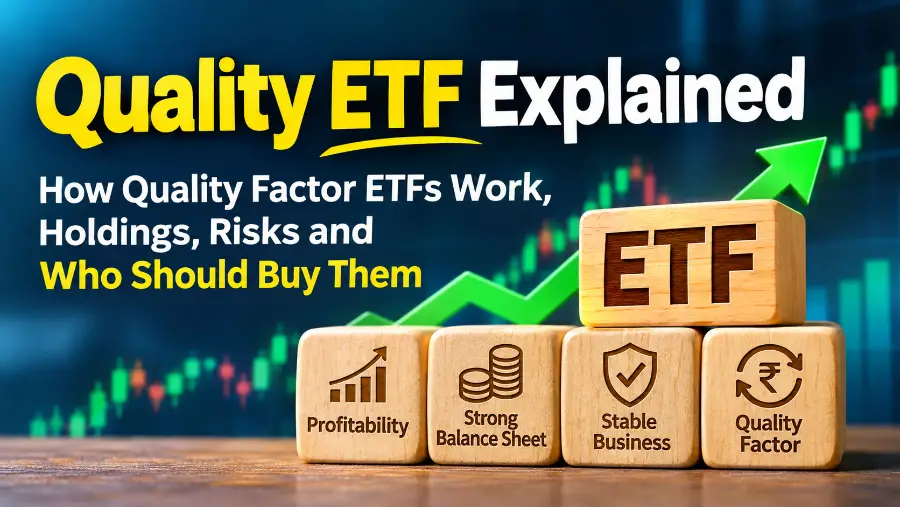
Investors often look for companies that can deliver sustainable growth without taking excessive financial risks. Businesses with consistent profitability, manageable debt, strong cash flows and reliable management tend to have characteristics that long-term investors value. However, identifying such companies individually requires research, time and regular portfolio monitoring. Quality Factor ETFs offer an alternative by bringing a group of financially stronger companies into a single investment.
Unlike conventional index ETFs that primarily track market capitalisation, Quality ETFs select and weight stocks using specific financial quality indicators. They aim to provide exposure to businesses with stronger underlying fundamentals. This makes them an interesting option for investors who want a rules-based approach to investing in financially sound companies.
In simple words
A Quality ETF invests in companies that score well on financial strength, profitability and business stability. Instead of choosing stocks purely by their market value, it follows a methodology designed to identify businesses with relatively stronger fundamentals.
What Is a Quality Factor ETF?
A Quality Factor ETF is an exchange-traded fund that tracks an index designed to identify companies with superior financial characteristics. The quality factor is one of several investment factors used in systematic investing, alongside value, momentum, low volatility and size.
The underlying index generally evaluates companies using indicators such as return on equity, debt levels, earnings consistency and profitability. Stocks with stronger scores receive higher representation, subject to the index methodology and weighting limits.
These ETFs provide diversified exposure through a single investment. Investors can buy and sell ETF units on the stock exchange during trading hours, just like ordinary shares.
How Do Quality Factor ETFs Work?
Quality ETFs follow a predefined index methodology rather than depending on a fund manager’s discretionary stock selection. The index provider evaluates eligible companies, assigns quality scores and determines their portfolio weights.
Also Read: Liquid ETF Explained: How Liquid ETFs Work in India, Returns, Risks and Who Should Buy Them
Three important financial characteristics commonly influence the selection process:
| Quality indicator | What it measures |
|---|---|
| Return on equity (ROE) | How efficiently a company generates profits from shareholders’ capital |
| Debt-to-equity ratio | The company’s dependence on borrowed money |
| Earnings stability | The consistency of profitability over time |
Some methodologies also consider operating profitability, cash flow generation and financial leverage. The index is periodically reviewed and rebalanced to reflect changes in company fundamentals.
However, quality scoring methods differ across indices. Investors should examine the underlying methodology rather than assuming every Quality ETF follows identical selection rules.
What Stocks Do Quality ETFs Hold?
Quality ETFs generally hold established businesses with relatively strong balance sheets, consistent earnings and efficient capital utilisation. Their portfolios may include companies from banking, information technology, healthcare, consumer goods, industrials and other sectors.

Also Read: Liquid ETF Explained: How Liquid ETFs Work in India, Returns, Risks and Who Should Buy Them
The actual holdings depend on the index being tracked. A company with a large market capitalisation is not automatically included, while a smaller company may qualify if it satisfies the quality requirements.
Investors should examine the following characteristics when reviewing holdings:
- Consistent profitability across different market conditions.
- Reasonable debt levels and manageable interest obligations.
- Healthy operating cash flows.
- Efficient use of shareholder capital.
- Sustainable business operations and competitive advantages.
Importantly, a quality score does not guarantee that a company will remain financially strong. Business conditions can change, and past profitability does not ensure future performance.
Quality ETFs vs Traditional Index ETFs
The main difference is how stocks are selected and weighted.
Traditional market-capitalisation ETFs allocate greater weight to companies with larger market values. Quality ETFs give preference to businesses that satisfy specific financial quality requirements.
For example, a conventional Nifty 50 ETF provides exposure to the largest eligible companies in the index. A quality-focused ETF may instead concentrate on companies that score well on profitability, leverage and earnings-related measures.
Neither approach is automatically superior. Traditional ETFs offer broad market exposure, while quality ETFs provide a more targeted investment strategy.
Risks of Investing in Quality ETFs
Despite their focus on financially stronger companies, Quality ETFs are not risk-free.
Also Read: Railway and Capital Goods ETF Explained: How It Works, Holdings, Risks and Who Should Buy It
Valuation risk: Investors may pay premium valuations for businesses considered financially superior. Even good companies can deliver disappointing returns when purchased at excessive prices.
Concentration risk: Quality indices can become heavily weighted towards particular sectors or companies, especially when certain industries consistently score well on the selected metrics.
Factor underperformance: Quality investing does not outperform every year. During strong speculative rallies or periods when highly leveraged businesses lead the market, quality-focused portfolios may lag broader indices.
Methodology risk: Different index providers use different quality measurements. A change in methodology or periodic rebalancing can significantly affect portfolio composition.
Market risk: Quality ETFs remain equity investments. Their market value can decline during economic slowdowns, corrections and broader stock market sell-offs.
Who Should Invest in Quality Factor ETFs?
Quality ETFs may suit long-term investors who prefer businesses with stronger financial fundamentals and want a systematic approach to stock selection.
They can be considered by:
- Long-term equity investors seeking exposure to financially stronger companies.
- Investors looking to diversify beyond conventional market-capitalisation indices.
- Investors who prefer rules-based investing over individual stock selection.
- Investors comfortable holding equity investments through market cycles.
However, these ETFs may not suit investors seeking guaranteed returns, capital protection or short-term trading opportunities. They should also not replace broad-market diversification without considering the investor’s overall portfolio.
Also Read: Bharat 22 ETF Explained: How It Works, Holdings, Risks and Who Should Buy It
How to Evaluate a Quality ETF Before Investing
Before selecting a Quality ETF in India, examine its underlying index, expense ratio, tracking error, assets under management, liquidity and portfolio concentration.
Also compare its performance with the relevant benchmark over different market cycles. A strong return over one year is not enough to establish the effectiveness of a factor strategy.
Investors should understand whether the ETF tracks a pure quality index or combines quality with other factors. This distinction can influence both portfolio behaviour and long-term returns.
Key Takeaways
- Quality ETFs select companies using financial strength and profitability indicators.
- Common selection measures include ROE, debt levels and earnings stability.
- They provide diversified, rules-based exposure to quality-focused businesses.
- Premium valuations, sector concentration and factor underperformance remain important risks.
- They can complement traditional index ETFs in a diversified long-term portfolio.
Financial Disclaimer: This article is for educational purposes only and should not be considered investment advice. Equity ETFs are subject to market risks, and investors should evaluate their financial objectives, risk tolerance and the fund’s underlying methodology before investing.
Also Read: CPSE ETF Explained: How India’s PSU Enterprise ETF Works, Holdings, Risks and Who Should Buy It


Keep learning with OneTrader
Explore structured lessons and practical guides to build your market knowledge.

Need a laugh after all that money talk?
Paisa LOL: India's funniest finance page, with memes, comics, jokes and long funny stories.
