
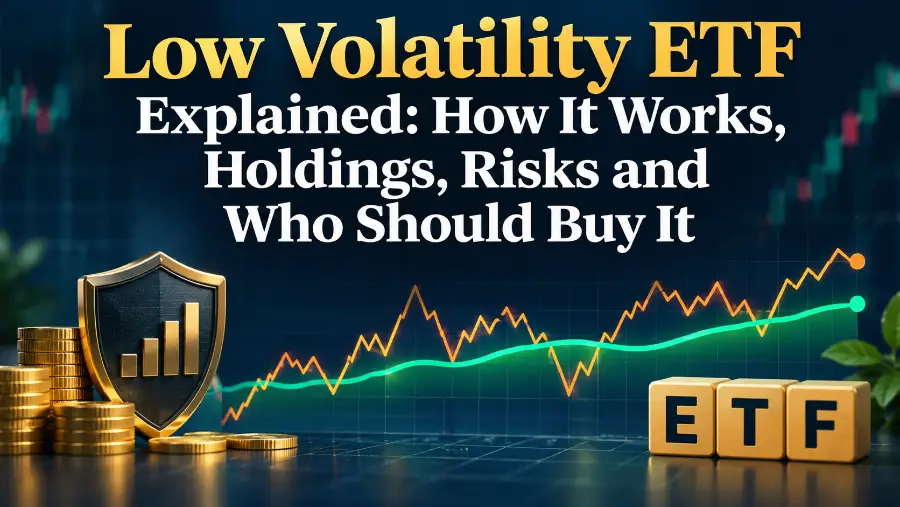
Investors often look for ways to participate in the stock market without experiencing the sharp price swings associated with aggressive equity strategies. While market volatility is unavoidable, some investment strategies are designed to favour stocks that have historically experienced smaller price fluctuations. Low volatility ETFs follow this approach, offering investors a rules-based way to access relatively stable segments of the equity market.
Unlike traditional index ETFs that track companies based primarily on market capitalisation, low volatility ETFs select and weight stocks using historical price behaviour. This makes them an interesting option for investors who prioritise a relatively smoother investment experience while remaining exposed to equities.
In simple words
A low volatility ETF invests in stocks that have historically shown smaller price movements than other stocks in its investment universe. It aims to reduce portfolio fluctuations, particularly during uncertain market conditions, without completely moving away from equity investing. However, lower volatility does not mean guaranteed capital protection.
What Is a Low Volatility ETF?
A low volatility ETF is an exchange-traded fund that tracks an index designed to identify companies with relatively stable share prices. The selection process generally uses historical price volatility, often measured through the standard deviation of daily stock returns over a defined period.
In India, one example is the Nifty 100 Low Volatility 30 Index. It selects 30 stocks from the Nifty 100 universe based on their historical volatility. Stocks with lower volatility receive higher weights under its volatility-based weighting approach. ETFs tracking this index allow investors to access the strategy through a single exchange-traded investment. Nifty Indices +1
How Does a Low Volatility ETF Work?
The process begins with an eligible group of stocks, usually drawn from a broader market index. The index methodology evaluates historical price movements and ranks companies according to their volatility.
Companies displaying relatively smaller fluctuations qualify for inclusion. The selected stocks are then assigned portfolio weights according to the index methodology. Periodic rebalancing helps the portfolio reflect changes in the volatility characteristics of individual companies.
Also Read: Liquid ETF Explained: How Liquid ETFs Work in India, Returns, Risks and Who Should Buy Them
For example, a consumer goods company with relatively stable earnings and share-price movements may qualify, while a highly speculative small-cap stock with frequent price swings may not.
The ETF replicates the underlying index by holding its constituent stocks, subject to operational requirements and tracking differences. Investors can buy and sell ETF units on the stock exchange through a demat and trading account.
What Does a Low Volatility ETF Hold?
The holdings depend on the underlying index and its periodic reviews. Indian low volatility portfolios can include companies from several established sectors rather than concentrating exclusively on one industry.

Commonly represented sectors include:
Also Read: Liquid ETF Explained: How Liquid ETFs Work in India, Returns, Risks and Who Should Buy Them
- Banking and financial services: Established banks and insurance companies.
- Consumer goods: FMCG and household product companies.
- Healthcare: Pharmaceutical businesses and hospital operators.
- Information technology: Established software and technology companies.
- Telecommunications: Large telecom operators.
- Automobiles and utilities: Established manufacturers and infrastructure-related businesses.
These companies are not necessarily the least volatile stocks in the entire market. They are selected from the eligible investment universe, which means the portfolio remains influenced by the index’s starting universe and selection rules.
Investors should check the latest portfolio disclosure to understand individual stock weights, sector exposure and concentration before investing.
Low Volatility ETF vs Regular Index ETF
Both investment products offer diversified exposure through passive investing, but their stock selection methods differ.
| Feature | Low Volatility ETF | Regular Index ETF |
|---|---|---|
| Selection | Historical volatility | Index methodology, often market cap |
| Weighting | Volatility-based | Usually market-cap based |
| Objective | Relatively stable price behaviour | Broad market exposure |
| Performance | May lag during strong rallies | Reflects its underlying index |
| Risk | Equity market risk | Equity market risk |
A low volatility ETF is therefore a factor-based investment rather than a replacement for every traditional index fund.
Benefits of Investing in Low Volatility ETFs
The primary attraction is the possibility of experiencing smaller portfolio fluctuations compared with a broader equity benchmark.
Relatively smoother investment experience: Historically less volatile stocks may help reduce the intensity of portfolio movements during certain market conditions.
Rules-based diversification: Investors gain exposure to multiple companies across different industries without individually researching and purchasing each stock.
Lower dependence on aggressive growth stocks: The strategy may provide exposure to established businesses rather than companies whose valuations depend heavily on future growth expectations.
Also Read: Railway and Capital Goods ETF Explained: How It Works, Holdings, Risks and Who Should Buy It
Convenient market access: ETF units trade on exchanges, allowing investors to enter or exit during market hours, subject to liquidity.
Risks Investors Should Understand
Low volatility ETFs remain equity investments. Their prices can decline substantially during market corrections, economic slowdowns or company-specific problems.
One important risk is underperformance during bull markets. When high-growth and high-beta stocks lead the market, a low volatility portfolio may struggle to match the returns of broader indices.
Another concern is sector concentration. If several low volatility companies belong to the same industry, unexpected weakness in that sector can affect the entire portfolio.
There is also the risk of changing market conditions. Historical volatility does not reliably predict future price movements. A company considered stable in the past can become volatile following regulatory changes, financial difficulties or business disruptions.
Investors should also examine the ETF’s expense ratio, tracking difference, tracking error and trading liquidity. A wide bid-ask spread can increase the actual cost of buying or selling units.
Who Should Buy a Low Volatility ETF?
Low volatility ETFs may suit long-term equity investors who prefer a relatively defensive approach to stock market participation. They can also interest investors looking to diversify an existing portfolio that is heavily exposed to aggressive growth or high-volatility stocks.
However, they may not be suitable for investors seeking maximum returns during strong bull markets, short-term traders expecting predictable price movements, or individuals who cannot tolerate equity market losses.
Also Read: Bharat 22 ETF Explained: How It Works, Holdings, Risks and Who Should Buy It
For most investors, a low volatility ETF is better considered as one component of a diversified equity portfolio rather than the only investment.
Key Takeaways
- Low volatility ETFs select stocks based on historical price fluctuations.
- They aim to provide relatively smoother equity market exposure, not guaranteed protection.
- Indian investors can access this strategy through ETFs tracking the Nifty 100 Low Volatility 30 Index.
- The strategy may lag broader indices during strong market rallies.
- Sector concentration, tracking differences, expenses and liquidity deserve attention.
- Long-term investors should consider these ETFs as part of a diversified portfolio.
Financial Disclaimer: This article is for educational purposes only and should not be considered investment advice or a recommendation to buy or sell any ETF. Equity investments are subject to market risks, including the possibility of capital loss. Investors should evaluate their financial goals, risk tolerance and investment horizon before making investment decisions.



Keep learning with OneTrader
Explore structured lessons and practical guides to build your market knowledge.

Need a laugh after all that money talk?
Paisa LOL: India's funniest finance page, with memes, comics, jokes and long funny stories.
