
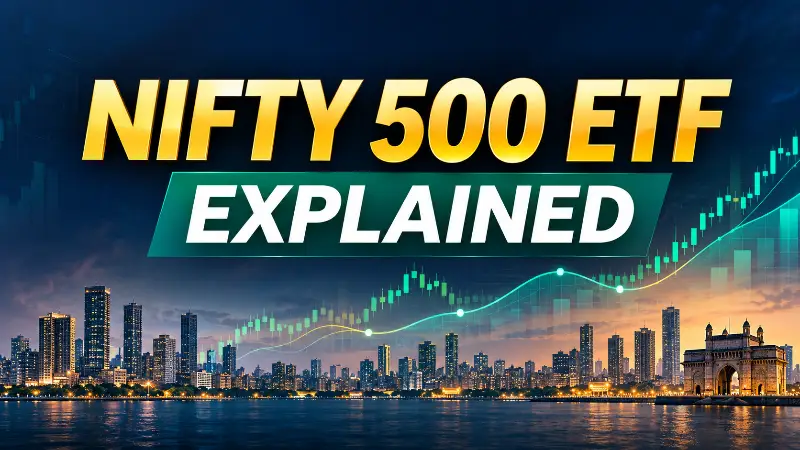
The Indian stock market offers several ways to invest in listed companies. The Nifty 50 represents 50 of the largest businesses, but investors seeking wider exposure may look at the Nifty 500. It covers large-cap, mid-cap and small-cap companies, providing a broader view of the Indian equity market through one index.
A Nifty 500 ETF makes this exposure available in an exchange-traded investment. Instead of buying hundreds of shares individually, investors can purchase units of a fund designed to track the index. Its breadth is useful, but it does not remove market risk or guarantee better returns. Understanding how it is constructed, what it costs and how it fits an existing portfolio matters before investing.
In simple words
A Nifty 500 ETF is a fund listed on the stock exchange that aims to track the Nifty 500 Total Return Index. It gives investors exposure to a broad range of Indian companies through one investment, without requiring them to select each stock themselves.
What Is the Nifty 500 Index?
The Nifty 500 represents around 500 NSE-listed companies selected under index rules that consider market capitalisation and liquidity. It spans large-, mid- and small-cap businesses, giving it broader coverage than a large-cap-only index.
It is weighted by free-float market capitalisation. Companies with larger publicly tradable market values receive higher weights, so the biggest businesses have more influence on performance. Constituents and weights are reviewed periodically and can change.
How Does a Nifty 500 ETF Work?
A Nifty 500 ETF pools investors’ money and buys the index’s constituent shares in broadly similar weights. Depending on the scheme, it may use full replication or representative sampling and hold a small cash balance for operations.
Investors buy and sell units on the stock exchange through a broker and demat account. The units trade during market hours, and the market price can be slightly above or below the fund’s net asset value (NAV), depending on demand, supply and liquidity.
Also Read: Liquid ETF Explained: How Liquid ETFs Work in India, Returns, Risks and Who Should Buy Them
The benchmark is generally the Nifty 500 Total Return Index, which includes reinvested dividends. The ETF can still deliver a different return because of expenses, transaction costs, cash holdings and tracking difference.

Holdings and Sector Exposure
A Nifty 500 ETF holds a broad selection of companies across the Indian market. Large constituents commonly include businesses such as HDFC Bank, ICICI Bank, Reliance Industries, Bharti Airtel, Larsen & Toubro, Infosys, State Bank of India, Axis Bank, Kotak Mahindra Bank and Bajaj Finance. The exact list and weight of each company change with index reviews and market movements, so investors should check the latest scheme portfolio.
Its sector exposure spans financial services, information technology, energy, automobiles, healthcare, consumer businesses, capital goods, metals and telecommunications. Allocations are not equal: financial services and other large sectors can carry substantial weights, and a handful of major companies can influence performance.
| Illustrative holding | Sector |
|---|---|
| HDFC Bank, ICICI Bank | Banking |
| Reliance Industries | Energy and retail |
| Infosys | Information technology |
| Bharti Airtel | Telecommunications |
| Larsen & Toubro | Engineering and infrastructure |
| Bajaj Finance | Financial services |
This is an illustration of prominent businesses, not a permanent or ranked list of ETF holdings.
Also Read: Liquid ETF Explained: How Liquid ETFs Work in India, Returns, Risks and Who Should Buy Them
Nifty 500 ETF vs Nifty 50 ETF
A Nifty 50 ETF focuses on 50 large companies, while a Nifty 500 ETF also includes mid-cap and small-cap businesses. The wider exposure can help when smaller companies outperform, but can add volatility during market declines.
| Feature | Nifty 50 ETF | Nifty 500 ETF |
|---|---|---|
| Constituents | 50 | Around 500 |
| Coverage | Mainly large-cap | Large-, mid- and small-cap |
| Market exposure | Narrower | Broader |
| Volatility | Generally lower | Can be higher |
Neither index is automatically better. The right choice depends on the exposure an investor wants and the risk they can tolerate. Someone already holding a Nifty 50 fund should also check overlap before adding a Nifty 500 ETF. The latter includes many of the same large companies, so it broadens exposure rather than replacing those holdings with an entirely different portfolio.
Benefits and Risks to Understand
The main benefit is convenience: one ETF provides exposure to hundreds of companies without requiring investors to research each share. Its passive strategy follows published index rules, and passive funds often cost less than actively managed funds.
But diversification does not prevent losses during a broad market decline. Mid- and small-cap holdings can add volatility, while the largest companies and sectors still influence returns. Low trading volumes may also create wide bid-ask spreads, and the exchange price can move away from NAV.
Check tracking difference, which shows the return gap against the benchmark, and tracking error, which measures how consistently the fund follows it. Finally, even a broad index can disappoint if bought at expensive market valuations. An ETF simplifies stock selection; it does not remove market or valuation risk.
How to Choose a Nifty 500 ETF
Compare expense ratios, tracking difference over several periods, tracking error, fund size and the AMC’s operating record. A low expense ratio is useful, but does not by itself guarantee better index replication.
Also check average traded value, bid-ask spread and market depth. Compare the exchange price with indicative NAV where available, and consider limit orders when spreads are wide. A lower unit price does not mean the underlying portfolio is cheaper.
Who Should Consider It?
It may suit investors with a long horizon who want broad Indian equity exposure and can tolerate volatility. It can form part of a core equity allocation, provided it fits alongside debt and other assets.
Also Read: Railway and Capital Goods ETF Explained: How It Works, Holdings, Risks and Who Should Buy It
Investors who already own diversified equity funds should check portfolio overlap before adding it. A Nifty 500 ETF contains many large companies also found in Nifty 50 funds, so another holding may add less diversification than expected.
It is unsuitable for near-term goals, emergency savings or anyone unable to tolerate temporary losses.
SIP, Lump Sum and Taxation
Investors can buy units periodically or invest a lump sum, depending on their cash flow and risk tolerance. Regular purchases encourage discipline but do not prevent losses. ETF SIPs may require recurring broker orders or an available automated facility.
For an equity-oriented ETF qualifying under Indian tax rules, units held for 12 months or less generally attract 20% short-term capital gains tax. Long-term gains on units held for more than 12 months are generally taxed at 12.5% on aggregate eligible gains above ₹1.25 lakh in a financial year, plus applicable surcharge and cess. Confirm the scheme’s tax classification and current rules before selling.
Key Takeaways
- A Nifty 500 ETF tracks a broad index spanning large-, mid- and small-cap Indian companies.
- It offers convenient market exposure through one exchange-traded product, but returns are not guaranteed.
- The index is free-float market-cap weighted, so large companies and sectors have greater influence.
- Compare expense ratio, tracking difference, tracking error, liquidity and bid-ask spreads before choosing a scheme.
- It may suit long-term investors who can tolerate volatility, but it is not a substitute for emergency savings or a diversified asset allocation.
Financial Disclaimer
This article is for educational and informational purposes only and is not investment advice or a recommendation to buy or sell any ETF. Mutual fund investments are subject to market risks. Investors should read scheme documents, assess their financial goals and risk tolerance, and consult a qualified financial adviser before investing.



Keep learning with OneTrader
Explore structured lessons and practical guides to build your market knowledge.

Need a laugh after all that money talk?
Paisa LOL: India's funniest finance page, with memes, comics, jokes and long funny stories.
