
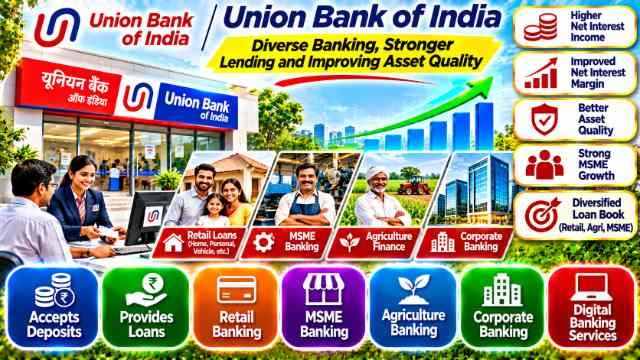
Explore Union Bank of India's lending business, Q2 FY27 results, net interest income, MSME growth, improving asset quality and key risks.
- Union Bank of India is a large public sector bank with operations across retail, micro, small and medium enterprises (MSME), agriculture and corporate banking.
- Union Bank of India serves individual borrowers, small and medium-sized businesses, farmers and corporate customers.
- Growth in advances is an important contributor to Union Bank of India’s business.
What Union Bank of India Does
Union Bank of India is a large public sector bank with operations across retail, micro, small and medium enterprises (MSME), agriculture and corporate banking. Its business involves accepting deposits and providing loans to individuals, businesses, farmers and corporate customers.
The bank’s earnings are primarily driven by net interest income, which represents the difference between interest earned on loans and interest paid on deposits. Fee-based services and treasury income provide additional sources of revenue.
Its lending activity spans several customer categories, with retail, agriculture and MSME businesses forming an important part of its domestic advances.
Customers and How Union Bank of India Makes Money
Union Bank of India serves individual borrowers, small and medium-sized businesses, farmers and corporate customers. Its retail banking business caters to personal financial requirements, while MSME and agricultural lending support business and farming-related credit needs.
Also Read: Vedanta: How Commodity Prices, Higher Volumes and Debt Reduction Drive Its Business
The bank collects deposits and deploys these funds through loans. The interest received from borrowers, after accounting for the interest paid to depositors, contributes to net interest income.

It also generates income through banking fees and treasury activities. Consequently, lending growth, deposit costs, interest rates and asset quality influence its overall profitability.
Growth Drivers
Growth in advances is an important contributor to Union Bank of India’s business. The expansion in its overall loan portfolio supports interest income, while stronger MSME lending provides momentum in a key customer segment.
The bank’s exposure across retail, agriculture and MSME customers also gives its domestic lending business a broad base. These segments collectively account for a substantial share of domestic advances.
Improvement in net interest margin is another positive development. A stronger margin can support net interest income, provided the bank manages the relationship between lending yields and deposit costs effectively.
Also Read: Siemens Energy India: How Power Transmission, Generation and Project Backlogs Drive Its Business
Competition and Risks
Interest rate movements remain an important risk for the bank. Rate cuts can put pressure on lending yields, while deposit costs may adjust at a different pace. This can affect net interest margins and the growth of net interest income.
Competition among public sector banks for deposits is another challenge. The cost of attracting and retaining deposits can influence the profitability of lending operations.
What Investors Should Watch
Investors should monitor net interest income and net interest margin to assess whether the bank can sustain its earnings momentum. Deposit costs and changes in lending rates will be important factors behind future margin performance.
Also Read: Shree Cement: How Premium Products, Sales Growth and Cost Management Drive Its Business
Loan growth deserves attention, particularly in MSME and other retail, agriculture and MSME segments. The bank’s ability to maintain advances growth while preserving lending quality will influence its financial performance.
Asset quality indicators, including gross and net NPA ratios and the provision coverage ratio, should also be tracked. A continuation of the recent improvement would support earnings stability, while any deterioration could increase credit costs.
Conclusion
The expansion in advances, particularly MSME lending, provides an important source of business momentum. However, interest rate sensitivity, deposit competition and the possibility of higher credit costs remain relevant risks. Investors should focus on whether the bank can sustain lending growth and profitability while maintaining the improvement in asset quality.
Financial Disclaimer: This article is for educational and informational purposes only. It is not investment advice or a recommendation to buy or sell Union Bank of India shares. Investors should conduct independent research before making financial decisions.






Keep learning with OneTrader
Explore structured lessons and practical guides to build your market knowledge.

Need a laugh after all that money talk?
Paisa LOL: India's funniest finance page, with memes, comics, jokes and long funny stories.
