
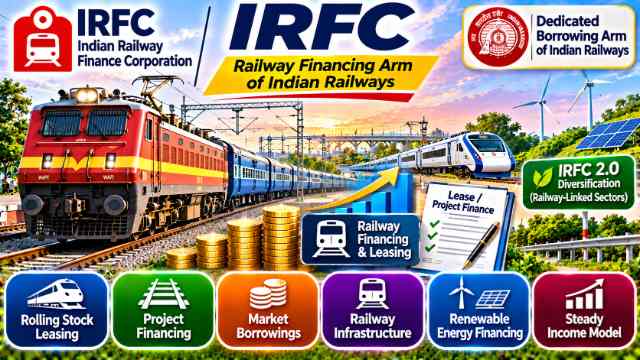
Understand IRFC's railway financing and leasing model, Q2 FY27 results, borrowing costs, dividend, IRFC 2.0 diversification and key risks.
- Indian Railway Finance Corporation (IRFC) is the dedicated borrowing arm of Indian Railways.
- IRFC’s traditional customers are railway entities that require funding for rolling stock and project assets.
- Railway investment and financing requirements remain central to IRFC’s business.
What IRFC Does
Indian Railway Finance Corporation (IRFC) is the dedicated borrowing arm of Indian Railways. Its primary role is to raise funds from financial markets and make them available to railway entities for financing rolling stock and railway-related project assets.
Rather than operating trains or manufacturing railway equipment, IRFC supports railway investment through financing arrangements. Its business is mainly structured around leasing rolling stock and project assets to railway entities.
The company is also expanding beyond its traditional railway financing role through a diversification roadmap called IRFC 2.0. Under this approach, it can finance other railway-linked sectors. One example is its Rs 4,200 crore term loan agreement with Damodar Valley Corporation (DVC) for renewable energy projects.
Customers and How IRFC Makes Money
IRFC’s traditional customers are railway entities that require funding for rolling stock and project assets. Its diversification strategy also allows it to finance other railway-linked borrowers, including through arrangements such as the DVC term loan.
Also Read: Vedanta: How Commodity Prices, Higher Volumes and Debt Reduction Drive Its Business
The company raises money from the market and provides financing through leases and loans. It earns income from these arrangements and makes its profit from the difference between the income it receives and the cost of borrowing the funds.

This spread-based model makes borrowing costs particularly important. If the cost of raising funds increases faster than the income earned from leases and loans, profitability can come under pressure.
Growth Drivers
Railway investment and financing requirements remain central to IRFC’s business. Its traditional leasing model provides funding for rolling stock and project assets, linking its activity to railway capital expenditure.
Diversification through IRFC 2.0 provides another potential source of business. Financing railway-linked sectors beyond traditional railway entities, including renewable energy-related projects, can broaden its lending activity. The DVC term loan agreement illustrates how this strategy is being implemented.
Competition and Risks
Rising borrowing costs are a key risk for IRFC. Since the company earns through the difference between its funding costs and lease or loan income, higher interest expenses can squeeze margins.
The concentration of lending among railway entities and government-linked borrowers is another consideration. IRFC’s business also depends on railway capital expenditure, while changes in interest rates can affect its funding economics and profitability.
Also Read: Siemens Energy India: How Power Transmission, Generation and Project Backlogs Drive Its Business
What Investors Should Watch
Investors should monitor the relationship between revenue growth, finance costs and net profit. The company’s ability to maintain its lending spread will be important, particularly if borrowing costs continue to rise.
Lease income trends also deserve attention following the completion of the EBR lease moratorium periods. The annualised net interest margin provides another measure of how effectively IRFC is managing the difference between its funding costs and financing income.
Progress under IRFC 2.0 is worth tracking as well. Investors should assess whether diversification produces meaningful business activity while keeping the company’s lending exposure and profitability in focus.
Conclusion
IRFC plays a specialised financing role within the Indian Railways ecosystem, raising market funds and providing financing through leasing and loans. Its traditional railway business remains central, while IRFC 2.0 introduces opportunities to finance other railway-linked sectors.
Also Read: Shree Cement: How Premium Products, Sales Growth and Cost Management Drive Its Business
Financial Disclaimer: This article is for educational and informational purposes only. It is not investment advice or a recommendation to buy or sell IRFC shares. Investors should conduct independent research before making financial decisions.



Keep learning with OneTrader
Explore structured lessons and practical guides to build your market knowledge.

Need a laugh after all that money talk?
Paisa LOL: India's funniest finance page, with memes, comics, jokes and long funny stories.
